You know what I hear every single week?
“We switched manufacturers because their prices were 20 cents cheaper per pair.”
And you know what I hear six months later?
“We lost three major retail clients because the quality was not consistent.”
If you are building a contact lens brand, choosing the right OEM/ODM partner is probably the most consequential decision you will make. More important than your logo. More important than your packaging. Because no amount of clever branding can save you when the product itself lets your customers down.
I have spent years working with contact lens manufacturers across different markets. I have seen brands succeed because they asked the right questions upfront. And I have seen them crash and burn because they only looked at the price tag.
Here are the five things that actually matter.
1. Material Science (Not Just the Brochure Specs)
Every manufacturer product sheet looks great on paper. Etafilcon A. Polymacon. Senofilcon. The numbers all seem similar enough. 38 percent water content here, 58 percent there. Close enough, right?
Not even close.
The base polymer is only half the story. What matters just as much is the manufacturing process, spin-cast versus cast-mold, because it directly affects lens consistency, edge design, and how the lens actually feels on the eye after eight hours of wear.
What to ask your manufacturer:
- What base materials do you offer, and what are the trade-offs of each?
- Do you use cast-mold or spin-cast production? Cast-mold generally gives tighter tolerances.
- Can you provide oxygen permeability (Dk/t) data for your materials?
- How do your lenses perform in dry conditions? Critical for Middle East and some European markets.
At MIOMI, we work with several base materials depending on the target market. For Southeast Asia humid climate, higher water content lenses work well. For the Middle East, where air conditioning dries everything out, we recommend lenses with better moisture retention even if the water content percentage is lower. The spec sheet does not tell you this. Experience does.
2. Color Technology (If You Are in the Cosmetics Space)
If you are selling colored or circle lenses, the printing technology is where brands live or die.
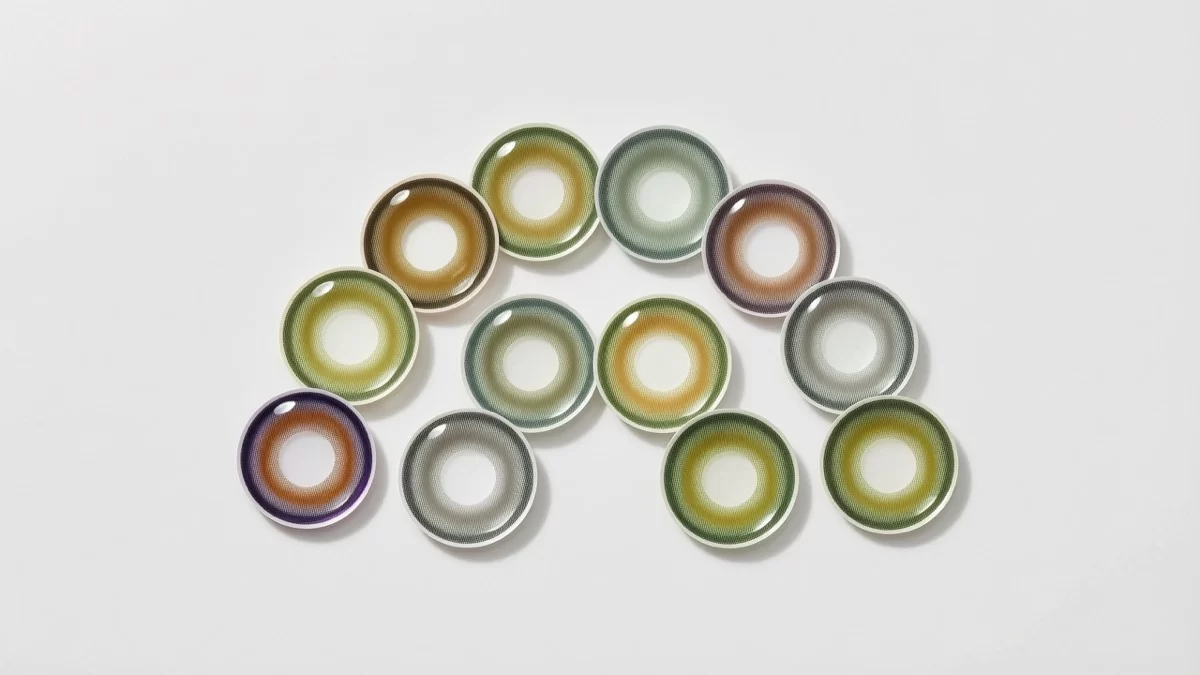
The question is not whether a manufacturer can print colors on a lens. Any decent factory can do that. The question is how they do it, and whether the pigment is safely encapsulated between lens layers so it never touches the wearer eye.
Here is what separates good color lens manufacturing from bad:
- Embedded pigment technology: The color layer sits between the lens material, not on the surface. This is non-negotiable for safety.
- Print resolution: Higher resolution means more natural-looking patterns. Cheap printing looks obvious, like someone stamped a sticker on the iris.
- Color consistency across batches: If your Hazel Brown looks different in batch 47 than it did in batch 12, your customers will notice. And they will complain.
- Edge blending: The transition from colored area to clear edge should be smooth. Harsh edges cause discomfort and look unnatural.
We recently had a brand come to us after their previous supplier delivered three consecutive batches with visible color shifting. Three batches. That is months of customer complaints and returns. The supplier had cut costs by switching to a lower-resolution printing process without telling the brand.
Ask for physical samples from multiple production batches before committing. If a manufacturer cannot provide them, that is your answer right there.
3. Quality Control That Goes Beyond the Certificate
Yes, your manufacturer should have ISO 13485 certification. That is the baseline, the minimum requirement, not a differentiator.
What you really want to understand is what happens on the factory floor when things go wrong, because they will.
Good manufacturers have:
- Automated inspection systems that catch defects the human eye would miss, edge chips, surface irregularities, diameter variance beyond tolerance.
- Batch traceability, if there is a problem with a specific production run, they can identify exactly which lenses are affected and issue a targeted recall instead of panicking about everything.
- Environmental controls, cleanroom standards (Class 10,000 or better) for the entire production line, not just the final assembly stage.
- Stability testing, lenses tested not just when they leave the factory, but after six months, twelve months, at different temperatures and humidity levels.
Ask your manufacturer: What is your defect rate, and what happens when a batch fails inspection? A confident manufacturer will give you specific numbers. A vague answer means they either do not track it or do not want you to know.
4. Certifications That Actually Matter for YOUR Market
This is where a lot of brands waste time and money chasing the wrong credentials.
Europe? You need CE marking under the Medical Device Regulation (MDR). That is the one that matters. ISO 13485 is the quality system that supports it.
United States? FDA clearance is mandatory. Period. No workaround, no exception. The process takes time, typically 12-18 months for new lens registrations, so plan accordingly.
Southeast Asia? Requirements vary by country. Some accept CE marking as sufficient. Others (like Thailand and Indonesia) have their own registration processes. A good manufacturer will know the landscape and can guide you.
Middle East? Many GCC countries accept CE or FDA. Saudi Arabia SFDA has its own process, but it is generally straightforward if you already have CE.
Do not let a manufacturer impress you with a wall of certificates that are not relevant to your target market. Focus on the ones that legally allow you to sell where you want to sell.
And if a manufacturer tells you we can sell without certification, run. Not walk. Run.
5. Communication and Flexibility (The One Nobody Talks About)
Here is a truth that does not appear in any procurement checklist:
Your relationship with the manufacturer matters as much as their technical capabilities.
I have seen technically excellent manufacturers lose clients because they were impossible to work with, slow responses, rigid MOQs, no willingness to accommodate small adjustments. And I have seen brands thrive with manufacturers who were not the biggest or the cheapest, but who were genuinely invested in making the partnership work.
What to look for:
- Response time: When you email them with a question or concern, how long before you hear back? Hours? Days? A week?
- MOQ flexibility: Are they willing to work with your growth trajectory? A manufacturer that demands 10,000 pairs for your first order but will not budge is not a partner, they are a gate.
- Customization willingness: Can they accommodate custom packaging designs? Custom lens parameters? Private label branding that actually looks professional?
- Problem-solving attitude: When something goes wrong (and it will), do they own it and fix it? Or do they deflect and delay?
At MIOMI, we have built our business model around this exact philosophy. We started by serving smaller brands that bigger manufacturers ignored, brands that needed 500-1,000 pairs instead of 10,000. Those brands grew. And many of them are still our clients today, ordering significantly larger volumes. The relationship we built early on is what kept them with us when bigger manufacturers started courting them with lower prices.
They stayed because they knew we would answer their phone call at 11 PM when a shipment was delayed. Because we would help them navigate a new market certification requirements instead of saying that is not our problem. Because we treated their business like it mattered, because it did.
The Bottom Line
Choosing a contact lens manufacturer is not a specs comparison exercise. It is a partnership decision.
The right manufacturer will:
- Make products your customers love wearing
- Stand behind quality when issues arise
- Help you navigate regulatory complexity
- Grow with you instead of pricing you out
- Treat your brand reputation as their own
The wrong one will give you a great price on paper and a lot of headaches in practice.
Take your time. Ask the hard questions. Request samples, not just one set, but from different production batches. Visit the factory if you can (or have someone you trust do it). And most importantly, trust your instincts about the people you will be working with, not just the products they make.
Your customers will never see your manufacturing contract. But they will absolutely feel the difference between a lens made by a manufacturer who cares and one who does not.
And in this business, that difference is everything.
Looking for a contact lens manufacturing partner who understands what it takes to build a brand from the ground up? Get in touch, we specialize in OEM/ODM with MOQs that make sense for growing brands.