# Contact Lens Parameters Explained: Diameter, Base Curve, Water Content — What Brands Need to Know
If you’re building a contact lens brand or sourcing inventory for your optical store, you’ve seen the spec sheets. Rows of numbers — 14.2mm, 8.6mm, 38%, 55% — and if you’re like many new brand owners, you might be glossing over them.
Here’s the truth: those numbers aren’t just technical jargon. They directly determine whether your customers love your lenses or return them. Get the parameters right, and you build loyalty. Get them wrong, and you’re dealing with complaints, exchanges, and damaged reputation.
In this guide, we break down the six core contact lens parameters that every brand owner and wholesaler needs to understand — what they are, why they matter, and how to choose the right ones for your target market.
—
## 1. Diameter (DIA) — The Size of the Lens
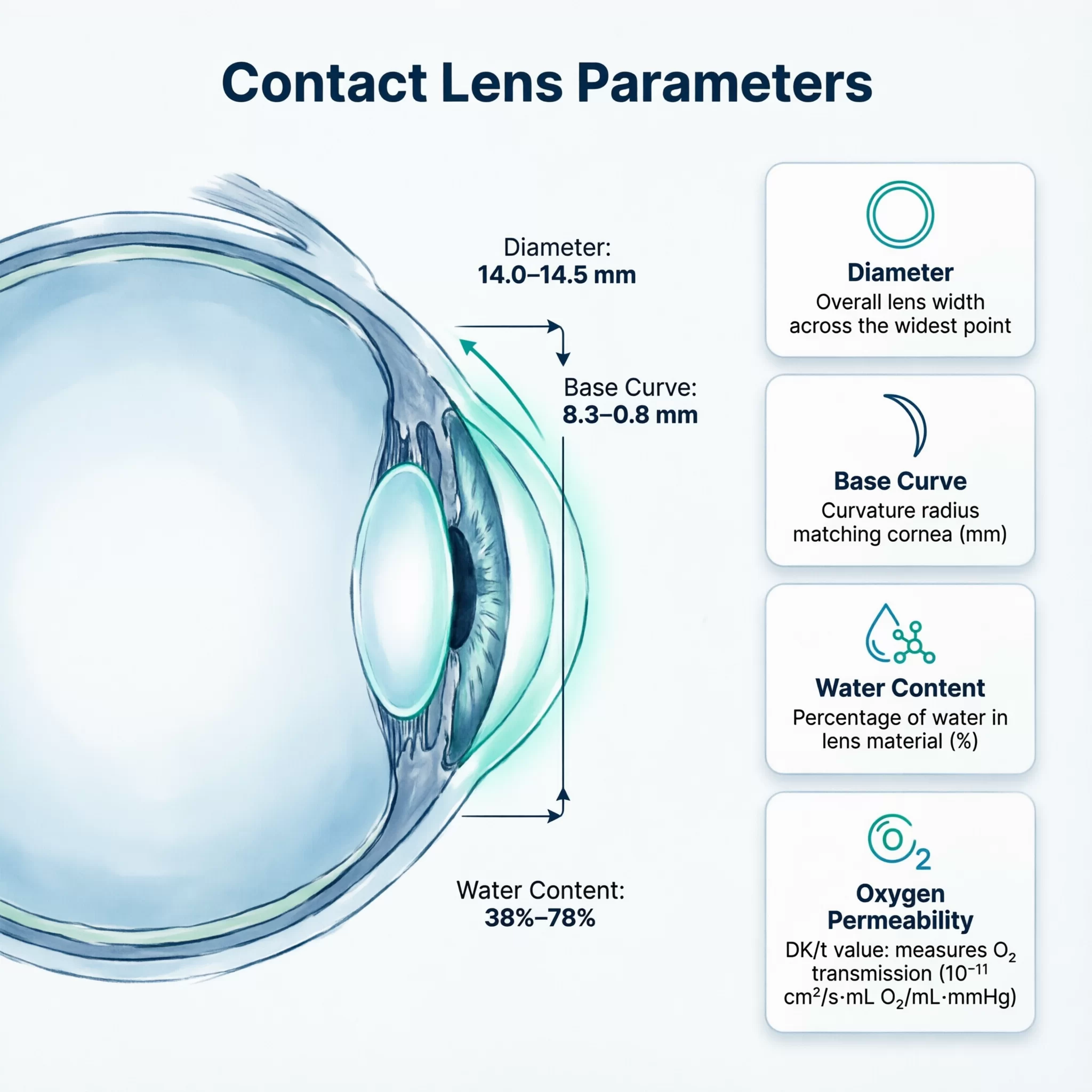
**What it is:** The diameter is the total width of the contact lens in millimeters, measured from one edge to the other through the center.
**Typical range:** 13.8mm – 14.5mm for standard soft contact lenses. Colored contact lenses typically sit at 14.0mm – 14.5mm.
### Why it matters
The diameter affects both comfort and appearance:
– **Too small** → the lens can slide around on the eye, causing blurry vision and irritation. It may also feel like it’s “floating.”
– **Too large** → the lens presses against the sclera (the white part of the eye), which can cause discomfort after a few hours of wear.
For colored contact lenses, diameter also has a cosmetic effect. A larger diameter (14.2mm+) can make eyes appear bigger — a key selling point in many Asian markets where “big eye” lenses are popular. But there’s a line between “enlarging” and “unnatural,” and your brand needs to know where it stands.
### Brand strategy takeaway
– **Everyday wear market:** Stick with 14.0mm – 14.2mm for the broadest comfort range.
– **Cosmetic/enlarging market:** Offer 14.2mm – 14.5mm options, but ensure the optical zone (the clear center) is large enough not to interfere with vision.
– **Always** confirm with your manufacturer that the diameter matches the base curve (see below) — these two parameters work together.
—
## 2. Base Curve (BC) — The Curve of the Lens
**What it is:** The base curve is the curvature of the back surface of the contact lens, measured in millimeters. It determines how the lens fits on the cornea.
**Typical range:** 8.4mm – 8.8mm for most soft contact lenses. 8.6mm is the most common “standard” BC.
### Why it matters
The base curve is the single most important parameter for fit:
– **Too steep (low number)** → the lens grips the eye too tightly. This restricts tear flow, causes redness, and can even damage the cornea over time.
– **Too flat (high number)** → the lens moves around too much, causing fluctuating vision and that “sandy” feeling.
If your customers are complaining that lenses “feel like they’re moving” or that vision “comes and goes,” the base curve is usually the culprit.
### Brand strategy takeaway
– **Start with 8.6mm** — it fits roughly 70-80% of the population. This is your safe default.
– **Offer 8.7mm as a second option** for customers with slightly flatter corneas. If you can only stock two BC options, 8.6 and 8.7 cover the vast majority.
– **Premium brands** may want to add 8.5mm and 8.8mm options for better fitting precision.
– **Always** ask your OEM partner about BC availability — not all designs come in every curve.
—
## 3. Water Content — How Much Water Is in the Lens
**What it is:** The percentage of the lens material that is water.
**Typical range:** 38% – 78% for hydrogel lenses. Silicone hydrogel lenses are typically 24% – 50%.
### Why it matters
Water content affects oxygen transmission, comfort, and durability:
**Higher water content (55%+):**
– ✅ Generally more comfortable for short-to-medium wear
– ✅ Better for people with sensitive eyes
– ❌ Lenses tear more easily
– ❌ Can actually dry out faster in low-humidity environments (the water evaporates)
– ❌ Shorter lifespan
**Lower water content (38-45%):**
– ✅ More durable and tear-resistant
– ✅ Better for long wear hours (when paired with the right material)
– ✅ Less prone to dehydration in dry climates
– ❌ May feel less comfortable initially
The common misconception is “more water = more comfortable.” That’s true for the first few hours, but after 6-8 hours, a medium water-content lens with good material quality often outperforms a high water-content one.
### Brand strategy takeaway
– **Daily disposables:** High water content (55-58%) is fine — they’re worn once and thrown away, so durability isn’t an issue.
– **Monthly/quarterly lenses:** Medium water content (38-45%) with hydrogel or silicone hydrogel material for durability and all-day comfort.
– **Dry climate markets (Middle East, parts of North America):** Lean toward lower water content with high Dk/t materials to reduce evaporation-related discomfort.
– **Don’t compete on water content alone.** Market it alongside material quality and oxygen permeability.
—
## 4. Oxygen Permeability (Dk/t) — Can the Eye Breathe?
**What it is:** Dk/t measures how much oxygen can pass through the contact lens to reach the cornea. Dk = permeability of the material; t = thickness. Dk/t = the effective oxygen transmission.
**Typical range:**
– Traditional hydrogel: 10 – 30 Dk/t
– Silicone hydrogel: 80 – 180+ Dk/t
### Why it matters
Your cornea needs oxygen to stay healthy. Deprive it of oxygen for extended periods, and you get:
– Red, bloodshot eyes
– Corneal swelling (edema)
– Increased risk of infection
– Blurred vision
– Discomfort after prolonged wear
The FDA recommends a minimum Dk/t of 24-35 for daily wear and 125+ for extended (overnight) wear.
### Brand strategy takeaway
– **If you’re selling monthly/quarterly lenses**, seriously consider silicone hydrogel options. The higher cost is worth it for the comfort and health benefits — and you can charge a premium.
– **For daily disposables**, standard hydrogel with Dk/t of 20-30 is acceptable for most people since they’re worn for shorter periods and replaced daily.
– **Be honest about Dk/t in your marketing.** This is a parameter that educated customers ask about, and transparency builds trust.
—
## 5. Center Thickness — How Thick Is the Lens?
**What it is:** The thickness of the lens at its center, in millimeters.
**Typical range:** 0.04mm – 0.12mm for soft contact lenses.
### Why it matters
– **Thinner lenses** → more comfortable, better oxygen transmission (higher Dk/t), but more fragile and harder to handle (especially for new wearers).
– **Thicker lenses** → sturdier, easier to handle, more durable, but potentially less comfortable and lower Dk/t.
Center thickness also interacts with power (prescription). Higher prescription lenses are thicker at the edges (minus power) or center (plus power), which affects comfort and fit.
### Brand strategy takeaway
– **For first-time wearers and new markets**, go slightly thicker (0.07-0.10mm). It’s easier for people to handle when they’re still learning.
– **For premium/experienced markets**, offer thinner options as an upgrade.
– **Always confirm center thickness with your manufacturer**, as it varies by power and material.
—
## 6. Replacement Schedule — How Often to Replace Lenses
**What it is:** The recommended wear cycle before the lens should be discarded.
**Common options:**
– **Daily disposable (1-day):** Worn once, then thrown away.
– **Bi-weekly (2-week):** Replaced every two weeks.
– **Monthly:** Replaced every month.
– **Quarterly/3-month:** Replaced every 3 months (less common now for health reasons).
– **Annual/Yearly:** Replaced every year (common for colored contact lenses in some markets).
### Why it matters
Replacement schedule affects:
– **Eye health:** Shorter replacement cycles = lower risk of protein buildup and infection.
– **Pricing model:** Daily disposables have the lowest per-pair cost but highest annual cost. Annual lenses have the highest per-pair cost but lowest annual cost.
– **Customer behavior:** Daily wearers buy more frequently, giving you more touchpoints and upsell opportunities.
### Brand strategy takeaway
– **Entry-level / price-sensitive markets:** Start with monthly or yearly colored lenses — lower barrier to entry.
– **Premium / health-conscious markets:** Lead with dailies and bi-weeklies — better margins and recurring revenue.
– **Colored contact lens brands** often default to yearly replacement because the cosmetic layer adds cost and customers want longer use. But offering a daily colored option can be a strong differentiator.
—
## How to Choose the Right Parameters for Your Brand
There’s no “one size fits all” answer, but here’s a decision framework:
### Step 1: Know your market
– **Who is your customer?** Young cosmetic buyers? Medical contact lens wearers?
– **Where are they?** Different regions have different average corneal shapes and climate considerations.
– **What’s their budget?** Premium markets expect more options and better materials.
### Step 2: Start with the basics, then expand
Launch with the most versatile parameters:
– **Diameter:** 14.2mm
– **Base Curve:** 8.6mm (add 8.7mm if possible)
– **Water Content:** 42-55% (depends on material and replacement schedule)
– **Replacement:** Start with one cycle, then add more as your brand grows
### Step 3: Validate with sampling
Before committing to a large order, **always get samples first**. Have them tested by real wearers in your target market. Fit and comfort are subjective, and what works in a lab doesn’t always work in real life.
### Step 4: Build your range gradually
Once you have data on what sells and what customers complain about, you can:
– Add a second base curve option
– Introduce a premium silicone hydrogel line
– Expand into daily disposables
– Add special effect or specialty diameter lenses
—
## The Bottom Line
Parameters aren’t just numbers on a spec sheet — they’re the foundation of your product quality. A brand that understands and communicates these parameters clearly positions itself as knowledgeable and trustworthy.
Whether you’re sourcing from a factory or building your own line through OEM/ODM, never hesitate to ask detailed questions about lens parameters. A good manufacturer will be happy to walk you through the options and help you choose the right combination for your market.
At MIOMI, we work with brand owners to optimize lens parameters for their specific target markets and customer profiles. If you’re building a contact lens brand and need guidance on choosing the right specs, [get in touch with our team](#) — we’re here to help.
—
*Got questions about contact lens parameters or OEM/ODM customization? Reach out to our team at sales@miomicon.com or connect with us on WhatsApp for a free consultation.*