Let me start with a story. A few months back, a new brand owner came to us with a problem. She’d just launched her own colored contact lens line, priced everything at $29.99 a pair, and… nothing was selling. She thought her product was bad. Turns out, her product was fine. Her pricing was the problem — she was priced right in the no-man’s-land between drugstore disposables and premium brands. Shoppers didn’t know if she was a budget option or a luxury pick, so they just kept scrolling.
Pricing isn’t just about slapping a number on a package. It’s one of the most important strategic decisions you’ll make for your contact lens business. Price too low and you destroy your margin (and maybe even your brand’s perceived value). Price too high and you price yourself out of the market before anyone’s even heard of you.
After working with dozens of brands across 30+ countries, I’ve seen what works and what doesn’t. Here’s the full framework we use to help our OEM/ODM clients nail their pricing strategy from day one.
First: Understand Your True Cost
Before you set any retail price, you need to know exactly what each pair of lenses costs you. And I’m not just talking about the factory cost. Most new brands forget about half the expenses.
Break down your cost per pair:
| Cost Component | Typical Range (per pair) | Notes |
|---|---|---|
| Factory unit cost | $1.50 – $6.00 | Depends on MOQ, design complexity, packaging |
| Packaging & labels | $0.30 – $1.50 | Custom boxes, foil blisters, instruction inserts |
| Certifications | $0.20 – $1.00 | Amortized over your order volume |
| Shipping (factory → you) | $0.30 – $1.00 | Sea freight is cheaper, air is faster |
| Customs & duties | $0.20 – $1.50 | Varies wildly by country; check your HS code |
| Warehousing & fulfillment | $0.50 – $2.00 | Per-unit pick, pack, and storage |
| Payment processing fees | 2.9% + $0.30 | Stripe, PayPal, Shopify Payments |
| Returns & exchanges | 3–8% of revenue | Colored lenses have higher return rates than clear |
| Marketing & customer acquisition | $3.00 – $15.00+ | Your biggest variable cost |
Add it all up, and a pair of lenses that costs you $3 from the factory might actually cost you $8–$12 by the time it reaches a customer’s door. And that’s before you make any profit.
The mistake most new brands make: They only look at the factory cost and think “I can sell these for $20 and make $17 profit!” By the time they factor in everything else, they’re losing money on every sale.
Don’t be that brand. Build your full cost model before you set a single price.
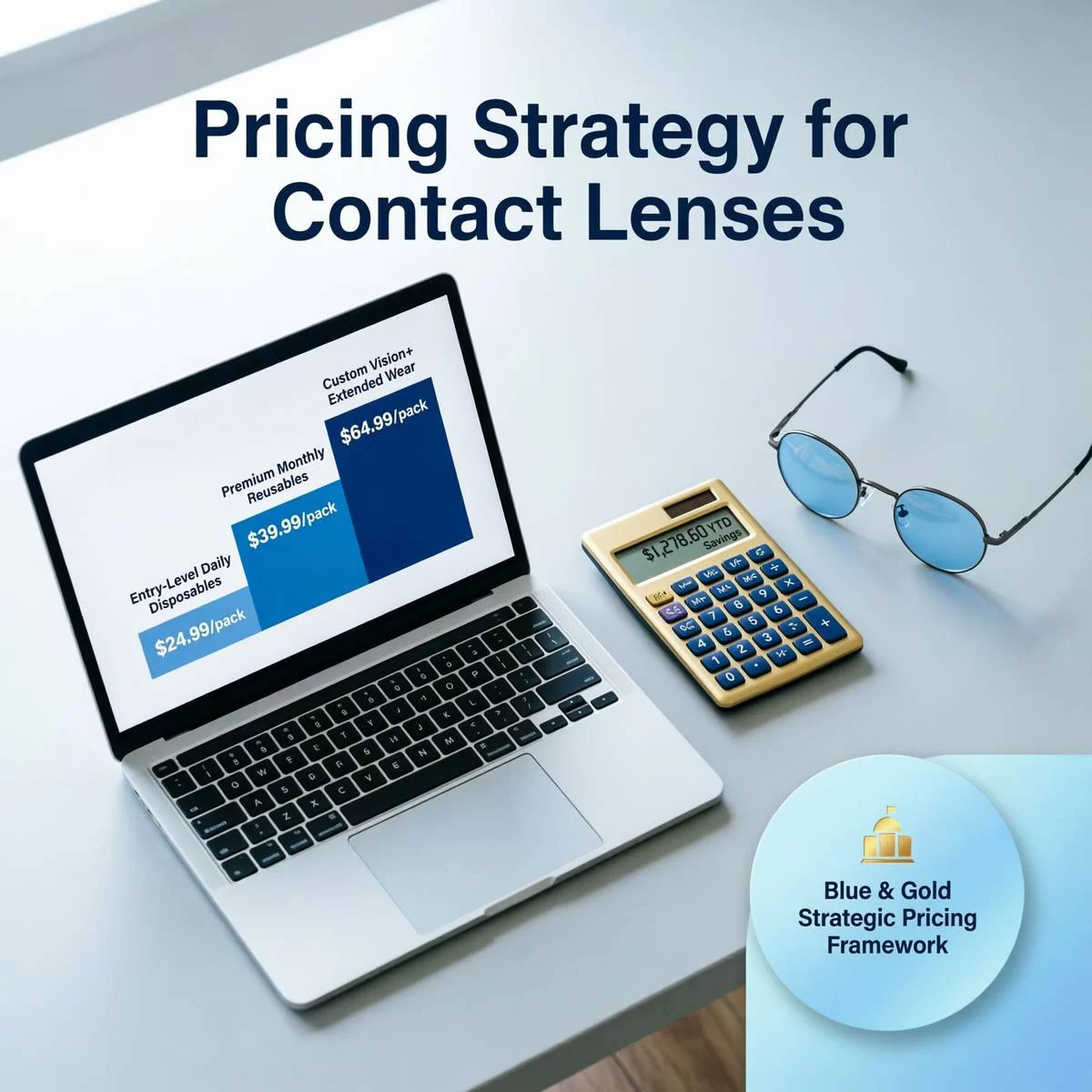
The 4 Pricing Tiers in Colored Contact Lenses
The colored contact lens market naturally sorts into four tiers. Knowing which tier you’re targeting is half the battle.
Tier 1: Budget / Value ($10 – $20 per pair)
- Who shops here: Price-sensitive buyers, students, first-time triers
- Volume: High
- Margins: Thin (30–40% gross)
- Brands: Generic Amazon sellers, AliExpress, Shein-style retailers
- What you need to compete: Extremely low unit costs, massive volume, minimal marketing spend
This tier is brutal. Unless you’re moving 50,000+ pairs a month, it’s almost impossible to make real money here. Most new brands should avoid it.
Tier 2: Mid-Market ($20 – $40 per pair)
- Who shops here: Everyday wearers, young professionals, social media shoppers
- Volume: Moderate to high
- Margins: Healthy (50–65% gross)
- Brands: Most DTC brands, mid-tier salon brands
- What you need to compete: Decent brand identity, solid marketing, good selection
This is where most new brands land. And it’s the most crowded space. You need a clear differentiator — whether that’s a unique color range, a specific niche (like prescription astigmatism colored lenses), or a strong brand story.
Tier 3: Premium ($40 – $80 per pair)
- Who shops here: Quality-focused buyers, older demographics, prescription lens wearers
- Volume: Moderate
- Margins: Excellent (65–75% gross)
- Brands: Boutique brands, optometrist-recommended lines, celebrity brands
- What you need to compete: Premium packaging, strong trust signals, professional brand image
This is our favorite tier for new brands with a good story and decent quality products. The margins give you room to invest in marketing, and customers in this tier are less price-sensitive and more loyal.
Tier 4: Luxury ($80+ per pair)
- Who shops here: High-end consumers, fashion-forward early adopters
- Volume: Low
- Margins: Very high (75%+ gross)
- Brands: Designer collaborations, limited-edition drops, ultra-premium lines
- What you need to compete: A-list marketing, luxury positioning, exclusivity
Very few brands pull this off. You’re not just selling contact lenses — you’re selling a status symbol, a fashion statement, an experience. Don’t attempt this until you’ve got the marketing budget and brand equity to back it up.
Which tier should you choose? For 90% of new brands, Tier 2 (mid-market) or Tier 3 (premium) is the sweet spot. You get reasonable volume with margins that actually let you run a business.
Pricing Strategies That Work (and Ones That Don’t)
✅ Strategy 1: Value-Based Pricing (Our #1 Recommendation)
Price based on what your customers are willing to pay, not what it costs you to make.
If your lenses solve a specific problem — say, colored lenses for dark brown eyes that actually show up — you can charge more because you’re delivering more value. If your brand stands for something (sustainability, inclusivity, medical-grade quality), that value translates directly into higher price tolerance.
How to do it:
- Research what your target customers currently buy
- Identify where their current options fall short
- Position your product as the better solution
- Price accordingly — usually 10–30% above the mid-market average
- A “starter pack” at $19.99 (low margin) gets people to try you
- Then you sell subscription plans, multi-packs, or accessories at healthy margins
- The real money is in repeat purchases, not the first order
- “Buy 2, Get 1 Free” — effectively 33% off, but AOV goes up
- Monthly subscription boxes — predictable revenue + loyalty
- “Complete set” with lens case, solution, and multiple colors
- Customers wear them regularly and need to reorder
- Predictable monthly revenue makes inventory planning easier
- Customer lifetime value (CLV) is 2–5x higher than one-time buyers
- You can build real relationships with your subscribers
- Offer 10–20% off for subscribers vs. one-time purchases
- Give flexibility — let customers choose monthly, every 2 months, or every 3 months
- Include subscriber-only perks: early access to new colors, free shipping, exclusive colors
- Make it easy to skip, pause, or cancel (hard cancellation policies backfire)
- Lower per-unit cost
- More cash tied up in inventory
- You need to move volume fast
- Pricing tends toward the lower end to drive quick sales
- Slightly higher per-unit cost
- Less risk, more flexibility
- You can test the market without a huge investment
- Pricing can be higher because you’re not desperate to dump inventory
- Factory cost: $3.20/pair (800 pairs per design, 8 designs = 6,400 total)
- Custom packaging: $0.80/pair
- All other costs (shipping, fulfillment, payment processing, returns): ~$4.00/pair
- Total all-in cost: ~$8.00/pair
- Target tier: Premium
- Retail price: £34.99 (~$44 USD)
- Gross margin: ~82% per pair (before marketing)
- Customer acquisition cost (CAC): ~£20 (~$25)
- Net margin per first-time customer: ~£14.99 (~$19)
- 35% of customers become repeat buyers
- Average repeat customer buys 3 more times in their first year
- Average CLV: ~£90 (~$113)
- Net margin per customer (first year): ~£55 (~$70)
The key here is communicating that value clearly on your website, in your packaging, and in your marketing.
✅ Strategy 2: Loss Leader + Upsell
Offer a low-price entry point to get customers in the door, then make your profit on higher-margin products.
For example:
This works well if you’ve got a subscription model or a range of SKUs with varying margins.
Warning: Make sure your loss leader is still high quality. If the cheap product turns people off, they’ll never buy your premium stuff.
✅ Strategy 3: Bundle Pricing
Sell pairs in bundles to increase average order value (AOV) while giving customers a perceived discount.
Common bundles:
The psychology here is powerful. A single pair at $30 feels expensive. Three pairs at $75 ($25 each) feels like a deal — and you just made more money per customer.
❌ Strategy 4: Match the Cheapest Competitor
Don’t do this. There will always be someone cheaper than you — usually someone cutting corners on quality, safety, or customer service.
If you compete on price alone, you’ll always be racing to the bottom. And in the contact lens industry, the bottom is a scary place with counterfeit products, fake certifications, and zero margins.
❌ Strategy 5: “Set It and Forget It”
Your pricing shouldn’t be a one-time decision. Review it every 3–6 months. Costs change. Competition changes. Your brand changes.
A common pattern we see: A brand launches at $29.99, builds a following, and by month 6 they could easily charge $39.99 — but they never raise their prices because they’re scared of losing customers. Meanwhile, they’re leaving 25–35% more profit on the table.
The Subscription Model Game-Changer
If you’re not at least considering a subscription model for your contact lens business, you’re leaving serious money on the table.
Why subscriptions work so well for colored lenses:
Subscription pricing tips:
We’ve seen brands go from 0 to 60% of revenue from subscriptions in under a year. It’s not a quick win — you need to build trust first — but it’s the most reliable path to long-term profitability.
How Your MOQ Affects Your Pricing Strategy
Here’s something that surprises a lot of new brand owners: Your minimum order quantity doesn’t just affect your cash flow — it directly shapes your pricing strategy.
High MOQ (5,000+ pairs per design):
Low MOQ (500–1,000 pairs per design):
This is why we’re big fans of low-MOO OEM models for new brands. Yes, your per-unit cost is a bit higher. But you can price your product at a premium tier, make better margins per unit, and not have 10,000 pairs gathering dust in a warehouse while you figure out what sells.
One of our clients started with 500 pairs per design at a $45 price point. They sold out in 6 weeks, then re-ordered 2,000 pairs at a lower unit cost — and kept the price at $45 because customers were already happy to pay it. Their margin on the second order? 15% higher than the first.
5 Common Pricing Mistakes to Avoid
1. Pricing too low because you’re “just starting out”
New brands often underprice themselves thinking, “I’m new, so I need to be cheap.” Wrong. If you launch cheap, you’ll attract price-shoppers who will leave as soon as someone cheaper comes along. And you’ll never be able to raise prices without alienating your early customers.
Better to launch at your target price point and offer a launch discount. That way, when the discount ends, your regular price feels “normal.”
2. Using round numbers like $30 or $50
$29.99 isn’t just a marketing gimmick — it actually works. Studies consistently show that prices ending in 9 convert better than round numbers. But go beyond that. $28.99 feels more calculated and thought-through than $29.99. $34.95 feels premium but not expensive. Play with the numbers.
3. Ignoring competitor pricing (or obsessing over it)
You need to know what your competitors charge. But you don’t need to match or beat them. Your pricing should be based on your value, your costs, and your target customer — not what someone else is doing.
Do your research. Know the landscape. Then make your own decision.
4. Not accounting for promotions and discounts
If you plan to run sales (and you should — promotions drive traffic and urgency), your regular price needs to leave room for those discounts. A 20% off sale shouldn’t put you below your break-even point.
A good rule of thumb: Your regular price should be at least 2x your all-in cost. That gives you room for promotions, returns, and the occasional bad month.
5. Forgetting about currency and local pricing
If you’re selling internationally (and most contact lens brands are), don’t just convert your USD price to local currency. Customers in different markets have different price expectations.
A $30 pair of lenses is normal in the US. In Southeast Asia, that’s premium pricing. In the Middle East, it’s mid-range. Do your research on each market you’re targeting and adjust accordingly.
A Real-World Example
Let me walk you through a typical new brand we work with, so you can see how all of this fits together.
The Brand: A boutique colored lens line targeting women in their 20s and 30s in the UK.
Their Numbers:
Wait, 82% margin sounds amazing, right? But here’s what happens when you add marketing:
Still good, but not quite as mind-blowing. Now here’s where it gets interesting:
That’s the power of getting your pricing right combined with repeat business. It’s not about making a killing on the first sale — it’s about building a profitable, sustainable business.
Final Thoughts: Price Is a Signal
At the end of the day, your price tells customers who you are. It tells them whether you’re a cheap alternative or a serious brand. It sets expectations for quality, service, and experience.
Don’t just pick a number because it feels right. Do the math. Understand your costs. Know your customer. Pick your tier. And then communicate the value that justifies your price.
The good news? You don’t have to get it perfect on day one. You can test. You can adjust. You can run A/B tests on your pricing page. You can start with one price and refine as you learn more about your market.
But you do need a strategy. Because without one, you’re just guessing — and in the contact lens industry, guessing with your pricing is the fastest way to go out of business.
Want help figuring out your pricing strategy? At MIOMI, we work with brand owners every day to build pricing models that actually work — not just for making sales, but for building profitable, sustainable businesses. Whether you’re launching your first line or repositioning an existing brand, our team can walk you through the numbers. Reach out at sales@miomicon.com and let’s talk.