Let me tell you something that almost every new contact lens brand founder gets wrong at some point: they think certifications are just paperwork.
I’ve been in this industry long enough to see it happen again and again. A brand owner comes to us excited about their new color collection, they’ve got the packaging designed, the influencer deals lined up, and then — wham — they hit a wall at customs. Or, even worse, they get their products on the market only to have them pulled because a regulator noticed something off on the box.
Certifications aren’t just boxes to tick. They’re your passport into a market. And in 2026, with regulators around the world getting stricter by the month, understanding what each certification actually means could be the difference between a successful launch and a very expensive lesson.
In this guide, I’m going to walk you through the major contact lens certifications you’ll encounter as a brand owner, what each one covers, how much they cost, how long they take, and — most importantly — which ones you actually need.
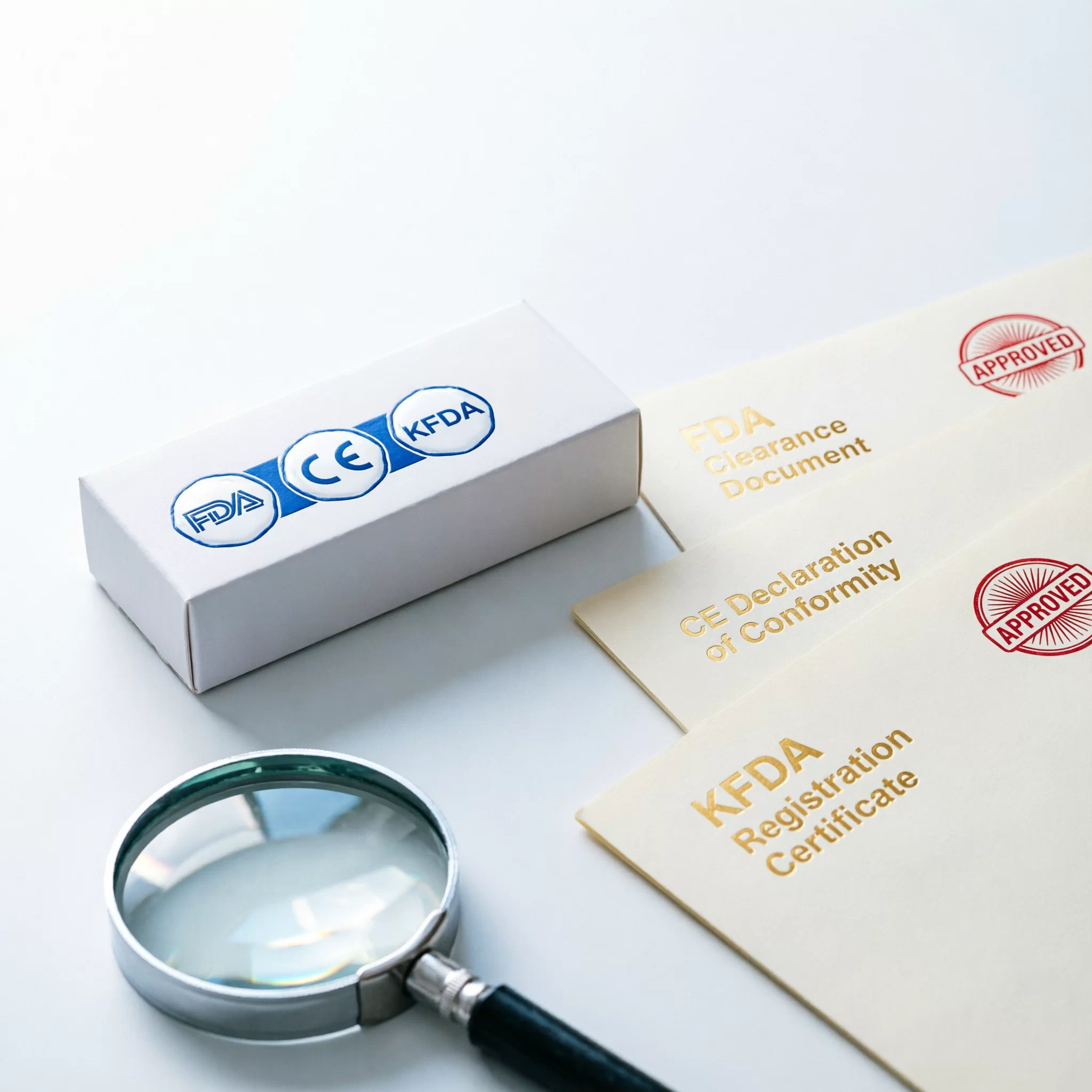
The Big Three: FDA, CE, and KFDA
When people talk about contact lens certifications, these three names come up more than any others. They’re like the Ivy League of regulatory approvals — not the only ones that matter, but the ones that immediately signal credibility.
FDA (United States)
The Food and Drug Administration oversees contact lenses in the United States, and they don’t mess around. In the US, contact lenses are classified as Class II or Class III medical devices, depending on the type and wear schedule.
Here’s what most people don’t realize: it’s not the lens itself that needs FDA approval in every case. The manufacturing facility needs to follow FDA quality system regulations (QSR), and the specific product needs to be cleared or approved depending on its classification.
For colored contact lenses with no corrective power — the plano cosmetic lenses — the FDA still classifies them as medical devices. You can’t just sell them as a beauty product. I’ve seen brands get into real trouble trying to list them under “costume accessories” or “beauty tools.” Don’t do it.
Timeline: 6-18 months, depending on whether you’re doing a 510(k) clearance (most common for lenses that are substantially equivalent to existing products) or a full premarket approval (PMA).
Cost: $50,000 – $200,000+ including testing, documentation, and consulting fees.
Who needs it: Anyone selling in the US market, full stop.
CE Marking (European Union / EEA)
The CE mark is the European Union’s way of saying a product meets their safety, health, and environmental protection requirements. For contact lenses, this falls under the Medical Devices Regulation (MDR) — which replaced the old MDD in 2021 and has been getting stricter every year.
Here’s a key point about CE marking for contact lenses: the actual assessment is done by a Notified Body, not directly by EU regulators. So you’ll work with a company like TÜV, BSI, or Intertek to go through the conformity assessment process.
One thing that’s changed significantly under MDR compared to the old system is the level of clinical evidence required. Before MDR, many colored contact lens manufacturers could get away with minimal clinical data. Now, the bar is much higher. If your OEM partner tells you CE marking is “easy” or “automatic,” that’s a red flag.
Timeline: 8-24 months, including technical documentation and clinical evaluation.
Cost: $30,000 – $150,000+, depending on the number of lens variants and whether clinical studies are needed.
Who needs it: Anyone selling in the EU, EEA, or any country that recognizes CE marking (many do).
KFDA / MFDS (South Korea)
The Korean Ministry of Food and Drug Safety (MFDS, formerly KFDA) is known for having one of the most rigorous approval processes in Asia. South Korea is both a major producer and consumer of colored contact lenses, so their standards carry real weight in the industry.
Korean approval is often seen as a quality benchmark across Southeast Asia. If your product has KFDA approval, retailers and distributors in countries like Thailand, Vietnam, and the Philippines will often take you more seriously — even if those countries have their own registration processes.
Timeline: 6-12 months.
Cost: $20,000 – $80,000.
Who needs it: Brands selling in South Korea, or brands targeting Southeast Asia who want to use KFDA as a quality signal.
Other Important Regional Certifications
The Big Three will get you into the most lucrative markets, but they’re far from the only certifications you’ll encounter. Here are the ones that come up most often in our work at MIOMI:
TFDA (Taiwan)
Taiwan’s Food and Drug Administration has its own registration system for medical devices, including contact lenses. The process is similar to FDA in many ways, though the timeline and costs are generally lower.
SFDA / NMPA (China)
China’s National Medical Products Administration (formerly SFDA) oversees contact lens registration for the Chinese market. This is a complex and time-consuming process that requires local representation. If China is in your expansion plan, start early — really early.
GCC / SFDA (Saudi Arabia & Gulf Countries)
The Gulf Cooperation Council countries have been working toward more unified medical device regulation, though the Saudi Food and Drug Authority (SFDA) still sets the pace for the region. If you’re targeting the Middle East — and you should be, given how fast that market is growing — you’ll need SFDA registration for Saudi Arabia, and possibly separate registrations for UAE (MOHAP), Kuwait, and others.
ISO 13485
Technically not a market-specific certification, ISO 13485 is the international standard for quality management systems in medical devices. Most serious manufacturers will already have this, and it’s often a prerequisite for regulatory approvals in many countries. If your OEM partner doesn’t have ISO 13485, that’s a major warning sign.
What Your OEM Partner Should (and Shouldn’t) Handle
One of the most common questions I get from new brand owners is: “Won’t my OEM factory take care of all the certifications?”
The answer is: it depends — and you need to be very clear about who is responsible for what before you sign anything.
Here’s the reality: most reputable OEM manufacturers will have their factory certified (ISO 13485, GMP, etc.), and they may have some of their own registered products with various certifications. But the brand owner is usually the one legally responsible for product registration in the target market.
Let me say that again, because it’s important: if you’re selling under your own brand name in the US, you — the brand owner — are the one the FDA will come after if something is wrong. Not the factory in China or Korea. Your OEM may help you with the documentation and testing (and a good one will), but the legal responsibility is yours.
Some OEMs offer “OEM with certification” packages where they’ll put your branding on a lens that’s already registered in your target market. This can be a good shortcut for new brands, but make sure you understand exactly what you’re getting. Is the registration under your company name, or the factory’s? If it’s the factory’s, what happens if your relationship ends? These are questions you need to ask before you place your first order.
The 5 Certification Mistakes That Kill New Brands
Alright, let’s talk about the mistakes. I’ve seen all of these, and none of them end well.
1. “We’ll get certified after we make some sales”
This is the number one mistake. Brand owners figure they’ll do a few test runs, see if the product sells, and then worry about certifications later.
Here’s the problem: you can’t legally sell contact lenses without the proper certification in most markets. And “test runs” still count as selling. At best, you’ll get your shipment stopped at customs. At worst, you’re looking at fines, product recalls, and permanent damage to your brand’s reputation before you even get started.
2. Assuming one certification covers everything
FDA doesn’t get you into Europe. CE doesn’t get you into the US. KFDA doesn’t get you into either. Each market has its own requirements, and you need to plan for each one individually.
That said, there are efficiencies. A lot of the testing you do for one certification can be reused for another, especially if you’re working with a testing lab that’s accredited for multiple regions. But don’t assume it’s automatic.
3. Not budgeting for ongoing compliance
Getting certified isn’t a one-time cost. There are annual fees, periodic audits, post-market surveillance requirements, and — when regulations change — re-certification costs.
Under MDR in Europe, for example, you need ongoing clinical evidence and post-market surveillance reports. This isn’t something you pay for once and forget about. Build these recurring costs into your business plan.
4. Going with the cheapest certification option
Not all certifications are created equal. A CE mark from a reputable Notified Body like BSI or TÜV carries real weight. A CE mark from a little-known outfit in a country with lax oversight? It might technically be valid, but distributors and retailers will know the difference.
Similarly, some factories will offer you “certified” products at rock-bottom prices. Dig into the details. What exactly is certified? Is it the factory, the lens material, the specific product? Is the certification current? Can you see the actual certificate? Ask for proof, and verify it with the issuing body if you can.
5. Ignoring labeling requirements
Certification isn’t just about the product itself. It’s also about how you label it, package it, and market it.
Different countries have different labeling requirements: what information needs to be on the box, what language it needs to be in, what claims you can and can’t make. I’ve seen a shipment of perfectly certified lenses get held at customs because the outer packaging was missing a single required piece of information.
Don’t design your packaging first and then figure out compliance later. Build compliance into your packaging design from the start.
How to Plan Your Certification Strategy
Alright, let’s get practical. If you’re starting a contact lens brand, how should you approach certifications?
Step 1: Start with your primary market
Don’t try to get certified everywhere at once. Pick your primary market — the one where you’re most confident you can generate sales — and focus on that first.
If your primary market is the US, go for FDA clearance first. If it’s Europe, go for CE marking. If it’s Southeast Asia, you might start with your home country’s registration and add KFDA as a quality differentiator.
Step 2: Choose an OEM partner with the right certifications
Your choice of manufacturing partner will have a huge impact on your certification timeline and cost. A factory that already has FDA-registered products and ISO 13485 certification is going to be able to support your certification efforts much better than one that doesn’t.
Ask potential OEM partners: what certifications does your factory have? What certifications do your stock products have? Can you support us through the certification process for our target market? What’s your track record with certifications in [your target market]?
Step 3: Build certification into your launch timeline
Certification takes time — often longer than the product development itself. If you’re planning to launch in six months but your FDA 510(k) is going to take 12, you’ve got a problem.
Work backwards from your desired launch date. Talk to a regulatory consultant (yes, it’s worth the money for your first product) and get a realistic timeline. Then add 25% to it, because things almost always take longer than expected.
Step 4: Budget for it properly
Certification isn’t a place to cut corners. Include it in your startup budget as a non-negotiable expense. And remember: it’s not just the direct certification costs. There’s also the cost of your time, the opportunity cost of delayed launches, and the ongoing compliance costs.
Step 5: Plan for expansion early
Even if you’re only starting with one market, think about where you might want to go next. Choosing test methods and labs that are accepted in multiple regions can save you time and money down the line.
Final Thoughts
I know certifications sound daunting. They’re expensive, they’re complicated, and they move slowly. But here’s the way I think about it: certifications aren’t just a barrier to entry — they’re also a moat.
The fact that you have to go through this process means fewer of your competitors will. The brands that skip certifications (and there are always a few) might make some quick money, but they’re always one enforcement action away from being shut down entirely.
If you’re building a brand that you want to last — a brand that retailers trust, that customers feel safe buying from, that can grow into real markets — then doing certifications the right way isn’t optional. It’s foundational.
And here’s the good news: you don’t have to figure it all out on your own. A good OEM partner (if I do say so myself) will walk you through the process, connect you with the right people, and help you avoid the most expensive mistakes. The key is to start the conversation early — before you’ve committed to a launch date or printed a single box.
Have questions about contact lens certifications for your brand? Drop us a line at sales@miomicon.com. We’ve helped dozens of brands navigate the regulatory maze, and we’re happy to point you in the right direction — even if you never end up working with us.