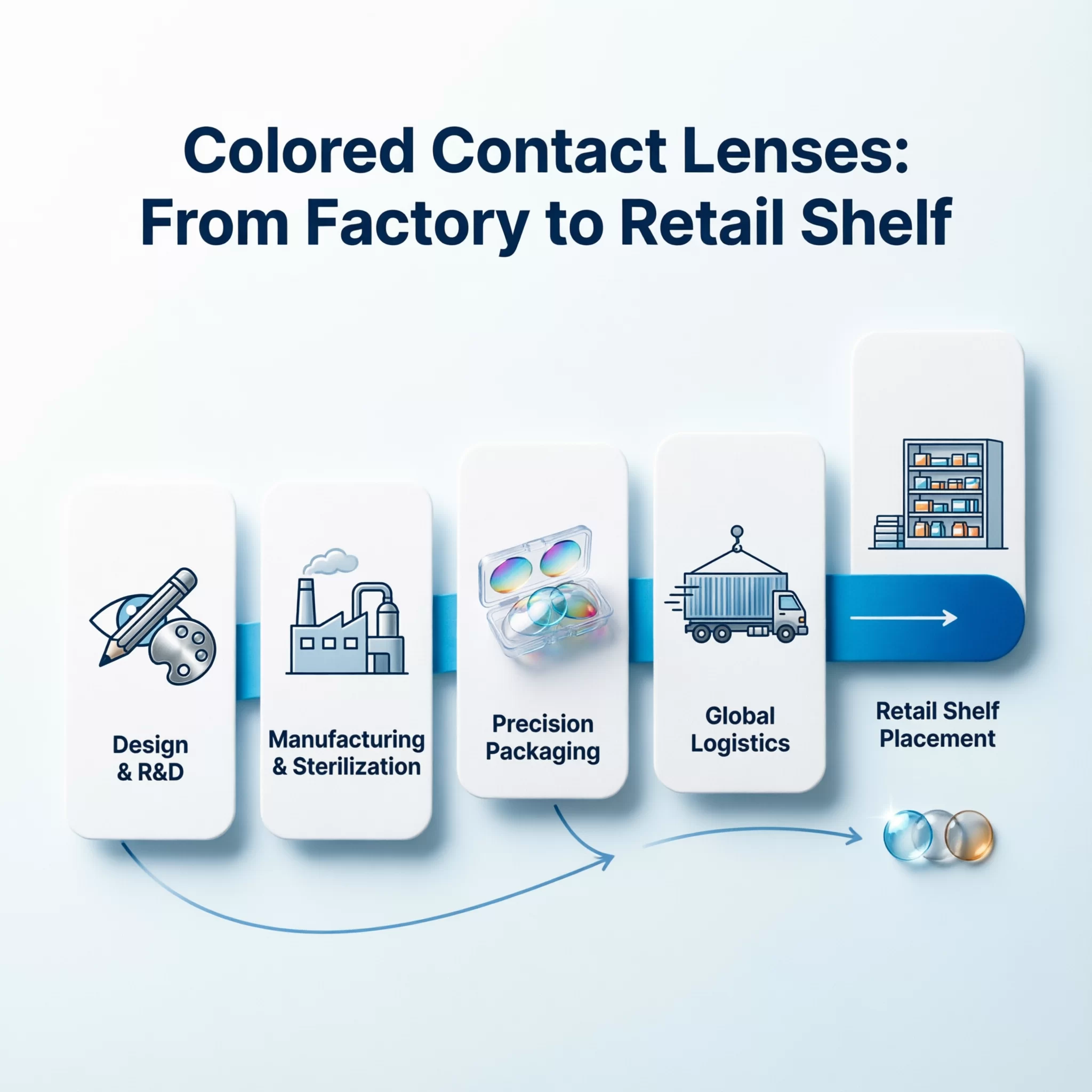
If you’re thinking about launching your own colored contact lens brand, you’ve probably asked yourself the same question every new brand owner does: How long is this actually going to take?
It’s a fair question. I’ve seen brands launch in as little as six weeks and others drag on for over a year. The difference usually isn’t the factory — it’s how well you understand the process and how prepared you are at each stage.
After working with dozens of brand founders through our OEM/ODM program at MIOMI, I can tell you the timeline is far more predictable when you know what to expect. This guide walks you through each stage with realistic timelines, common bottlenecks, and what you can do to speed things up without cutting corners.
The Honest Answer First
A typical private label contact lens launch takes 8–12 weeks from initial inquiry to receiving your first sellable inventory.
If you’re in a huge hurry and everything goes perfectly — you have your designs ready, you pick stock molds, and paperwork flows smoothly — you might pull it off in 5–6 weeks.
If you’re creating fully custom designs, navigating complex certification pathways, or you’re slow to approve samples, plan on 12–16 weeks.
I’m giving you ranges instead of a single number because you control a lot of the timeline. The factory can only move as fast as your decisions allow.
Stage 1: Research & Factory Selection (Week 1–2)
Before a single lens gets made, you need to find the right manufacturing partner. This is not the stage to rush.
What happens this phase
- You research factories and request quotes
- You verify certifications (FDA, CE, KFDA — whatever your market requires)
- You ask for samples to test quality
- You compare MOQs, pricing, and design capabilities
- You negotiate terms and sign an agreement
How long it takes
1–2 weeks if you’re decisive. Longer if you’re shopping around endlessly.
The biggest bottleneck here
Analysis paralysis. I’ve seen founders spend three months comparing five factories when two of them were clearly outside their budget or couldn’t meet their certification needs.
How to speed it up
- Know your market first (which certifications do you actually need?)
- Have a rough budget and MOQ in mind before reaching out
- Ask for sample lenses early — you can’t judge a factory from their website alone
- Narrow it down to 2–3 serious candidates, not ten
Pro tip: If a factory quotes you a price that seems too good to be true, it usually is. The contact lens industry has real quality costs. Cut-rate factories often skip proper sterilization, use lower-grade materials, or fake their certifications. Is that really the risk you want to take with your customers’ eyes?
Stage 2: Design & Artwork Finalization (Week 2–4)
This is where your brand starts to take shape — literally. You’ll decide on lens colors, patterns, packaging, and all the visual elements that make your product yours.
What happens this phase
- You choose or create lens designs (stock designs vs. fully custom)
- You finalize packaging artwork (boxes, vials, instruction leaflets)
- You decide on product specs: diameter, base curve, water content
- The factory creates digital mockups for your approval
How long it takes
- Stock designs: 3–7 days
- Semi-custom designs (tweaking existing patterns): 7–14 days
- Fully custom designs (from scratch): 2–4 weeks, often with 2–3 revision rounds
The biggest bottleneck here
Endless design revisions. I once worked with a client who went through eleven rounds of color adjustments on a single lens design. Eleven! Each round added 3–5 days to the timeline.
How to speed it up
- Collect 3–5 reference images of what you like (and what you don’t)
- Give specific feedback, not “make it prettier”
- Limit yourself to 2–3 revision rounds max — perfection is the enemy of launched
- If you’re not a designer, work with one before you come to the factory, not during
Important: Your packaging artwork needs to include all legally required information for your target market — ingredient lists, manufacturer details, lot number space, expiration dates, warning statements. If you skip this now, you’ll pay for it later in compliance delays.
Stage 3: Tooling & Sampling (Week 4–7)
This is the phase where digital designs become physical products. It’s also where most delays happen, so pay attention.
What happens this phase
- The factory creates or selects molds for your lenses
- A first sample batch is produced (usually 10–50 pairs per design)
- Quality control checks are run
- Samples are shipped to you for review and approval
How long it takes
- Stock molds (existing designs): 7–10 days for samples
- Custom molds (new designs): 14–21 days for tooling, plus 7–10 days for samples
- Shipping time: 3–7 days depending on your location and courier choice
The biggest bottleneck here
Mold tooling for custom designs. Creating a new contact lens mold is precision work — we’re talking about microscopic layers of color pigment sandwiched between lens materials. It’s not like printing a t-shirt. Each custom design requires its own mold set, and each mold set takes time to machine, test, and refine.
How to speed it up
- If speed matters more than absolute uniqueness, start with stock designs and add custom packaging
- Approve samples quickly — set yourself a 48-hour review deadline
- Don’t request tiny sample changes that no customer would ever notice
Real talk: I know you want your brand to be perfect. But here’s what I’ve observed across dozens of launches — the brands that succeed aren’t the ones with the “perfect” first collection. They’re the ones that get to market, learn from real customer feedback, and iterate from there. A good product in customers’ hands beats a perfect product sitting in a factory.
Stage 4: Certification & Compliance (Week 6–10, often runs parallel)
This is the stage that surprises people who are new to the industry. Contact lenses are medical devices in most countries, not cosmetics. That means they need proper certification before you can sell them.
What happens this phase
- The factory provides existing certification documents (CE, FDA, KFDA, etc.)
- You may need to register your brand with local authorities
- Product testing may be required in your target market
- Import/export documentation is prepared
How long it takes
- Using factory’s existing certifications: 1–2 weeks (just paperwork)
- New market registration: 4–8 weeks (varies wildly by country)
- Full new certification: 3–6 months (not typical for private label)
The biggest bottleneck here
Not knowing what your market actually requires. I’ve had clients spend months pursuing FDA clearance when they were only selling in Southeast Asia, where it wasn’t necessary. Conversely, I’ve seen clients try to sell in Europe without CE marking and get their shipments seized at customs.
How to speed it up
- Research your target market’s requirements before you start production
- Ask your factory which certifications they already hold — you may not need new ones
- Work with a local regulatory consultant if you’re unsure; it’s cheaper than getting it wrong
- Get this process started while samples are being made, not after
Critical note: If a factory tells you certifications “don’t matter” or offers to sell you uncertified lenses, run. Not only is this illegal in most markets, but it’s also dangerous for your customers and catastrophic for your brand reputation.
Stage 5: Mass Production (Week 8–10)
Once samples are approved and paperwork is in order, the real production begins.
What happens this phase
- Raw materials are prepared and sterilized
- Lenses are produced using the approved molds
- Each batch undergoes quality inspection
- Lenses are packaged in your custom packaging
- Final QC and sterilization of finished products
How long it takes
- Standard order (1,000–5,000 pairs): 10–15 business days
- Larger order (5,000–20,000 pairs): 15–25 business days
- Peak season (before major holidays): Add 5–10 days
The biggest bottleneck here
Factory scheduling. If you’re trying to produce during a busy season — like before Halloween or the holiday shopping period — factories get booked up. Your order might sit in the queue for a week or two before production even starts.
How to speed it up
- Place your order well before peak seasons
- Be flexible on timing — ask when the factory has available capacity
- Build a buffer into your launch timeline (see below)
- Place reorders before you sell out completely, not after
Quality never takes a holiday: A good factory won’t rush production at the expense of quality. If they tell you it will take 15 days, that’s because 15 days is what proper manufacturing and testing require.
Stage 6: Shipping & Receiving (Week 10–12)
Your lenses are made, inspected, and packaged. Now they need to get to you.
What happens this phase
- The factory arranges shipping (or you use your own forwarder)
- Goods clear export customs in China
- Goods clear import customs in your country
- You receive the shipment and do your own incoming inspection
How long it takes
- Air freight (express): 3–7 days door-to-door
- Air freight (standard): 7–14 days
- Sea freight: 25–45 days (only cost-effective for very large orders)
- Customs clearance: 1–5 days (but can be longer if paperwork is incomplete)
The biggest bottleneck here
Customs delays. This is where your certification paperwork really matters. If customs finds issues — missing documents, incorrect labeling, uncertified products — your shipment can sit in a warehouse for weeks, or worse, get seized and destroyed.
How to speed it up
- Make sure all documentation is complete before shipping
- Work with an experienced freight forwarder who handles medical devices
- Consider using the factory’s shipping partners — they know the paperwork requirements
- Inspect your shipment within 48 hours of receiving it
The Timeline Summary: At a Glance
| Stage | Typical Duration | Fast Case | Slow Case |
|---|---|---|---|
| Research & Factory Selection | 1–2 weeks | 3 days | 4+ weeks |
| Design & Artwork | 2–3 weeks | 3 days | 6+ weeks |
| Tooling & Sampling | 2–3 weeks | 1 week | 5+ weeks |
| Certification & Compliance | 2–4 weeks (parallel) | 1 week | 3+ months |
| Mass Production | 2–3 weeks | 10 days | 5+ weeks |
| Shipping & Receiving | 1–2 weeks | 3 days | 6+ weeks |
| Total | 8–12 weeks | 5–6 weeks | 16+ weeks |
5 Habits of Brands That Launch On Time
After seeing so many launches, I can tell you that speed is less about the factory and more about how you work. Here’s what the fastest-launching brands do differently:
1. They make decisions quickly
The fastest brand we ever worked with approved every sample within 24 hours. The slowest? Took 3+ weeks per approval. That adds up.
2. They prepare before they reach out
They have their brand name, logo, packaging concepts, and market research done. They don’t use the factory as their design team.
3. They ask the right questions early
“Which certifications do you already hold?” “What’s your current production lead time?” “How many revision rounds are included?” These questions save weeks of surprises later.
4. They build a buffer
Smart founders add 2–3 weeks of padding to their launch timeline. When something inevitably takes longer than expected — and something always does — they don’t miss their launch date.
5. They don’t try to do everything at once
The best launches start with 3–5 core designs, not 20. They validate the market first, then expand. Starting small means faster launches, lower risk, and quicker feedback.
When to Start — Planning Backwards from Your Launch Date
If you have a target launch date in mind, here’s how to work backwards:
- Want to launch in time for Halloween? Start your factory selection by mid-July at the latest.
- Aiming for holiday season sales? Begin the process by early September.
- Planning a summer launch? Get started by March to avoid spring rush delays.
And if you’re reading this and thinking, “I wish I’d started sooner,” — you’re not alone. Most founders underestimate how long everything takes. The good news is that you know now, and you can get started today.
Final Thought
Launching a contact lens brand isn’t fast, and it isn’t easy. But it’s absolutely doable when you understand the process and work with the right partner. Eight to twelve weeks might feel like a long time when you’re excited to launch, but remember — you’re building a brand, not dropshipping t-shirts.
Those weeks of design, sampling, and quality control are what separate a serious brand from a fly-by-night operation. Your customers will feel the difference, and your business will be built on a solid foundation.
If you’re in the research phase and trying to figure out if MIOMI is the right manufacturing partner for your brand, I’m happy to walk you through our process, answer your questions, and give you a realistic timeline based on your specific needs. No hard sell, no pressure — just honest information to help you make the right decision.
Have questions about the OEM/ODM process? Drop us a line at sales@miomicon.com and we’ll get back to you within 24 hours.