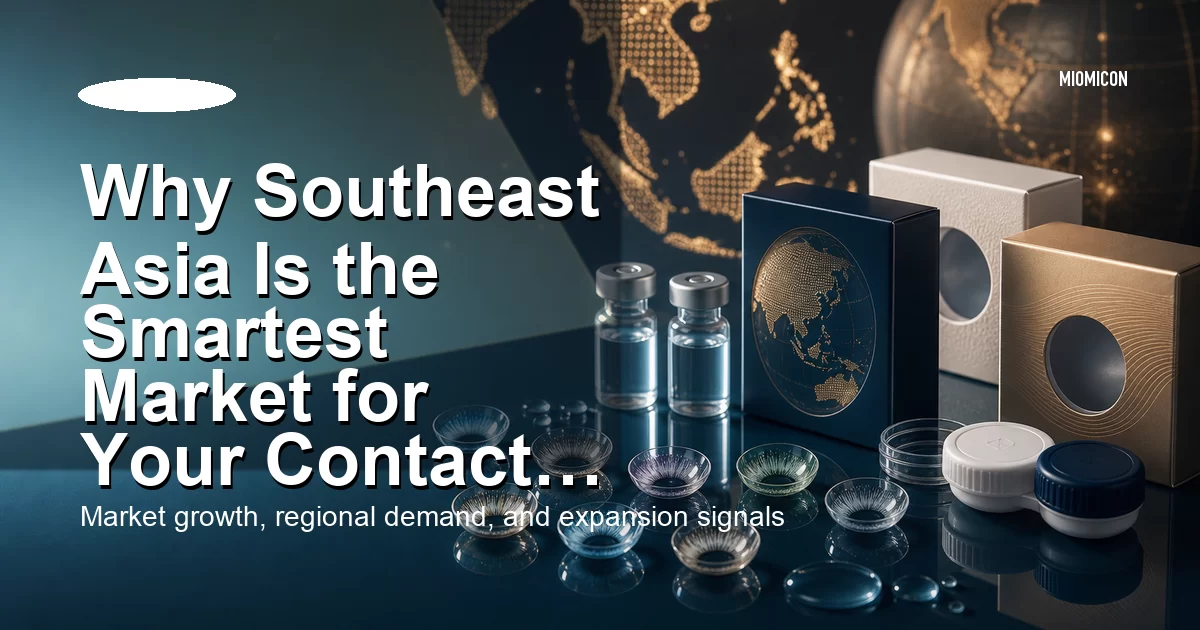
If you’ve been watching the contact lens industry from the sidelines, you’re missing the most interesting story of 2026. And it’s not happening in the markets you’d expect.
Everyone talks about North America and Western Europe. Fair enough — they’re mature, established, and predictable. But mature markets are also saturated. The real growth — the kind that can turn a regional brand into a serious player — is happening in Southeast Asia. And it’s happening fast.
Let me break down what we’re seeing on the ground, why it matters for brand owners, and whether you should be paying attention.
The Numbers Don’t Lie
Southeast Asia’s contact lens market grew at roughly 8-10% annually over the past three years. Compare that to the 2-3% growth in Western Europe and you start to see the pattern.
The region’s population sits around 680 million. More importantly, it’s young. The median age in countries like Indonesia, the Philippines, and Vietnam hovers in the low 30s. That’s a demographic sweet spot for color contact lenses — the single fastest-growing segment in the entire industry.
Here’s what’s driving it:
Rising disposable income. Middle-class consumers in Southeast Asia are spending more on personal care and beauty than ever before. Contact lenses, especially colored ones, have shifted from a medical necessity to a lifestyle product. That’s a fundamental change in purchasing behavior, and it means customers buy more frequently and experiment with more products.
Social media influence. Instagram, TikTok, and local platforms like Shopee Live are pushing beauty trends at an unprecedented pace. When a Thai beauty influencer reviews a new pair of gray contact lenses, that review reaches hundreds of thousands of potential buyers within hours. The conversion cycle from “I saw this” to “I want this” has shrunk dramatically.
Urbanization. More people are moving to cities, more people are working in customer-facing roles, more people are conscious about their appearance. All of this feeds directly into contact lens demand.
The Country-by-Country Breakdown
Not every Southeast Asian market looks the same. If you’re building a brand strategy, you need to know where to focus your energy first.
Indonesia — The Sleeping Giant
Population: 275 million. It’s the fourth most populous country in the world and the largest economy in Southeast Asia. The contact lens market here is still underpenetrated compared to neighboring countries, which means the ceiling is high.
Halal certification matters enormously in Indonesia. If you’re entering this market and you haven’t considered halal compliance, you’re leaving money on the table. We’ve seen brands launch with full halal certification and gain immediate trust from local distributors who were hesitant to stock non-certified products.
Color preferences lean toward warm tones — honey brown, warm gray, and olive green tend to perform better than cool-toned blues and grays. This makes sense when you consider natural coloring palettes and what looks harmonious on darker eyes.
Vietnam — The Fast Mover
Vietnam has been one of the fastest-growing economies in Asia for the past decade. The contact lens market is catching up quickly. E-commerce adoption is strong, and young consumers are comfortable buying beauty products online.
What’s interesting about Vietnam: the demand for natural-looking color lenses outpaces the demand for dramatic, fashion-forward designs. Vietnamese consumers tend to prefer subtle enhancement — “my eyes but better” rather than “look at my eyes.” If you’re curating a product lineup, prioritize natural series here.
Thailand — The Trendsetter
Thailand has a mature beauty culture and an enormous social media presence. Thai consumers are trend-aware and willing to experiment. This is the market where bold colors, unique patterns, and limited-edition releases actually work.
Thai consumers also have higher quality expectations. They’ll pay more for lenses with better comfort specs — higher water content, superior Dk/t values, and reputable certifications. If your brand positioning is premium, Thailand is where you prove it.
Philippines — The Volume Play
English proficiency is high, social media penetration is among the highest in the world, and the population is extremely young. The Philippines is a volume market. Margins may be thinner, but the sheer number of potential customers makes it attractive for brands scaling up.
Korean beauty influence is massive here. If your brand can tap into the “K-beauty” aesthetic — soft, natural, approachable — you’ll find an audience that’s already primed for it.
What This Means for Brand Owners and Distributors
If you’re sitting on a contact lens brand and wondering where to expand next, Southeast Asia should be at the top of your list. But you can’t just dump your existing product catalog into these markets and expect results. You need a strategy.
1. Localize Your Product Mix
Don’t assume one color palette works across the region. It doesn’t. Indonesia’s warm tones won’t necessarily resonate in Vietnam. Build market-specific SKUs and test them before going all-in.
2. Get Your Compliance House in Order
Different countries have different regulatory requirements. ASEAN has harmonized some medical device regulations, but enforcement varies. CE certification gets you credibility everywhere. FDA (US) certification is a bonus signal even in non-US markets. For Indonesia, explore halal certification.
3. Partner With People Who Know the Ground
Local distributors who understand retail dynamics, social commerce, and influencer marketing are worth their weight in gold. The wrong distributor can sink a brand in six months. The right one can make you a category leader in eighteen.
4. Price for the Market, Not Your Home Base
Pricing that works in Europe will price you out of Southeast Asia. You don’t need to go cheap — there’s room for mid-tier and premium brands — but your price-to-value ratio needs to make sense locally.
The OEM/ODM Angle
Here’s where it gets interesting for brand builders. You don’t need to manufacture your own lenses to capture this market. OEM and ODM partnerships let you launch with your own branding, your own packaging, and your own positioning — without the capital expenditure of building a factory.
The key is finding a manufacturing partner who:
- Offers low MOQs so you can test markets without overcommitting
- Has the technical capability to produce the specs these markets demand
- Understands certification requirements and can support your compliance needs
- Provides flexibility on packaging design and branding
We’ve worked with brands launching in Southeast Asia with initial orders as small as 500-1,000 pieces per SKU. That’s enough to test the market, gather real customer feedback, and iterate before scaling.
The Bottom Line
Southeast Asia isn’t a “someday” market anymore. It’s a “right now” market. The window of opportunity is open, but it won’t stay open forever. As more international brands wake up to the growth potential here, competition will intensify and customer acquisition costs will rise.
The brands that move first — with the right product mix, the right compliance strategy, and the right local partnerships — will build advantages that are hard to dislodge.
If you’re a brand owner, distributor, or entrepreneur looking at the contact lens space, the question isn’t whether to look at Southeast Asia. The question is whether you’re going to move before or after everyone else does.
MIOMI Optical specializes in OEM/ODM contact lens manufacturing with low MOQs for emerging market brands. We’ve helped over 200 brands launch globally. If you’re exploring the Southeast Asian opportunity, let’s talk — contact us to discuss your project.