Let’s talk about the one question every brand founder and wholesaler asks me, usually in a quiet corner at a trade show: “How much should I actually charge for these?”
Pricing colored contact lenses isn’t just about doubling your cost and calling it a day. Get it wrong and you either leave money on the table or price yourself out of the market. After working with over 80 brands across 30+ countries, I’ve seen every pricing mistake in the book — and the strategies that consistently win.
In this guide, I’m breaking down the real numbers, the psychological tricks, and the tiered strategies that separate profitable brands from the ones struggling to stay afloat. No fluff, just actionable frameworks you can apply this week.
First: Understand Your True Cost (Not Just the Factory Price)
Before you set any price, you need to know exactly what each pair costs you. Most new brand owners only look at the unit cost from their supplier and call it a day. That’s a dangerous mistake.
Here’s what actually goes into your cost per pair:
- Unit cost from factory — the obvious one. For standard color lenses in reasonable MOQs, this is usually $1.50-$5.00 per pair depending on complexity.
- Packaging and labeling — custom boxes, foil pouches, instruction inserts. Don’t forget this. Good packaging can add $0.30-$1.00 per pair.
- Shipping and logistics — air freight from China to your warehouse, customs, duties, last-mile delivery to customers. This alone can be $2-$8 per pair depending on volume and destination.
- Payment processing fees — typically 2.9% + $0.30 per transaction for most gateways.
- Returns and exchanges — budget 3-8% of revenue for this. Yes, even with contact lenses.
- Marketing and customer acquisition — if you’re selling direct-to-consumer, this is your biggest variable cost. CAC (Customer Acquisition Cost) can range from $8 to $40+ in this industry.
- Platform fees — Shopify takes 2.9%, Amazon takes 15%, your local marketplace takes its cut.
- Overhead — website hosting, tools, customer service, your time.
Let me give you a real example. A brand I consulted with thought their cost was $3.20 per pair (the factory price). When we added everything up, the true landed cost was closer to $9.50 per pair for D2C sales. They were selling at $19.99 and wondering why they never seemed to make any money.
Rule #1: If you don’t know your true all-in cost, you don’t have a business — you have a hobby with inventory.
The Three Pricing Models (And When to Use Each)
There’s no single “right” way to price contact lenses. It depends on your business model, your market position, and who you’re selling to. Here are the three main approaches:
1. Cost-Plus Pricing (The Safe, Boring Option)
This is the simplest method: take your cost and add a markup percentage.
Formula: Price = Cost × (1 + Markup %)
Typical markups in the contact lens industry:
- Wholesale / B2B: 30-80% markup
- Retail / D2C: 200-400% markup (yes, really — and it’s not as high as it sounds once you factor in all the costs above)
- Premium / luxury brands: 500-1000%+ markup (this is where the real money is, but it requires brand building)
Best for: New brands who aren’t sure where to start, or wholesale businesses where the market sets the price range. It’s simple and ensures you don’t lose money on each sale.
Problem with it: It ignores perceived value and what the market will actually pay. You could be charging more — or you could be priced too high and wonder why nobody buys.
2. Value-Based Pricing (The Smart Brand Play)
This is where the big money is. Instead of pricing based on what it costs you, price based on what it’s worth to your customer.
Think about it. Why will someone pay $25 for a pair of color lenses when they could get a similar pair for $8? Because of:
- Brand reputation and trust (this is huge for something you put in your eye)
- Unique designs and color formulas they can’t get elsewhere
- Better materials (silicone hydrogel vs. standard hydrogel)
- Medical-grade quality and certifications
- Customer experience — easy ordering, fast shipping, hassle-free returns
- The feeling they get when they wear your lenses (confidence, beauty, self-expression)
The most successful D2C color lens brands don’t compete on price — they compete on desirability. They sell a look, a vibe, an identity. The lens is just the vehicle.
How to do it: Research what premium brands in your target market charge. Position yourself slightly below the top tier, but clearly above the budget options. Invest in brand visuals, packaging, and storytelling that justify the price.
3. Competitive Pricing (For Commodity Markets)
If you’re selling on Amazon, Shopee, or other marketplaces where customers compare 10 similar products side by side, you’re largely a price-taker. You need to know what everyone else charges and position yourself within that range.
But here’s the thing: in commodity markets, the cheapest price rarely wins. The product with the best reviews at a reasonable price wins.
Don’t race to the bottom. Instead, find the price point where you can still make decent margins while offering slightly better value (better packaging, faster shipping, bonus items) than the competitors at your price level.
Rule #2: There is always someone willing to sell cheaper than you. Competing on price is a race to the bottom, and nobody wins except the customer (and even they lose when quality drops).
Pricing Psychology: Tricks That Actually Work
Let’s be real — pricing is part math, part psychology. These aren’t tricks, they’re proven behavioral economics principles that every successful brand uses.
The Magic of .99 (But Use It Wisely)
You’ve seen this a million times. $19.99 instead of $20.00. It’s cliché because it works. Our brains process the left digit first, so $19.99 feels like “teens” while $20.00 feels like “twenties” — a much bigger psychological gap than one cent.
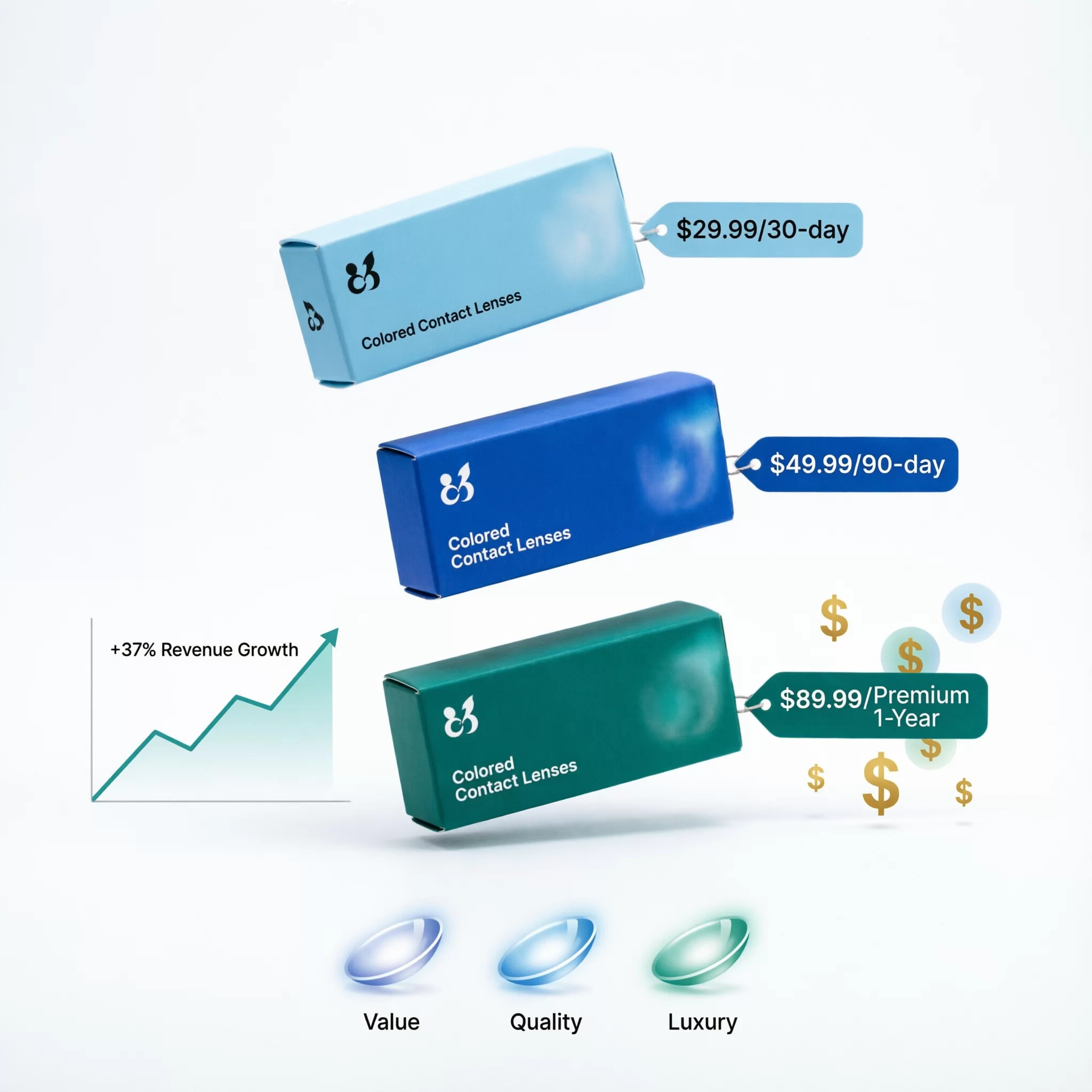
But here’s the catch: for premium and luxury positioning, round numbers actually work better. $30.00 feels more premium than $29.99. Use .99 for mid-range and budget products, round numbers for premium tiers.
Price Anchoring: Show the Most Expensive First
When you show your highest-priced option first, it sets a mental anchor that makes everything else look like a deal. If the first thing a customer sees is a $49.99 premium pack, then $24.99 for a single pair starts to look reasonable.
This is why every subscription service shows the annual plan first (at the highest total price) — it makes the monthly plan look like a better value by comparison.
The Decoy Effect
Here’s a classic. Imagine you have three options:
- 1 pair: $19.99
- 3 pairs: $49.99
- 10 pairs: $79.99
The 3-pair option is the decoy — it’s priced close enough to the 10-pair option that people think, “Well, for only $30 more, I get SEVEN more pairs?” and go for the biggest pack.
The decoy isn’t meant to sell. It’s meant to make the option you actually want to sell look like a no-brainer.
Bundle Pricing
Selling pairs individually is fine, but bundling is where you increase average order value (AOV) and improve perceived value.
Popular bundle strategies for contact lenses:
- “Buy 2, Get 1 Free” — classic, always works. Customers love “free.”
- Monthly subscription box — recurring revenue is the holy grail.
- “Best Sellers” pack — curate 3-5 of your most popular colors and sell as a set at a slight discount.
- Complete look bundle — lenses + case + solution + applicator tool. Higher perceived value.
Bundles work because they increase your AOV, reduce per-unit shipping costs, and give customers the feeling of getting a deal — even if you’re still making excellent margins.
Wholesale Pricing: How to Structure B2B Pricing Tiers
If you’re selling to retailers, beauty salons, or online stores, you need a clear wholesale pricing structure. Here’s what I recommend based on what works in the industry:
| Tier | MOQ | Discount off Retail | Typical Unit Price |
| Sample / Starter | 10-50 pairs | 30-40% | $12-$18 |
| Small Wholesale | 100-300 pairs | 50-60% | $8-$12 |
| Standard Wholesale | 500-1,000 pairs | 60-70% | $5-$8 |
| Large / Exclusive | 2,000+ pairs | 70-80% | $3-$6 |
A few important principles for wholesale pricing:
- Never undercut your own retailers. If you sell D2C at $24.99, your wholesale price needs to be low enough that retailers can sell at that price and still make money. Typically 50% off retail is the minimum for serious wholesale partners.
- Volume-based pricing encourages larger orders. The jump from tier to tier should be meaningful enough that buyers stretch for the next level.
- MAP pricing protects everyone. If you’re selling to multiple retailers, set a Minimum Advertised Price (MAP) so they don’t race each other to the bottom and devalue your brand.
- Don’t forget net terms. Net-30 or net-60 payment terms are standard in B2B. Factor this cash flow cost into your pricing.
The #1 Pricing Mistake I See New Brands Make
They start too low.
I get it. You’re new, you’re nervous, you want to make your first sales. So you underprice your product to “get traction.” Here’s the problem:
- You attract price-sensitive customers who will leave as soon as someone is cheaper
- You don’t have enough margin to invest in marketing and grow
- When you eventually raise prices (and you will), your existing customers feel betrayed
- You position your brand as “cheap” in people’s minds — and that’s very hard to change later
It’s much easier to start at a healthy price point and run promotions when you need a boost, than to start cheap and try to raise prices later.
Rule #3: Price for the business you want to be, not the business you are right now.
A Real-World Example: Brand A vs. Brand B
Let me show you two brands with similar products but very different pricing strategies. Both buy lenses from the same factory at $3.50 per pair. Both sell D2C in the US market.
| Brand A (Budget) | Brand B (Premium) | |
| Selling Price | $14.99 | $29.99 |
| All-in Cost per Pair | $9.00 | $11.00 (better packaging) |
| Gross Profit per Pair | $5.99 | $18.99 |
| Monthly Sales Volume | 1,200 pairs | 600 pairs |
| Monthly Gross Profit | $7,188 | $11,394 |
| CAC (Customer Acquisition Cost) | $12 | $18 |
| Net Profit (before overhead) | -$7,212 (losing money!) | $594 (profitable) |
Brand A sells twice as many units but still loses money. Brand B sells half as much but is profitable. And here’s the kicker: Brand B has more margin to reinvest in marketing, which means they’ll grow faster and eventually outsell Brand A anyway.
There’s a reason every successful D2C color lens brand positions in the $25-$40 range. The math simply doesn’t work at the bottom end for a real business with marketing costs.
When and How to Raise Prices
So you’ve been in business a while, and you’re wondering if you can charge more. The answer is almost certainly yes — if you do it right.
Signs it’s time to raise prices:
- Your conversion rate is above 4% (means people see your price and still buy — you could probably charge more)
- Customers never mention price as an objection
- Your costs have gone up (supplier increases, shipping, etc.)
- You’ve improved the product or added value (better materials, new designs, better packaging)
- Your brand has grown in recognition
How to raise prices without losing customers:
- Give advance notice (2-4 weeks) so loyal customers can stock up at the old price
- Frame it as an improvement — “We’re upgrading to X material, so prices will be adjusting” instead of “We’re charging more now”
- Add value at the same time — free shipping, new colors, better packaging
- Keep an entry-level option if you’re worried about price-sensitive customers
- Test with new customers first before announcing to your existing list
Your Action Plan: Set Your Prices This Week
Enough theory. Here’s exactly what to do:
- Step 1: Calculate your true all-in cost per pair. Be honest. Include everything.
- Step 2: Research 5-10 competitors in your target market. Note their prices, positioning, and what they include.
- Step 3: Decide where you want to position yourself — budget, mid-range, premium, or luxury. I strongly recommend mid-range or premium for new brands.
- Step 4: Set 2-3 price points (individual pair, 3-pack, 10-pack) using the psychological principles we covered.
- Step 5: Calculate your margins at each price point. If you’re not making at least 60% gross margin on D2C sales, something is wrong.
- Step 6: If you do wholesale, build your tiered pricing structure. Make sure MAP is clear.
- Step 7: Test it. Watch your conversion rate and AOV. Adjust as needed.
Final Thoughts
Pricing isn’t something you set once and forget. It’s a living, breathing part of your business that you should review every 3-6 months. Your costs change, the market changes, your brand grows — your prices should evolve with all of it.
The biggest lesson I’ve learned from working with contact lens brands is this: the brands that win aren’t the cheapest — they’re the ones that understand their value and price accordingly.
Price like you believe in your product. Because if you don’t, why should anyone else?
— Diana, Overseas Business Strategy Director at MIOMI Optical
Looking to start your own colored contact lens brand or expand your wholesale inventory? MIOMI offers OEM/ODM services with low MOQ options, custom packaging, and global shipping. Get in touch with our team to discuss your project.