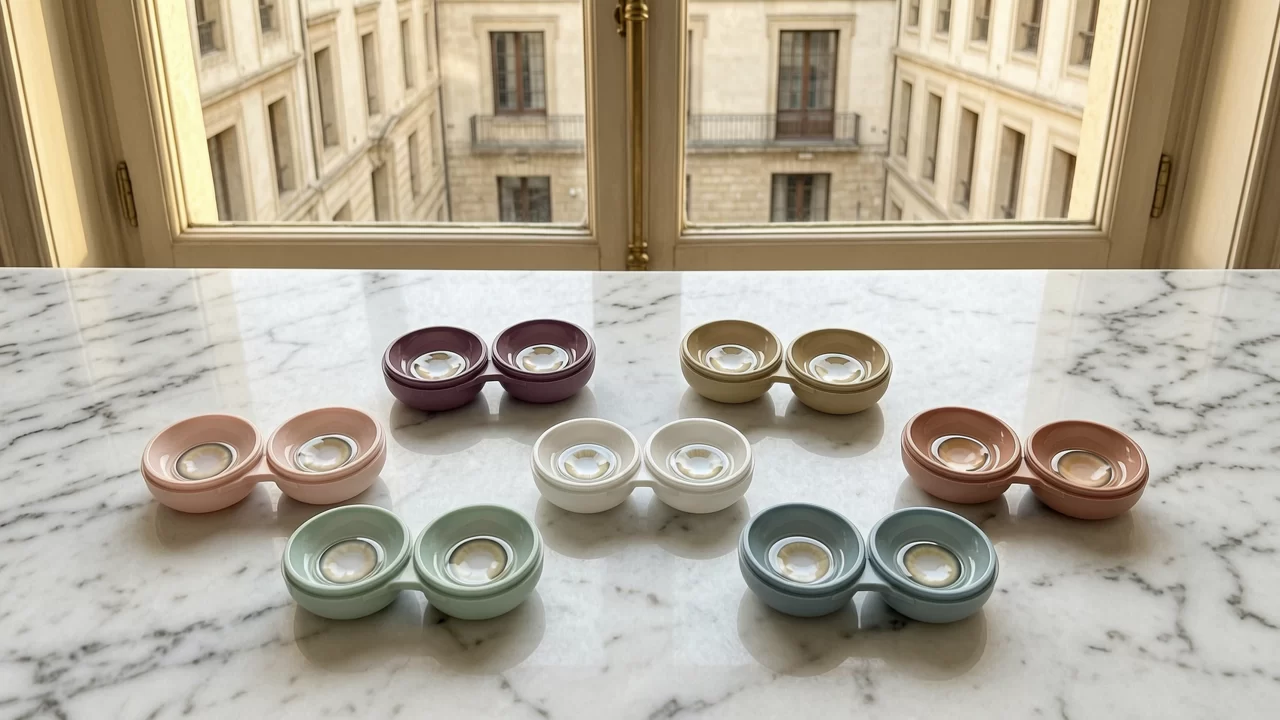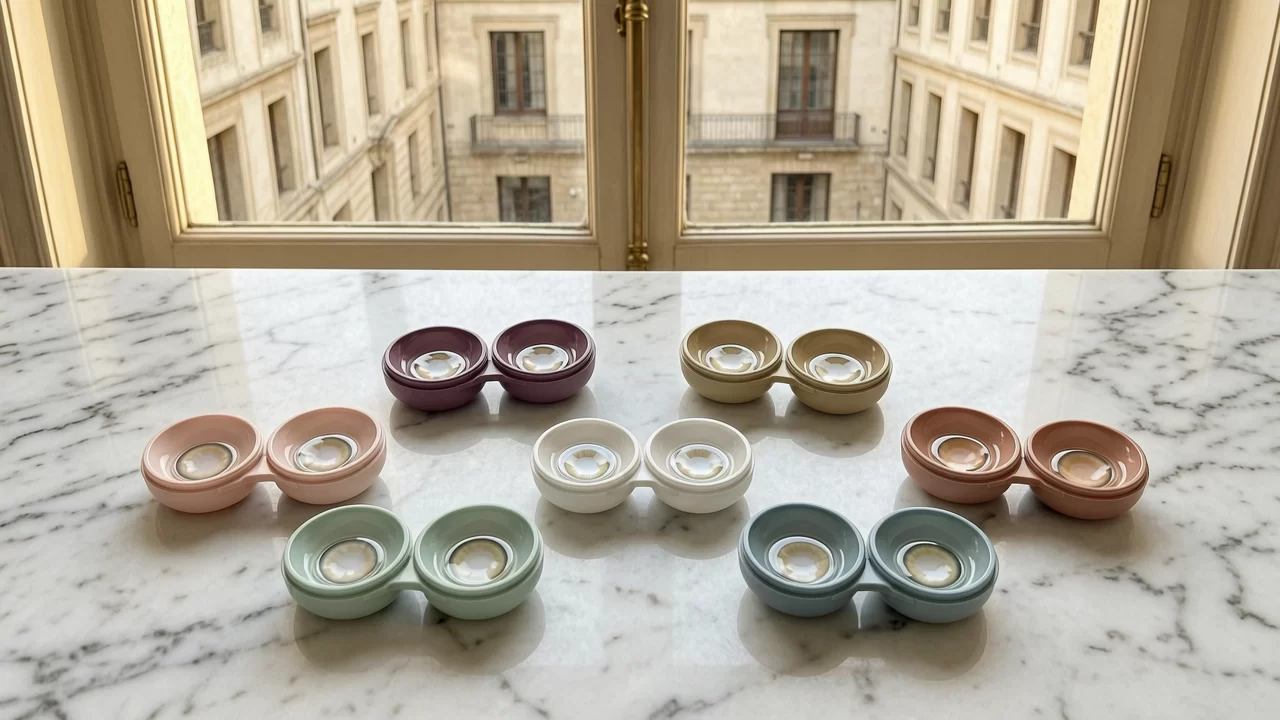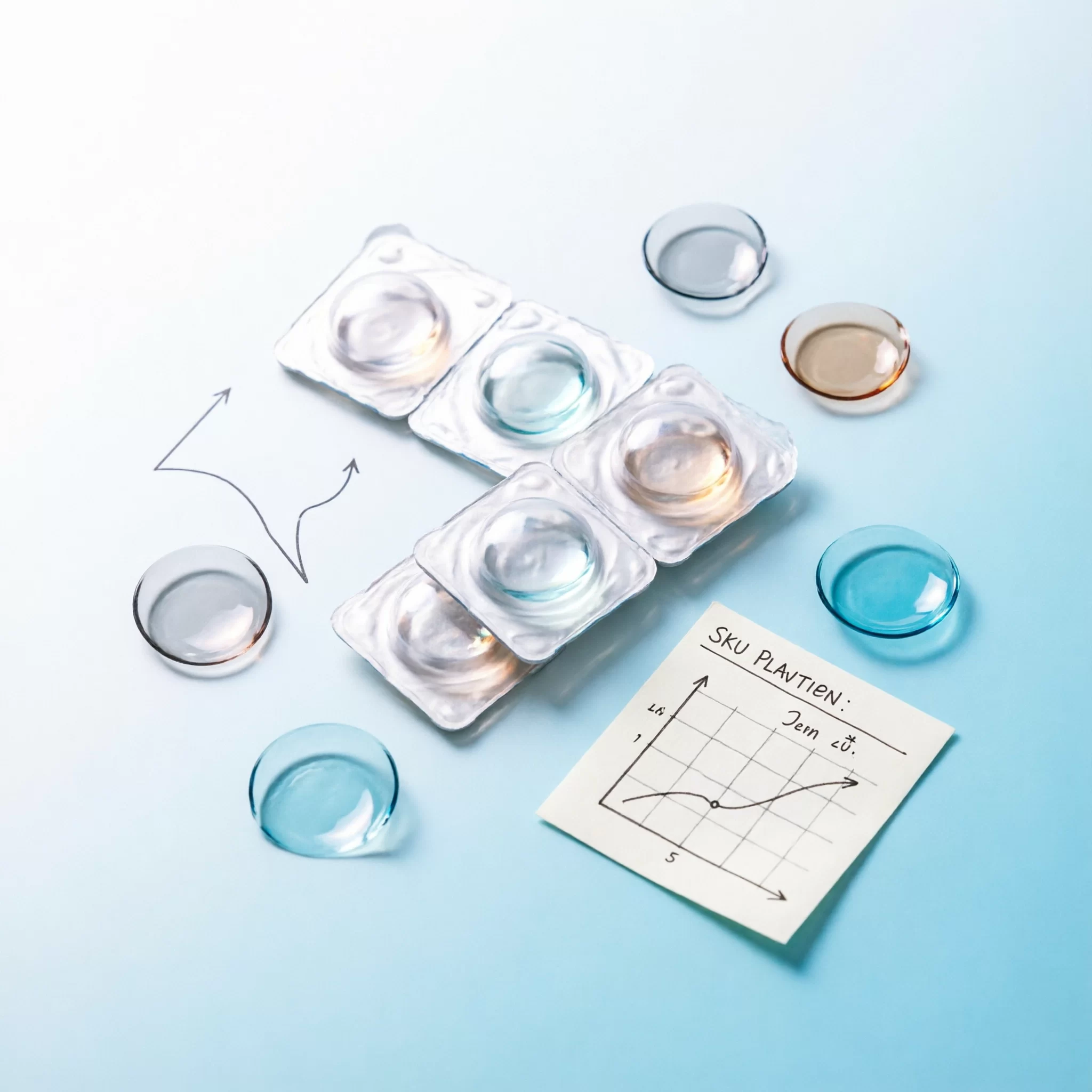
For a long time, many contact lens brands grew in the most obvious way: they added more styles.
More brown lenses. More gray lenses. More enlarging designs. More monthly options. More packaging variations. More “new arrivals” to keep the catalog looking active.
On the surface, this made sense. Beauty consumers like choice, and colored contact lenses are highly visual products. A bigger catalog can make a brand look established, especially on Instagram, TikTok, Shopee, Amazon, or a Shopify store.
But in 2026, a different pattern is becoming clear among stronger B2B buyers and private-label contact lens brands: growth is no longer about having the largest number of SKUs. It is about having the right SKUs — planned around real demand, inventory speed, compliance risk, and repeat purchase behavior.
This shift matters for wholesalers, brand owners, and OEM/ODM buyers because the cost of a messy product line is much higher than it looks. A weak SKU structure does not only create slow-moving stock. It also makes marketing harder, forecasting less accurate, sampling more expensive, and customer support more complicated.
The brands that win over the next few years will not necessarily be the ones with 200 lens designs. They will be the ones that understand which 20, 30, or 50 products actually deserve space in the catalog.
The old playbook: launch often, sell what sticks
The contact lens industry has always moved with beauty trends. A certain gray tone becomes popular. A Korean-inspired natural brown catches attention. A dramatic enlarging lens goes viral on short video platforms. Buyers notice the trend, ask factories for similar designs, and quickly add new SKUs.
This “launch often, sell what sticks” approach worked reasonably well when competition was lighter and logistics costs were lower. Many small brands could afford to test a wide range of designs without thinking too deeply about product architecture.
However, the market is now more crowded. Consumers compare products faster. Paid traffic is more expensive. Platforms are stricter about product claims and compliance. Warehousing costs are rising. At the same time, consumers expect better comfort, clearer product information, and more reliable after-sales support.
In this environment, a large catalog can become a burden if it is not managed carefully.
A buyer may feel proud of carrying 80 designs, but if 60% of sales come from only 12 of them, the rest are quietly consuming cash. They sit in storage, expire slowly, complicate stock management, and distract the brand from the products customers actually want.
Why SKU discipline is becoming a competitive advantage
SKU discipline simply means being intentional about what products belong in the catalog and why.
For contact lens brands, this includes questions such as:
- Which colors are core products and which are trend tests?
- Which diameters and graphic diameters match the target market?
- Which wearing cycles should be prioritized: daily, monthly, quarterly, or yearly?
- Which designs produce repeat purchase, not just first-time curiosity?
- Which products require deeper stock because they sell consistently?
- Which products should be seasonal, limited, or removed?
These questions may sound basic, but many growing brands do not answer them clearly. They add products based on supplier catalogs, competitor screenshots, or customer comments, without building a product strategy.
The result is a catalog that looks rich but performs unevenly.
Strong brands are now doing the opposite. They are simplifying the catalog where needed, separating core products from experimental products, and using data from wholesale orders, online sales, and customer feedback to decide what to keep.
This is not a conservative move. It is a smarter growth move.
Contact lens SKUs are more complex than ordinary beauty products
A lipstick shade is mostly a color decision. A contact lens SKU is not.
Every contact lens product involves a mix of design, diameter, base curve, water content, material, wearing cycle, packaging, regulatory documentation, and after-sales responsibility. For colored lenses, there is also the question of pigment technology, pattern clarity, enlargement effect, and how the color appears on different natural eye colors.
This means each additional SKU adds operational weight.
If a brand launches one new colored lens series with four colors, that may sound simple. But if it offers multiple prescriptions, different packaging languages, and several market-specific requirements, the SKU count can grow quickly. A small design decision becomes a larger supply chain decision.
For B2B buyers, this is where many hidden costs appear. Sampling takes longer. Artwork versions multiply. MOQ planning becomes harder. Forecasting mistakes become more expensive. The sales team may also struggle to explain the difference between similar designs.
A customer who sees five almost identical brown lenses may not feel excited. They may feel confused.
Confusion reduces conversion.
The rise of “hero product” thinking
One of the strongest trends in 2026 is the return of the hero product.
Instead of treating every design equally, more contact lens brands are building their catalog around a small number of signature styles. These are the products that define the brand: the most wearable brown, the best-selling gray, the soft daily lens for beginners, or the premium natural series for office and everyday makeup.
Hero products are easier to market because the message is clearer. They are easier to stock because demand is more predictable. They are easier to improve because feedback concentrates on fewer items.
A hero product does not need to be loud or unusual. In many markets, the best hero lens is often a natural-looking design that customers can wear repeatedly. It may not look dramatic in a product photo, but it performs well because it fits real life.
This is especially important for B2B wholesale and private-label buyers. A product that looks exciting once may generate trial orders. A product that customers repurchase builds the business.
The most valuable question is not “What is new?”
It is: “What will customers come back for?”
Trend products still matter — but they need a clear role
None of this means brands should stop launching trend products. The contact lens market still needs freshness. Seasonal collections, influencer-inspired colors, and limited designs can create attention and support social media content.
The problem is when every product is treated like a permanent product.
A smarter structure is to divide the catalog into layers:
1. Core SKUs
These are stable, repeat-purchase products. They deserve consistent inventory, better packaging, strong product pages, and long-term advertising support.
2. Growth SKUs
These are promising products with early traction. They may need more testing across markets, influencers, or sales channels before becoming core products.
3. Trend SKUs
These are seasonal or experimental designs. They should have controlled production quantities, clear launch windows, and a planned review date.
4. Exit SKUs
These are slow-moving products that no longer justify inventory or marketing effort. Removing them is not failure. It is healthy catalog management.
This kind of structure helps brands avoid emotional decision-making. A design may be beautiful, but if it does not sell, repeat, or support the brand position, it may not deserve long-term space.
Daily lenses are changing SKU planning
The growth of daily disposable contact lenses is also affecting SKU strategy.
Daily lenses are attractive because they fit consumer demand for convenience, hygiene, travel, and beginner-friendly use. They are also easier to position as a premium lifestyle product in many markets.
But daily lenses can create higher inventory pressure because pack sizes, price points, and consumption patterns differ from monthly or yearly lenses. A customer who wears daily lenses regularly may repurchase more often, but the brand must manage supply carefully to avoid stockouts.
For B2B buyers, this means daily lens expansion should be planned around a focused range first. Launching too many daily colors at once can create unnecessary risk. It is often better to start with the strongest natural shades, validate repeat purchase, then expand into more expressive colors.
A good daily lens line should feel easy to understand:
- one or two natural browns
- one soft gray
- one subtle enlarging option
- possibly one special color for fashion users
The exact mix depends on the market, but the principle is the same: clarity beats clutter.
Different markets need different SKU logic
A common mistake in international contact lens business is assuming one product line can serve every market equally.
In reality, SKU performance varies by region.
In Southeast Asia, natural brown and soft enlarging lenses often perform strongly because they fit daily beauty routines and social commerce behavior. In the Middle East, lenses that show clearly on darker iris colors may have stronger appeal, especially in gray, hazel, honey, and premium natural tones. In parts of Europe, buyers may prioritize comfort, safety documentation, and subtle designs over dramatic enlargement. In North America, compliance expectations and prescription-related sensitivity can heavily shape product planning.
This does not mean brands need a completely different catalog for every country. That would be inefficient. But it does mean brands should separate global core products from market-specific extensions.
A practical model is:
- 60–70% global core SKUs
- 20–30% regional preference SKUs
- 10% seasonal or experimental SKUs
This gives the brand consistency while still allowing local adaptation.
What wholesalers should ask suppliers before expanding SKUs
For wholesalers and private-label buyers, the supplier conversation should go beyond “Can you make this design?”
A better discussion includes:
- Which existing designs are stable sellers across multiple markets?
- Which colors have the lowest complaint rate?
- Which specifications are most suitable for our target customers?
- What MOQ is practical for testing without overstocking?
- Can we start with a smaller focused range and expand later?
- How should we plan packaging if some SKUs are only seasonal?
- What documentation is available for the target market?
- How long will repeat production take if a SKU sells faster than expected?
These questions protect the buyer from building a catalog that looks impressive but performs poorly.
A good manufacturer should not push endless SKUs just to increase the first order. A good manufacturing partner should help the buyer choose a product structure that can survive after launch.
The bottom line for 2026
The contact lens industry is not becoming less creative. It is becoming more disciplined.
Design still matters. Color still matters. Newness still matters. But for serious B2B buyers, these things must be supported by better planning.
The next stage of growth will belong to brands that understand their product line as a business system, not just a collection of pretty designs.
A smaller catalog with strong repeat purchase can outperform a huge catalog with weak inventory turnover. A clear hero product can do more for brand memory than twenty similar launches. A well-planned OEM/ODM project can save months of confusion later.
For contact lens wholesalers, retailers, and brand builders, 2026 is a good time to review the catalog honestly.
Keep what sells. Improve what has potential. Test trends carefully. Remove what drains attention.
In a crowded market, smart SKU planning is not boring back-office work. It is one of the most practical competitive advantages a contact lens brand can build.