Understanding Oxygen Permeability (Dk/t) in Colored Contact Lenses: What You Need to Know
Oxygen permeability, often referred to as Dk or Dk/t, is a critical specification for contact lenses. It measures how well a lens material allows oxygen to pass through to the cornea. For colored contact lenses, this specification is particularly important because the color layer can affect the overall oxygen permeability of the lens.
Many consumers and even some retailers are not familiar with oxygen permeability or how it affects lens comfort and eye health. This guide will explain what oxygen permeability is, how it is measured, and why it is important for colored contact lenses.
What is Oxygen Permeability (Dk/t)?
Dk: Oxygen Permeability
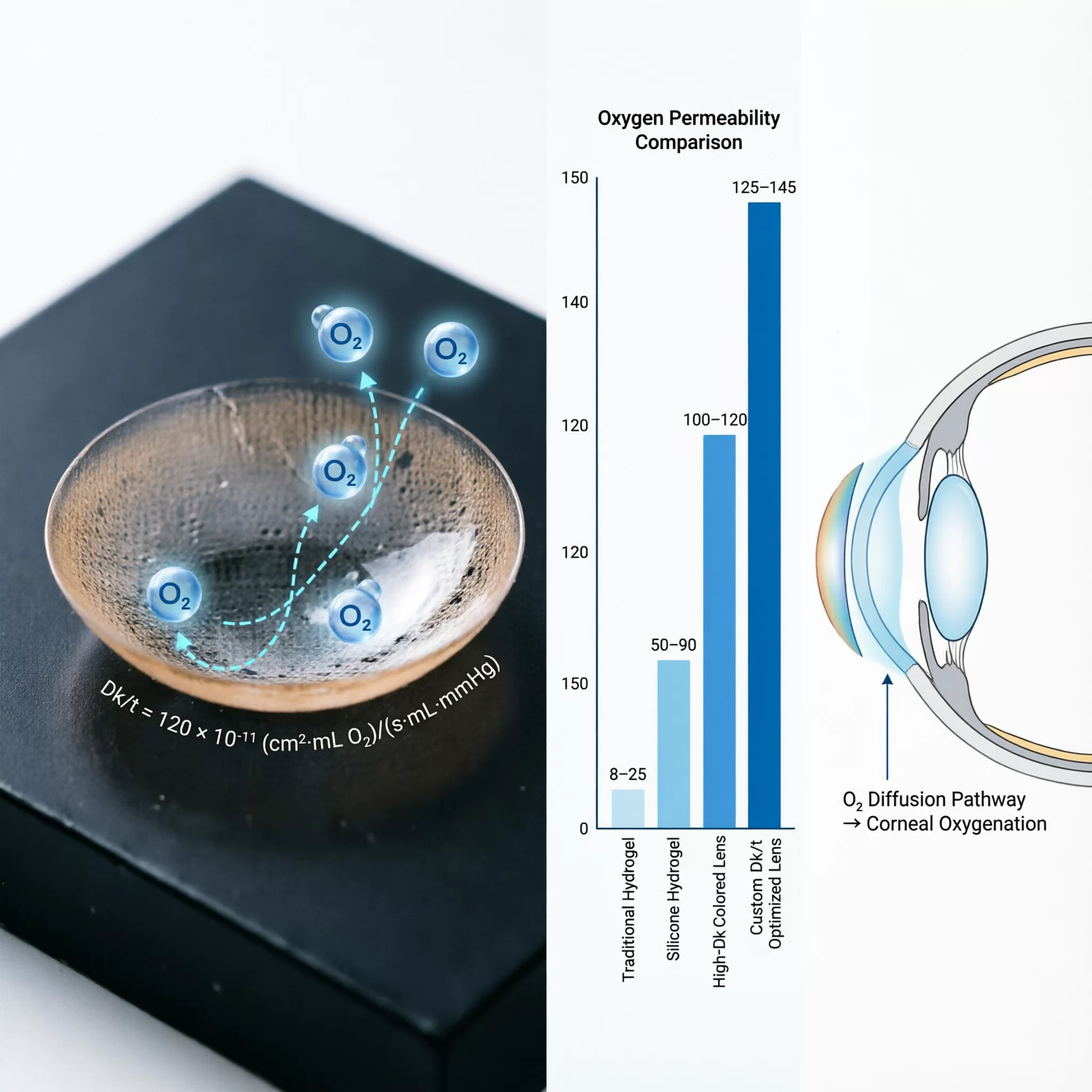
Dk is a measure of the oxygen permeability of a contact lens material. It is expressed as a number, with higher numbers indicating greater oxygen permeability. For example, a material with a Dk of 100 allows more oxygen to pass through than a material with a Dk of 50.
Dk/t: Oxygen Transmissibility
Dk/t is a measure of the oxygen transmissibility of a contact lens. It takes into account both the oxygen permeability of the material (Dk) and the thickness of the lens (t). This is important because thicker lenses allow less oxygen to pass through than thinner lenses. For example, a lens with a Dk of 100 and a thickness of 0.1mm has a Dk/t of 1000, while the same material with a thickness of 0.2mm has a Dk/t of 500.
Why is Oxygen Permeability Important?
Eye Health
The cornea is the only part of the eye that does not have its own blood supply. It relies on oxygen from the air to stay healthy. If a contact lens does not allow enough oxygen to pass through to the cornea, it can cause a condition called corneal hypoxia. This can lead to symptoms such as redness, dryness, blurred vision, and even corneal infections.
Comfort
Oxygen permeability also affects lens comfort. Lenses with high oxygen permeability tend to be more comfortable for long wear, as they allow more oxygen to reach the cornea. This is especially important for colored contact lenses, which are often worn for extended periods of time.
Corneal Neovascularization
Long-term use of contact lenses with low oxygen permeability can cause corneal neovascularization, a condition where new blood vessels grow into the cornea. This can lead to vision loss if left untreated.
Oxygen Permeability and Colored Contact Lenses
The Effect of the Color Layer
Colored contact lenses have an additional layer of color pigment that can affect the overall oxygen permeability of the lens. Some color layers are thicker than others, which can reduce the oxygen transmissibility of the lens. However, advances in technology have made it possible to create colored contact lenses with high oxygen permeability.
Material Selection
The material used to make colored contact lenses also affects oxygen permeability. Silicone hydrogel materials are known for their high oxygen permeability, making them a good choice for colored contact lenses that are worn for long periods of time. Hydrogel materials, on the other hand, have lower oxygen permeability but are often more affordable.
Wearing Schedule
The wearing schedule of colored contact lenses also affects oxygen permeability. Daily disposable lenses are often made from hydrogel materials with lower oxygen permeability, but they are only worn for one day, so corneal hypoxia is not a major concern. Monthly disposable lenses, on the other hand, are often made from silicone hydrogel materials with high oxygen permeability, as they are worn for longer periods of time.
How to Choose Colored Contact Lenses with High Oxygen Permeability
1. Check the Dk/t Value
When choosing colored contact lenses, it is important to check the Dk/t value. Look for lenses with a Dk/t value of at least 50 for daily wear and at least 100 for extended wear.
2. Choose the Right Material
Silicone hydrogel materials are known for their high oxygen permeability, making them a good choice for colored contact lenses that are worn for long periods of time. Hydrogel materials are more affordable but have lower oxygen permeability.
3. Consider the Wearing Schedule
Daily disposable lenses are a good choice for occasional wear, as they are only worn for one day and corneal hypoxia is not a major concern. Monthly disposable lenses are a good choice for regular wear, as they are made from silicone hydrogel materials with high oxygen permeability.
4. Consult with an Eye Care Professional
It is always a good idea to consult with an eye care professional before choosing colored contact lenses. They can help you determine the right type of lens for your eye health and lifestyle.
Conclusion
Oxygen permeability is a critical specification for colored contact lenses. It affects eye health, comfort, and the risk of corneal hypoxia and neovascularization. When choosing colored contact lenses, it is important to check the Dk/t value, choose the right material, and consider the wearing schedule. By following these guidelines, you can ensure that your colored contact lenses are safe and comfortable to wear.
At MIOMI, we offer a wide range of colored contact lenses with high oxygen permeability. Our silicone hydrogel lenses have Dk/t values of up to 180, making them a good choice for long wear. If you are interested in learning more about our colored contact lenses or would like to place an order, please contact us today.