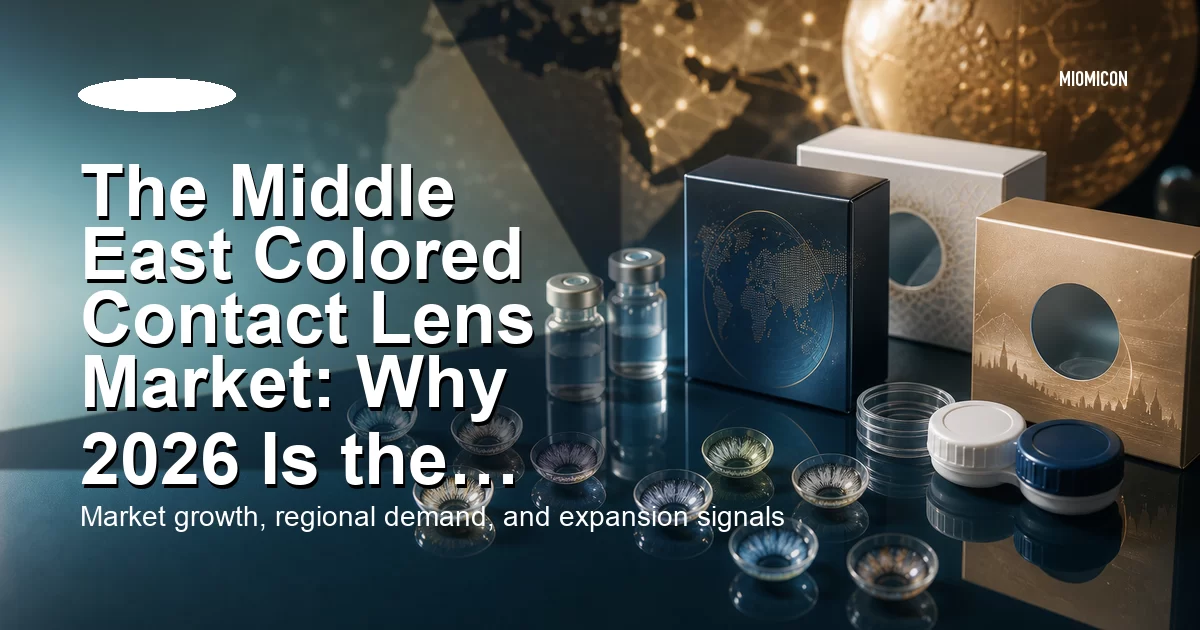
If you have been watching the global eye care market even casually, one thing is hard to miss: the Middle East is waking up to colored contact lenses in a big way. And I do not just mean consumers buying a pair here and there for a wedding. I mean brands launching, social media driving real demand, and distributors actively looking for reliable suppliers.
This is not hype. Let me walk you through what is actually happening, why the numbers make sense, and — if you are a brand owner or distributor reading this — how to get in before the market gets crowded.
The Numbers Tell a Clear Story
The Middle East and Africa contact lens market has been growing at roughly 7–9% annually over the past five years. But colored lenses are outpacing the overall market significantly. Saudi Arabia, the UAE, and Egypt are the three biggest growth engines, and each one has its own dynamics.
Saudi Arabia alone has a population of around 36 million, with over 70% under the age of 35. That demographic profile is basically a perfect match for colored contact lenses. Young consumers, high social media usage, strong spending power — especially in cities like Riyadh and Jeddah.
The UAE, while smaller in population, punches above its weight. Dubai is a regional hub for beauty and fashion retail. Products that trend in Dubai tend to ripple out across the entire GCC within weeks. If you want a test market for the Middle East, this is it.
Egypt brings volume. A population of over 110 million, with a rapidly growing middle class and one of the highest social media engagement rates in the world. Price sensitivity is higher here than in the Gulf, but the volume opportunity is massive.
What Is Driving Demand Right Now
Three forces are converging, and they are not going away anytime soon.
Social media beauty culture. Instagram, TikTok, and Snapchat are enormous in the Middle East. Saudi Arabia consistently ranks among the top countries globally for per-capita TikTok usage. Beauty content — tutorials, before-and-after transformations, “get ready with me” videos — performs exceptionally well. Colored contact lenses are a natural fit for this content ecosystem. They are visual, they are dramatic, and they photograph well.
The modest fashion movement. This is an interesting dynamic that a lot of Western observers miss. In markets where modest fashion is the norm, eye makeup and eye accessories become the primary canvas for self-expression. Colored contact lenses fit right into that. They allow people to transform their look without changing anything else.
Growing awareness of eye health. This one gets less attention but matters a lot. Consumers in the Middle East are becoming more informed about contact lens safety, proper wearing schedules, and the difference between cosmetic and medical-grade products. That means there is growing demand for lenses that are not only beautiful but also certified, safe, and comfortable. Brands that lead with both aesthetics and credibility will win.
What Buyers in This Market Actually Want
After working with partners across the region, here is what I have learned about buyer preferences.
Color preferences are specific. Warm tones dominate — hazel, honey, golden brown, and deep green. Blue and grey have steady demand, but the real volume is in colors that enhance rather than completely transform natural eye color. That said, there is a segment of younger consumers who want bold, dramatic looks — think vivid blue, grey, or even purple. The smart approach is to carry both: a core range of natural enhancers and a smaller collection of statement colors.
Comfort matters more than you think. The Middle East climate is hot and dry for much of the year. Low water content lenses that dry out quickly are a non-starter. Buyers increasingly ask about water content, material composition, and wearing time. Lenses with 38–55% water content and a smooth edge design perform best. If you can offer daily disposables alongside monthlies, even better — convenience is a growing selling point.
Packaging needs to speak the language — literally. Arabic labeling is not just a nice-to-have in several GCC markets; it is increasingly expected by retailers and, in some cases, required by regulators. Bilingual packaging (Arabic and English) is the standard. Beyond language, packaging design should feel premium. The beauty market in the Gulf is accustomed to luxury presentation, and contact lens packaging that looks cheap will struggle on the shelf.
Certification and Compliance: The Gatekeeper
Here is where a lot of suppliers stumble. You cannot just ship colored contact lenses into the Middle East without the right paperwork.
The UAE requires product registration with the Ministry of Health and Prevention (MOHAP). Saudi Arabia's SFDA (Saudi Food and Drug Authority) has its own registration process. Both require evidence of quality management systems — typically ISO 13485 certification — and product testing documentation.
If your lenses already carry CE marking (European conformity), that helps. The GCC regulatory frameworks generally accept CE as part of the evidence package, though it is not a substitute for local registration. FDA clearance is also viewed favorably, though it is not a GCC requirement per se.
The bottom line: if you are serious about this market, start the registration process early. It can take several months. But once you are registered, you have a significant moat — because many smaller competitors simply will not bother.
How to Enter: A Practical Playbook
If you are a brand owner or distributor looking at the Middle East in 2026, here is the approach that makes the most sense.
Start with the UAE. Use Dubai as your beachhead. Register your products, establish a local distribution relationship, and test your product range. The market is small enough to manage but connected enough to give you regional visibility.
Build a color range that fits local taste. Do not just import your existing Western catalog. Work with your OEM partner to develop or select colors that resonate with Middle Eastern consumers. Samples and wear trials with local focus groups are worth the investment.
Price for the channel. The Middle East beauty retail landscape is layered. You have high-end beauty retailers, pharmacy chains, independent optical shops, and a booming e-commerce segment (Noon, Amazon.ae, and local platforms). Your pricing needs to work across these channels with appropriate margins at each level. A common mistake is pricing too low for premium retailers or too high for e-commerce.
Invest in local marketing relationships. Influencer partnerships work exceptionally well in this market. Micro-influencers (10,000–100,000 followers) in the beauty and lifestyle space deliver strong engagement rates at reasonable costs. Provide them with product samples and let them create authentic content. The ROI here is often better than paid advertising.
Plan for regional expansion. Once you have the UAE sorted, Saudi Arabia is the logical next step. The market is larger, but the regulatory process is more involved. Having a UAE track record — registered products, proven sales, local references — makes the SFDA process smoother.
The Window Is Open, But Not Forever
Here is the honest assessment: the Middle East colored contact lens market is in a growth phase that rewards early movers. The infrastructure is there — distributors, e-commerce platforms, social media channels, regulatory frameworks. The consumer demand is real and accelerating.
But markets like this do not stay open forever. As more brands enter, competition intensifies, margins compress, and the cost of customer acquisition goes up. The brands that establish themselves now — with the right product range, the right partnerships, and the right positioning — will be the ones that define this market for the next decade.
If you are considering entering the Middle East with a colored contact lens brand, the time to start building is now. Not next year. Now.
MIOMI Optical specializes in OEM/ODM colored contact lens manufacturing for global brands. We offer low-MOQ customization, full certification support (CE, FDA, ISO 13485), and end-to-end supply chain solutions. If you are exploring the Middle East market and need a reliable manufacturing partner, get in touch — we would love to talk through your vision.