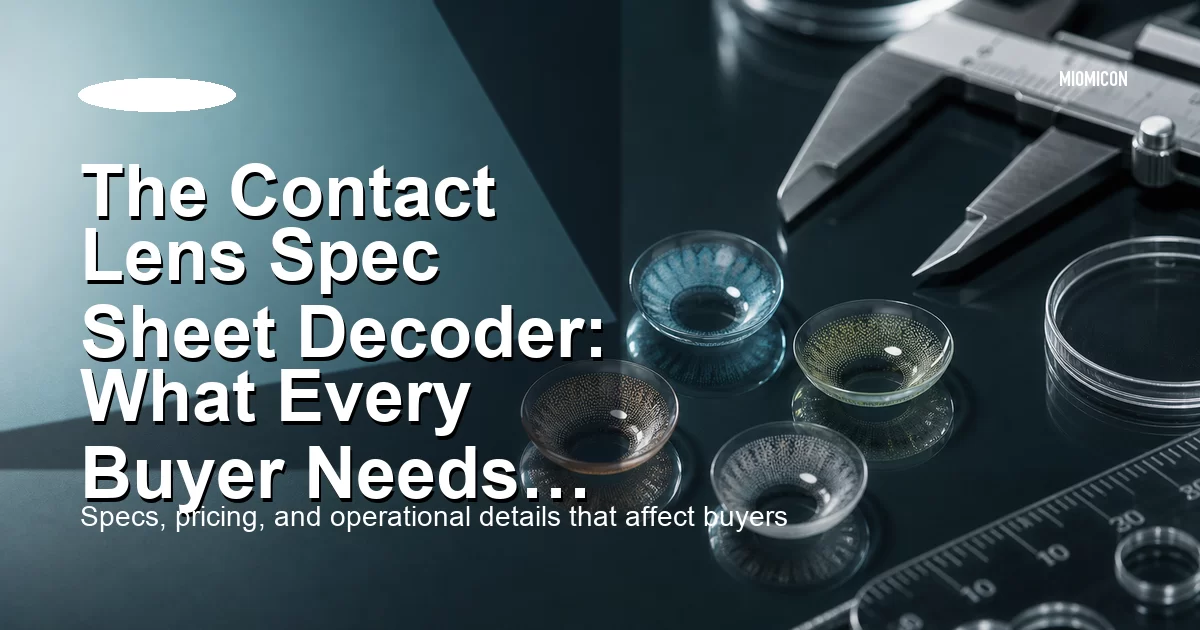
If you've ever received a product specification sheet from a contact lens manufacturer and felt like you were reading a foreign language, you're not alone.
Diameter. Base curve. Water content. DK/t values. Modulus. These numbers sit on every spec sheet, and most buyers glance at them, nod politely, and move on to the price column.
That's a mistake.
Because those numbers are the difference between a product that your customers reorder and one that generates complaints, returns, and a damaged brand reputation.
I've been in this industry long enough to know that the buyers who win aren't the ones who chase the lowest unit cost. They're the ones who understand what they're buying.
So let's decode the spec sheet — in plain English, without the marketing fluff.
Diameter: It's Not Just About Size
Diameter (DIA) measures the total width of the lens from edge to edge. The typical range for soft contact lenses is 13.8mm to 14.5mm.
Here's what matters in practice:
A larger diameter doesn't automatically mean better coverage. If the diameter is too large for your target market's average corneal size, the lens edge can lift, causing discomfort and reduced oxygen flow. Too small, and the lens moves excessively with every blink.
For cosmetic and color contact lenses — which is where most overseas brands focus — the GIA (Graphic Inner Area) and the overall pattern diameter matter just as much as the lens diameter itself. A 14.2mm lens with a well-designed graphic area can create a more natural enlargement effect than a 14.5mm lens with poor pattern placement.
Practical takeaway: When you're evaluating a supplier's color contact line, ask to see the actual graphic diameter, not just the lens diameter. It's the graphic area that determines how the lens looks on the eye.
Base Curve: The Fit That Keeps Customers Coming Back
Base curve (BC) is the curvature of the back surface of the lens, measured in millimeters. Common values range from 8.3mm to 8.9mm.
Think of it like shoe sizing for eyes. Get it wrong, and nothing else matters.
A base curve that's too flat (larger number) means the lens sits loosely on the cornea. It slides around, blurs vision, and can even pop out during sports or windy conditions. A base curve that's too steep (smaller number) means the lens grips too tightly, restricting tear exchange and oxygen flow — which leads to dryness, redness, and eventually, your customer stops wearing your product.
Most Asian markets (Japan, Korea, Southeast Asia) tend to do well with 8.6mm base curves. European and North American markets often prefer 8.6mm to 8.7mm, with some variation.
Practical takeaway: If you're launching in multiple markets, consider offering two base curve options. It's a small SKU addition that dramatically reduces fit-related complaints. Ask your manufacturer if they can produce the same lens design in both 8.6mm and 8.7mm — most established factories can.
Water Content: The Comfort Paradox
Water content (WC) is expressed as a percentage — typically 38% to 58% for conventional hydrogel lenses, and lower (24-36%) for silicone hydrogel.
The intuitive assumption: higher water content equals more comfort.
The reality is more nuanced.
High-water-content lenses (50%+) feel soft and comfortable initially. But they also draw moisture from the tear film to maintain their hydration. In dry climates, air-conditioned offices, or for people who stare at screens all day (so, most of your customers), a high-WC lens can actually make eyes feel drier over a long wearing day.
Low-water-content lenses hold their shape better and tend to perform more consistently in varied environments. They're also generally more durable for monthly or annual replacement lenses.
Silicone hydrogel lenses, which are becoming the industry standard in mature markets, operate at lower water content but deliver far superior oxygen transmission through the silicone material itself rather than through water.
Practical takeaway: Match water content to your market's climate and wearing habits. For Southeast Asia's humid climate, standard hydrogel at 38-42% works well. For Middle Eastern dry heat, consider lower WC or silicone hydrogel. For European daily disposables, the trend is shifting toward silicone hydrogel regardless of water content.
DK/t: The Oxygen Number Nobody Checks (But Should)
DK/t measures oxygen transmissibility — how much oxygen reaches the cornea through the lens. DK is the material's oxygen permeability; t is the lens thickness at its center.
The cornea has no blood supply. It breathes oxygen directly from the air. A contact lens sits between the cornea and the atmosphere. If that lens blocks too much oxygen, the cornea starves.
The FDA's general benchmark for daily wear is a DK/t of at least 24. For extended (overnight) wear, the benchmark jumps to 87.
Conventional hydrogel lenses typically achieve DK/t values of 20-35. Silicone hydrogel lenses range from 60 to 175+.
Practical takeaway: If you're selling in regulated markets (EU, US, Australia), your product must meet minimum oxygen transmissibility standards. Make sure your manufacturer provides actual DK/t test reports, not just material claims. This is especially important for color contact lenses, where the pigment layer can reduce oxygen flow. Ask: "Can you provide the DK/t test certificate for this specific lens design, including the colored version?"
Modulus: The Stiffness Factor
Modulus measures the stiffness or rigidity of the lens material, typically in megapascals (MPa).
Higher modulus = stiffer lens. Lower modulus = softer, more flexible lens.
Why does this matter?
Stiffer lenses (higher modulus) are easier to handle — they hold their shape on the finger and are simpler to insert and remove. They also tend to be more durable during manufacturing and shipping. But they can feel "present" on the eye, especially for first-time wearers.
Softer lenses (lower modulus) feel more natural once on the eye, but they can be trickier to handle and more prone to tearing during production and packaging.
Silicone hydrogel materials naturally have higher modulus than conventional hydrogel. Modern formulations have addressed this to some extent, but it's still a factor in lens design.
Practical takeaway: For markets with experienced contact lens wearers (North America, Western Europe, Korea), slightly higher modulus lenses are generally well-received. For emerging markets where many customers are first-time or occasional wearers, prioritize comfort with lower modulus materials.
Center Thickness: Thin Is Not Always Better
Center thickness (CT) is measured at the thinnest point of the lens, usually expressed in millimeters. Typical range: 0.03mm to 0.10mm.
The marketing message is always "thinner is better." Thinner means more oxygen, more comfort, more invisibility.
In practice, lenses that are too thin are fragile. They tear during handling, fold during insertion, and are more difficult to manufacture consistently. For color contact lenses specifically, a certain minimum thickness is needed to properly embed the pigment layer using sandwich technology.
Practical takeaway: Don't chase the thinnest number. Ask your manufacturer what their standard center thickness is for each product category and why. A consistent 0.06mm from a factory that controls its process well is far better than a spec sheet claiming 0.03mm from a factory that can't hold tolerances.
The Spec Sheet Questions You Should Be Asking
When a supplier sends you their product specification sheet, here are the questions that separate serious buyers from the rest:
**Are these values for the clear version or the colored version?** Pigment layers change oxygen transmission and sometimes thickness.
**What are the tolerance ranges?** A base curve of 8.6mm ± 0.2mm is a very different product than 8.6mm ± 0.05mm.
**Can you provide test certificates?** DK/t, water content, and dimensional accuracy should all have lab test documentation.
**What's the lens material?** Etafilcon, Senofilcon, Polymacon, HEMA-based — the material determines performance characteristics and regulatory pathway.
**How do these specs compare to your best-selling line in my target market?** A good manufacturer will have market-specific recommendations based on real sales data.
Why This Matters for Your Brand
Every spec number on that sheet translates directly to customer experience.
Wrong fit → complaints and returns.
Poor oxygen transmission → health concerns and liability.
Inconsistent dimensions → quality control failures and lost trust.
Mismatched water content → uncomfortable wearing experience and no repeat purchases.
Your customers don't read spec sheets. They just know whether the lens feels good or not. If it feels good, they buy again. If it doesn't, they buy from someone else — and they don't tell you why.
The brands that succeed in the contact lens space are the ones that invest in understanding these numbers before they invest in inventory.
Moving Forward
If you're evaluating manufacturers or considering an OEM partnership, don't settle for a glossy brochure with pretty numbers. Ask for the test reports. Ask for samples. Ask for the tolerance data. Ask what they'd recommend for your specific market and why.
A manufacturer that welcomes these questions is one worth partnering with. One that deflects or gives vague answers is one you should walk away from.
At MIOMI, we've built our reputation on transparency. Every spec we publish is backed by lab testing. Every sample we ship matches the production specification. And every conversation we have with a potential partner starts with understanding their market — not just pushing our catalog.
Because the best business relationships are built on the same principle as a well-fitted lens: get the fundamentals right, and everything else follows naturally.
Looking to launch or expand your contact lens brand? Reach out to our team at sales@miomicon.com — we'll help you choose the right specifications for your market, not just the ones that look good on paper.