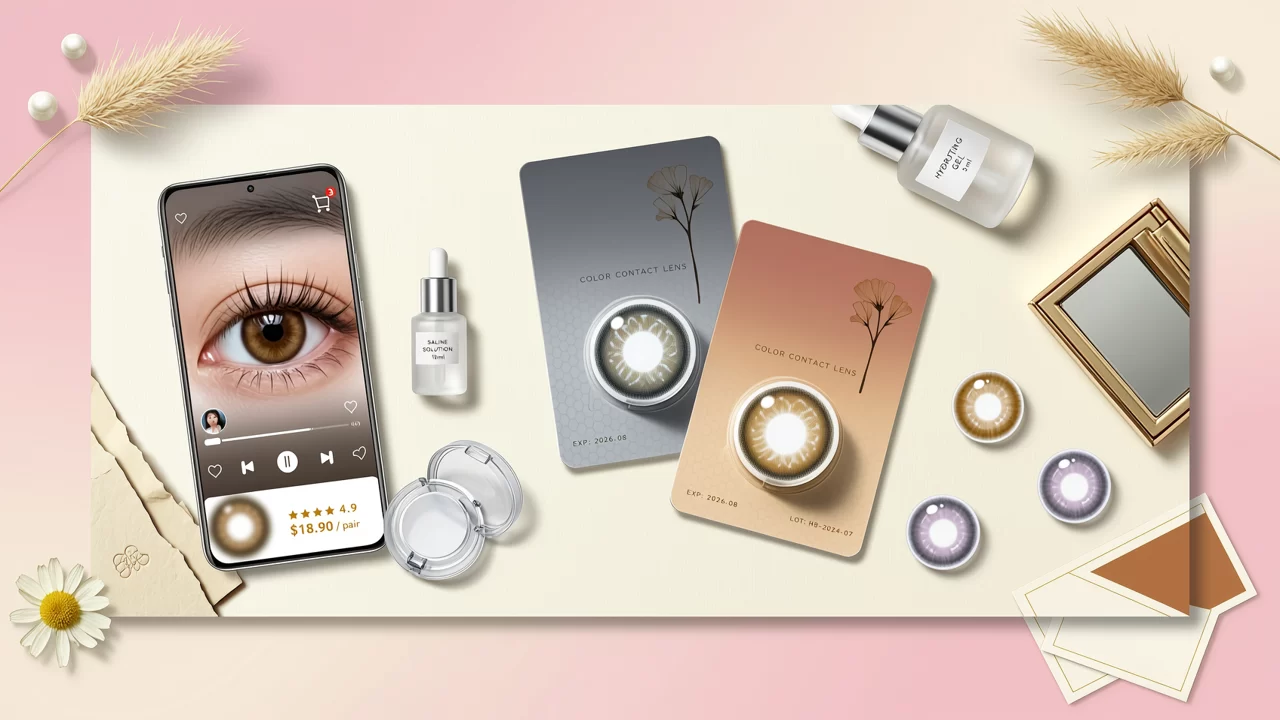
A few years ago, colored contact lenses were something you found at an optician’s counter or a costume shop. Today, a teenager in Jakarta can watch a creator try on a honey-brown shade, tap the product tag in the video, and have a pair delivered within days — all without leaving TikTok.
That shift is not a gimmick. Social commerce has become the fastest-growing sales channel in the beauty and personal care space, and colored contact lenses sit right at the center of it. They are visual, affordable, and made for transformation content — the exact combination that performs on short-video platforms.
This playbook is written for wholesalers and new brands: how to win on social commerce, how to stay compliant, and how a flexible OEM/ODM manufacturing partner helps you move fast without betting the company on one big order.
Why Social Commerce Fits Colored Contacts Perfectly
Colored contacts have a rare advantage: the product sells itself visually. No long explanations, no spec sheets needed. One before/after clip does the job better than any banner ad.
Three forces make this category a natural fit for social-first selling:
- The try-on effect. A creator switching from bare brown eyes to a grey or hazel lens is instant, dramatic content. Viewers see the result in under three seconds, which is all the time you get.
- Low price, high repeat. Most cosmetic lenses fall into an affordable impulse-buy range, typically between $10 and $40 per pair at retail, depending on the brand and market. That is exactly the sweet spot for social checkout.
- Identity and style. Younger buyers treat lenses like makeup or jewelry — part of a look, not a medical necessity. That mindset means they discover and buy products the same way they do for cosmetics: through creators, trends, and community.
The numbers back this up. In Southeast Asia alone, social commerce GMV has been growing at a pace that dwarfs traditional e-commerce, and the beauty category — where colored lenses often live in marketplace taxonomy — is consistently one of the top performers.
The Platform Landscape: Where the Sales Actually Happen
Different markets live on different platforms. Here is where to focus.
TikTok Shop
TikTok Shop is the engine room of social commerce for this category. It works in the US, the UK, and — most importantly for lenses — Southeast Asia: Indonesia, Thailand, Vietnam, Malaysia, and the Philippines all have enormous TikTok Shop ecosystems.
What works here:
- Live selling. Sellers running daily lives, trying on multiple shades and answering questions in real time, routinely outperform static product pages. Live viewers ask about comfort, diameter, and whether a shade suits darker eyes — questions that, once answered publicly, convert the whole audience.
- Short video with product links. Try-on transitions, “which color fits your outfit” polls, and creator duets.
- The affiliate model. Instead of paying creators upfront, brands offer a commission on every sale. This is ideal for new brands with limited budgets: hundreds of small creators can test your product with zero risk on either side.
One caution: TikTok restricts certain health-related products, and contact lenses are frequently classified as medical devices on the platform. Some markets require seller authorization or category approval before listing. Verify the current category rules for each market before you build a strategy around them.
Instagram is no longer the checkout powerhouse it once tried to be, but it remains essential for brand-building. This is where your aesthetic, your shade library, and your social proof live. Reels drive discovery; Stories with polls (“grey or green for summer?”) drive engagement; and DMs still close a surprising number of B2B and wholesale conversations. For lens brands, Instagram is the portfolio. TikTok is the cash register.
Regional Marketplaces: Shopee and Lazada
In Southeast Asia, TikTok Shop is only half the story. Shopee and Lazada dominate everyday e-commerce, and most serious lens sellers run all three in parallel. Shopee in particular has strong social features — live streams, feeds, and coins — that blur the line between marketplace and social platform. If you are entering Indonesia or Thailand, treat Shopee as a first-class channel, not a backup.
Middle East: Snapchat, TikTok, and Instagram
The Gulf markets (Saudi Arabia, the UAE, Kuwait, Qatar) are high-value for colored lenses — some of the highest per-capita demand in the world. Snapchat is unusually powerful here for beauty commerce, alongside TikTok and Instagram. Arabic-language creator content massively outperforms translated English content, so localization is not optional.
Content Formats That Actually Convert
Not all content sells. These are the formats that consistently move product:
- Try-on videos. The single most important format. One eye with the lens, one without — or a clean before/after cut. Film in natural daylight; ring lights wash out subtle shade differences.
- Shade comparisons on different eye colors. “Same lens on dark brown vs. light brown eyes” is gold, because the #1 buyer objection is “will this show up on my dark eyes?” Answer it before it is asked.
- Before/after transformation cuts. Full-face transitions tied to trending audio. These are your reach engine — the content that gets shared.
- Comfort and wear-test content. A creator wearing the lenses for 8–12 hours and reporting honestly builds trust that pure beauty content cannot. Pair this with care instructions.
- Creator partnerships over celebrity endorsements. Mid-tier creators (10k–200k followers) in the beauty and cosplay niches deliver better ROI than big names. Their audiences trust them, their rates are sane, and you can work with ten of them for the cost of one macro-influencer. Use affiliate or commission structures where possible.
- UGC repurposing. With permission, turn creator content into your ad creative. Real faces outperform studio shots for this category every time.
Compliance: The Do’s and Don’ts
This is where social commerce gets serious. Colored contact lenses are regulated as medical devices in most major markets — even plano (zero-power) cosmetic ones. Getting this wrong means takedowns, fines, or platform bans.
Do:
- Treat lenses as medical devices in every compliance decision, regardless of whether they correct vision.
- Verify your products carry the right certifications for each target market (CE marking for the EU, FDA clearance for the US). Ask any manufacturer you work with for documentation before you sign anything.
- Include clear usage and care guidance in your content. “Wash hands before handling,” “replace as directed,” “consult an eye-care professional if you experience discomfort” — these lines protect your customers and your brand.
- Enforce age restrictions. Most markets require buyers to be adults or to have parental consent, and platforms increasingly enforce this on health-related categories.
- Sell through licensed channels where local law requires prescriptions or registered sellers.
Don’t:
- Don’t make medical claims. No “safe for sensitive eyes,” no “prevents dryness,” no “oxygen-permeable so you can sleep in them” unless you have cleared, documented evidence for that specific claim in that specific market.
- Don’t imply lenses are risk-free or as casual as makeup. Regulators in the US, EU, and across Asia have repeatedly acted against sellers who market cosmetic lenses with no safety information.
- Don’t let creators improvise safety messaging. Give them approved talking points. One viral video with a false claim becomes your brand’s problem.
- Don’t target minors with ads, even where the product is technically legal to sell.
How Wholesalers Can Arm Their Retail Partners
If you are a wholesaler or distributor, social commerce changes your job description. Your retail customers — the boutique brands, the marketplace sellers, the Instagram shops — are only as good as their content. Helping them create it is the highest-leverage thing you can do for sell-through.
Practical ways to support partners:
- Provide a content asset library: professional product shots, macro images of lens patterns, model wear photos across multiple skin tones and eye colors, and ready-to-edit video clips.
- Create compliance-safe copy templates: product descriptions, claim language, and care instructions that partners can adapt without accidentally crossing a regulatory line.
- Share what’s working: if try-on lives are converting in Thailand, tell your other partners. A distributor that shares market intelligence earns loyalty that price discounts can’t buy.
- Offer white-label content: unbranded footage that small brands can overlay their own logo on. Many new sellers cannot afford shoots; handing them a content starter kit removes their biggest barrier.
- Sample smartly: send creators and small sellers sample kits with your best-performing shades, not your full catalog. Focus drives sales.
How OEM/ODM Manufacturing Enables Social-First Brands
The old model of launching a lens brand — order 10,000 pairs of one design, wait three months, hope it sells — is the opposite of what social commerce needs. Social-first brands test, iterate, and scale in weeks, not quarters.
This is what to look for in a manufacturing partner, and what we built at MIOMI:
- Low MOQ. A new brand testing TikTok should be able to launch with a modest first order — enough to validate a design and a market without tying up capital. Low minimums let you test five designs instead of committing to one.
- Fast custom lead times. Trends on TikTok live for weeks, not months. An OEM partner that can turn a custom design around in roughly 20 days means you can ride a trend instead of arriving after it died.
- Built-in compliance. CE and FDA compliance at the factory level means your product is sellable in regulated markets from day one. Do not launch first and paper later — platforms and regulators both punish that order of operations.
- Design support. Many new founders have an audience but no product development experience. A partner that helps with pattern design, color matching, and packaging turns an idea into a shippable SKU.
The economics work for both sides: small first orders, fast reorders on what sells. That is the rhythm social commerce runs on.
Common Mistakes to Avoid
- Buying followers instead of building content. A 50k account with dead followers sells nothing.
- Ignoring marketplace rules until the listing gets taken down. Category approvals for lenses vary by platform and country; check before listing.
- One-size-fits-all content across markets. The shade that went viral in Manila may not suit Gulf preferences, and the humor that works in Jakarta does not translate to Riyadh. Localize creators, not just captions.
- Overpromising in ad copy. “100% comfortable,” “looks exactly natural on everyone” — absolutes invite complaints, refunds, and regulator attention.
- No reorder plan. When a video blows up, stock sells out in days. Have a manufacturing partner who can move fast, or the competitor reorders and you don’t.
- Skipping aftercare content. Repeat purchases depend on comfortable first experiences. Teach buyers how to wear and store lenses properly.
Your Launch Checklist
Before you publish your first product video, run through this:
- Target market chosen; local regulations for cosmetic lens sales verified
- Product certifications confirmed for that market (CE / FDA / local)
- Platform account set up with any required health-category approvals
- 10+ pieces of content filmed: try-ons, shade comparisons, wear tests
- 5–10 creator partnerships lined up, with approved compliance talking points
- Pricing set in a competitive range with margin left for affiliate commissions
- Stock plan confirmed with your manufacturer, including reorder lead time
- Aftercare instructions prepared for packaging and post-purchase messaging
- Review and complaint process ready — respond publicly and fast
The Bottom Line
Social commerce has turned colored contact lenses from a niche accessory into a fast-moving consumer category, and the winners are not the brands with the biggest budgets. They are the ones with the best content, the fastest iteration, and a supply chain that can keep up.
Pick one market, build for one platform, and start filming. Your first ten videos will teach you more than any market report.
If you are planning a colored lens brand or expanding your wholesale line, MIOMI supports social-first launches with low MOQs, custom designs delivered in about 20 days, and CE/FDA-compliant manufacturing. Reach out through our contact page to talk through your first run.