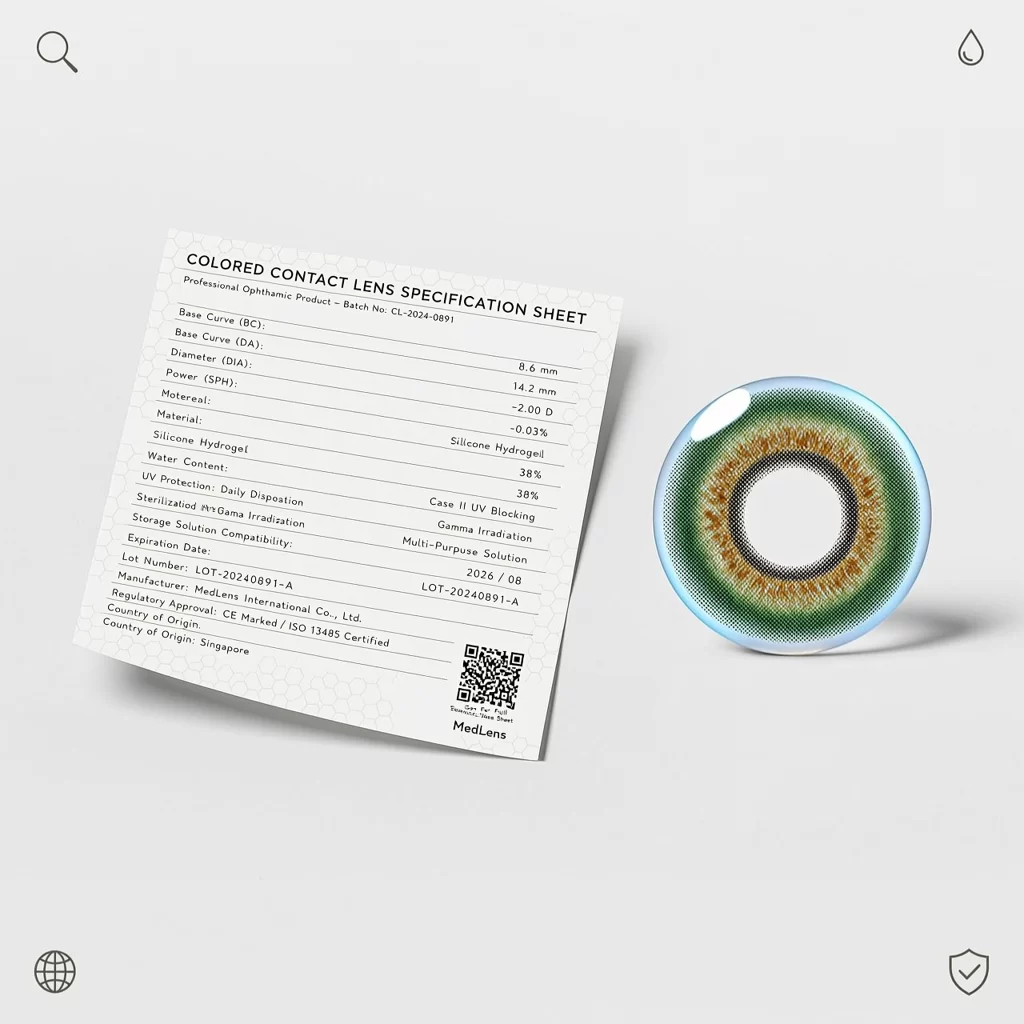
If you’ve ever received a product spec sheet from a contact lens manufacturer and felt like you were reading a foreign language, you’re not alone. I’ve sat across from brand owners — people launching their first colored lens line — stare at a table full of numbers and acronyms, completely lost.
The thing is, understanding those specs isn’t optional. It’s the difference between launching a product your customers love and launching one that generates complaints, returns, and a damaged reputation.
Here’s what every B2B buyer needs to know before signing off on a purchase order.
The Specs That Actually Matter
Let’s walk through a typical spec sheet line by line. I’ll skip the obvious ones (product name, packaging details) and focus on the parameters that directly affect quality, comfort, and marketability.
1. Material: Hydrogel vs. Silicone Hydrogel
This is the single most important decision you’ll make, and it shapes everything downstream — pricing, positioning, target market, even your marketing claims.
Hydrogel (typically HEMA-based) has been the standard for decades. It’s affordable, widely understood by consumers, and works well for daily disposable colored lenses. Water content usually ranges from 38% to 55%.
Silicone hydrogel offers significantly higher oxygen permeability (Dk/t), which matters a lot for lenses worn 8+ hours daily. It’s more expensive, but if your target market includes health-conscious consumers or people in dry climates, it’s worth the premium.
What to ask your supplier: What’s the exact material composition? Is it a proprietary blend? Can you provide the Dk/t value, not just the water content?
2. Diameter (DIA)
Standard colored lens diameters range from 14.0mm to 14.5mm. Some fashion-forward markets prefer 14.5mm or even 15.0mm for a more dramatic eye-enlarging effect — this is especially popular in East and Southeast Asia.
For Western markets, 14.0–14.2mm tends to be the sweet spot. Anything larger can look unnatural on smaller eye shapes and may cause fit issues.
What to ask your supplier: Do you offer multiple diameter options? Can I get samples in different sizes for fit testing?
3. Base Curve (BC)
Base curve determines how the lens sits on the cornea. The industry standard is 8.6mm or 8.8mm. Most manufacturers produce at one of these two values.
If you’re selling in markets where consumers have access to eye care professionals, this matters less — they’ll be fitted properly. But in markets where colored lenses are bought over-the-counter or online without a fitting, sticking to 8.6–8.8mm is the safe choice. Going outside this range without clinical data is a liability risk.
4. Water Content
Here’s where a lot of buyers get confused. Higher water content doesn’t automatically mean “better.” It means the lens feels softer initially, but high-water lenses (above 55%) can actually draw moisture from the eye over time, causing dryness.
For daily disposables, 38–42% water content is often the most comfortable for extended wear. For fashion lenses worn 4–6 hours, 45–55% is fine.
Red flag: If a supplier only tells you “high water content” without a specific number, they may not have tight quality control.
5. Center Thickness
Typically 0.05–0.08mm at -3.00D. Thinner lenses are more comfortable but harder to handle. Thicker lenses are easier to insert but may feel more noticeable.
This is less critical for colored daily disposables (most consumers won’t notice the difference), but it matters if you’re positioning as a premium comfort brand.
6. Oxygen Permeability (Dk/t)
This is the number that eye care professionals care about most. Higher Dk/t means more oxygen reaches the cornea. For reference:
- Standard hydrogel: Dk/t around 20–30
- Silicone hydrogel: Dk/t around 80–150+
If your marketing claims include “all-day comfort” or “breathable,” you need the Dk/t numbers to back it up. Don’t just say “high oxygen” — show the data.
7. Pigment Technology
For colored lenses, this is critical. The industry uses two main approaches:
- Sandwich (encapsulated) pigment: The color layer is sealed between two clear layers. Pigment never touches the eye. This is the gold standard for safety.
- Surface-printed pigment: Color is applied to the lens surface. Cheaper to produce, but higher risk of pigment transfer.
What to ask: Is your pigment encapsulated? Can you provide a safety test report? This is non-negotiable for CE and FDA compliance.
Certifications: The Fine Print That Protects Your Business
Every spec sheet should reference the certifications the product holds. Here’s what matters by market:
| Market | Required Certification | Notes |
|---|---|---|
| European Union | CE (MDR) | Under EU Medical Device Regulation 2017/745 |
| United States | FDA 510(k) | Colored lenses are Class II medical devices |
| South Korea | KFDA (MFDS) | Required for domestic sale |
| Southeast Asia | Varies by country | Some accept CE, others require local registration |
| Middle East | Varies | UAE and Saudi Arabia increasingly require local registration |
A word of caution: Some suppliers will show you a CE certificate that covers clear lenses but not colored lenses. Always verify that the specific product you’re buying is covered by the certificate, not just the product category.
How to Use This Information in Your Buying Decision
Once you understand the specs, you can make smarter comparisons between suppliers. Here’s a practical framework:
- Define your target market first. Are you selling to fashion-conscious Gen Z in Indonesia, or to professional women in Germany? The answer determines your ideal spec combination.
- Set your spec requirements before requesting quotes. Don’t let suppliers pitch you whatever they have in stock. Tell them what you need: “I need a 14.2mm, 42% water content, sandwich-pigment daily disposable with CE certification.”
- Request samples for fit and comfort testing. No spec sheet replaces actual wear testing. Get at least 3–5 pairs and have real people wear them for a full day.
- Compare total cost, not unit price. A lens with better specs might cost $0.15 more per pair but save you from returns, complaints, and brand damage. Do the math over 12 months.
- Ask for the full technical file. A reliable supplier won’t hesitate to share complete specs, test reports, and certification documents. If they’re evasive, that’s your answer.
The Bottom Line
A spec sheet isn’t just a list of numbers — it’s a promise. It tells you what the product is, how it performs, and whether it’s safe for your customers. Learning to read it properly is one of the most valuable skills you can develop as a brand owner in this industry.
Don’t be afraid to ask questions. Don’t be afraid to push back. The suppliers who respect your curiosity are the ones worth working with long-term.
At MIOMI Optical, we provide full technical documentation with every OEM/ODM project — including material specs, Dk/t data, pigment safety reports, and market-specific certification support. If you’re launching a colored contact lens brand and want a manufacturing partner who’s transparent about specs, let’s talk.