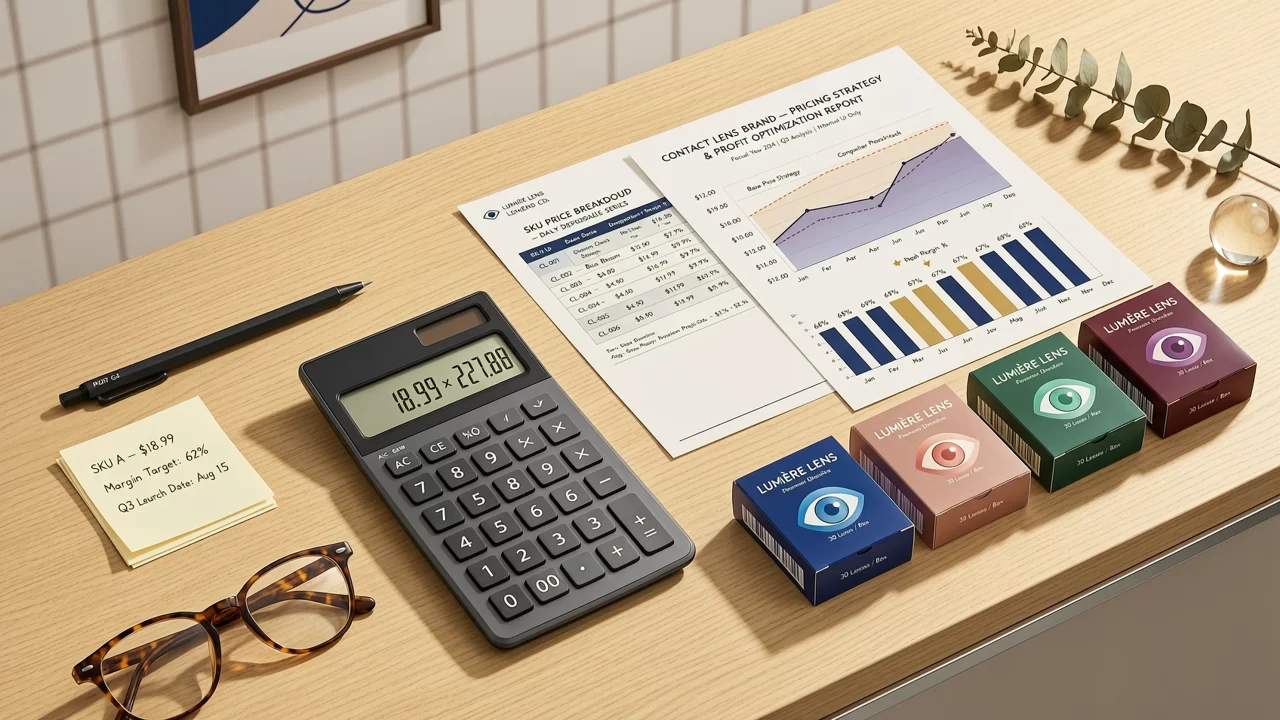
Pricing is where most new contact lens brands either leave money on the table or price themselves out of the market. I’ve watched brand owners spend months perfecting their lens designs, packaging, and marketing—only to slap on a price that doesn’t make sense.
If you’re launching a private label contact lens line, here’s what you need to know about pricing strategy in 2026.
The Three Costs You Can’t Ignore
Before you think about margins, you need to understand your actual landed cost per unit. Most brand owners I work with miss at least one of these:
1. Manufacturing cost per pair
This is obvious—you’re paying your OEM supplier per pair or per box. But watch out for tiered pricing. Ordering 5,000 pairs might cost you $1.80/pair, while 20,000 pairs drops to $1.20/pair. Your unit cost changes dramatically based on volume.
2. Packaging and labeling
Custom boxes, blister packs, instruction inserts, and regulatory labels add up. I’ve seen brands spend $0.40-$0.80 per box on packaging alone. That’s real money when you’re selling boxes for $8-$15 retail.
3. Shipping, duties, and compliance
Don’t forget freight costs, import duties (which vary wildly by country), and certification fees amortized across your units. FDA registration, CE marking, or local regulatory approvals aren’t free—they need to be factored into your per-unit cost.
Here’s a real example: A brand owner in Southeast Asia was manufacturing colored lenses at $1.50/pair. After packaging ($0.60/box), shipping ($0.30/box), duties ($0.20/box), and compliance amortization ($0.15/box), their true landed cost was $2.75/box—not the $1.50 they thought.
Pricing Models That Actually Work
Once you know your real cost, you have three main pricing strategies:
Cost-Plus Pricing (The Safe Route)
You calculate your total cost and add a fixed margin—usually 40-60% for wholesale, 200-400% for retail.
Pros: Predictable, easy to explain to distributors.
Cons: Ignores what customers will actually pay. You might be leaving 30% margin on the table.
Best for: B2B wholesale where you’re selling to distributors who need clear pricing logic.
Value-Based Pricing (The Smart Route)
You price based on what the market perceives as fair value for your brand positioning.
If you’re positioning as a premium natural-look colored lens brand, you can charge $12-$18/box retail even if your cost is $3. If you’re going for volume in price-sensitive markets, maybe $6-$8/box is the sweet spot.
Pros: Maximizes margin when done right.
Cons: Requires market research and brand investment to justify premium pricing.
Best for: DTC brands with strong marketing and clear positioning.
Competitive Pricing (The Realistic Route)
You look at what similar brands charge and position yourself slightly above, below, or at parity.
In Southeast Asia, mid-tier colored lenses retail for $8-$12/box. In Europe, similar quality goes for €12-€18. In the Middle East, $10-$15 is common.
Pros: Reduces price resistance—customers already accept that price range.
Cons: You’re following, not leading. Harder to differentiate.
Best for: New brands entering crowded markets where price sensitivity is high.
The Regional Pricing Trap
Here’s where most brand owners mess up: they use one global price.
Your cost structure is the same whether you’re selling to Thailand or Germany. But customer willingness to pay is completely different.
Southeast Asia: Price-sensitive market. Retail sweet spot is $6-$10/box for monthly lenses. Distributors expect 30-40% margin.
Middle East: Willing to pay for premium positioning. Retail $10-$16/box works if your branding and packaging look premium.
Europe: Regulatory compliance costs more (CE marking, local language packaging), but customers pay €12-€20/box for quality colored lenses.
North America: FDA compliance is expensive, but the market supports $15-$25/box retail for premium brands.
If you’re selling the same lens for $12 everywhere, you’re either overpriced for Southeast Asia or underpriced for Europe.
Wholesale vs. Retail Pricing
If you’re selling B2B wholesale, your pricing math is different:
Wholesale pricing formula:
- Your cost: $2.75/box (from the example above)
- Distributor margin: 35% (they need to make money too)
- Your wholesale price: $4.23/box
- Your margin: $1.48/box (35% gross margin)
Retail pricing formula (if you sell DTC):
- Your cost: $2.75/box
- Target retail margin: 70-75%
- Retail price: $9.17-$11/box
- Your margin: $6.42-$8.25/box (70-75% gross margin)
See the difference? Wholesale gives you volume but lower margins. Retail gives you higher margins but requires marketing investment and customer acquisition costs.
Most successful brands do both—wholesale to build market presence and cash flow, retail to maximize margin on loyal customers.
The MOQ Pricing Lever
Your minimum order quantity is a pricing tool, not just a production constraint.
If you offer 500-box MOQ at $4.50/box wholesale, but 5,000-box MOQ at $3.80/box, you’re incentivizing larger orders without explicitly discounting.
Smart brand owners use tiered pricing to encourage volume:
- 500-1,999 boxes: $4.50/box
- 2,000-4,999 boxes: $4.10/box
- 5,000+ boxes: $3.80/box
Your cost per unit drops as volume increases (better manufacturing efficiency, lower shipping cost per unit), so you can afford to offer these tiers while maintaining healthy margins.
Common Pricing Mistakes I See
1. Pricing too low to “get started”
You think you need to be the cheapest option. But if your price is $5/box retail and competitors are at $10, customers assume your quality is worse. Cheap pricing attracts price-sensitive customers who’ll leave you the moment someone undercuts you.
2. Ignoring currency fluctuations
If you’re manufacturing in RMB and selling in USD, a 5% currency swing can wipe out your margin. Build in a 5-10% buffer or use forward contracts to lock in rates.
3. Forgetting about promotions and discounts
Black Friday, Ramadan sales, Singles’ Day—your customers expect discounts. If your regular price is $12/box, you need margin to offer 20% off during promotions. Price at $14-15 regular, discount to $11-12 during sales.
4. Not adjusting for inflation
Your costs went up 8% this year. Did you raise prices? If not, you’re slowly bleeding margin. Annual price reviews are non-negotiable.
How to Test Your Pricing
Don’t guess—test.
A/B test retail prices: Run the same product at $9.99 vs. $11.99 for 30 days. Track conversion rates and total profit (not just revenue). Sometimes the higher price converts fewer units but generates more total profit.
Test wholesale tiers: Offer different pricing to different distributor segments. See where the sweet spot is between volume and margin.
Monitor competitor pricing: Use tools or manual checks to track what similar brands charge. You don’t have to match them, but you need to understand your position.
Ask customers directly: If you have a sales team or distributor network, ask them: “Is the price a barrier? What would you expect to pay?”
The Bottom Line
Pricing isn’t just about covering costs—it’s about positioning your brand, incentivizing the right customer behavior, and building a sustainable business.
Start with your real landed cost. Understand your target market’s willingness to pay. Choose a pricing model that fits your brand strategy. Test and adjust.
And remember: you can always raise prices if you start too low. But lowering prices after positioning as premium? That’s a much harder conversation.
Looking to launch your own private label contact lens line? MIOMI Optical offers OEM/ODM customization with low MOQ starting from 500 pairs. Get in touch to discuss your project.