If you’re launching your own contact lens brand, pricing is probably keeping you up at night. Price too high and nobody buys. Price too low and you’re bleeding money on every box sold. Get it wrong, and you’ll spend months figuring out why your beautiful brand isn’t converting.
Here’s the thing most guides won’t tell you: pricing isn’t about your costs. It’s about positioning. And in the colored contact lens market, positioning is everything.
Let me walk you through how we’ve helped dozens of brand owners set their pricing — and the mistakes we see them make over and over.
Start With Your Market, Not Your Factory Quote
Most new brand owners come to us with a factory quote in hand and start adding margins on top. That’s backwards.
Before you look at a single cost figure, you need to answer three questions:
- Who is your customer? A 22-year-old in Bangkok shopping on Shopee has a very different budget than a 35-year-old in Dubai buying from a premium optical boutique.
- What are comparable brands charging? Look at brands in your target market that have similar positioning. Not the cheapest ones. Not the luxury ones. The ones your customer actually considers.
- What does your customer expect to pay for the quality you’re offering? This is where research matters. Browse local e-commerce platforms, visit retail stores, talk to distributors.
Once you know the price range your market accepts, you work backwards to see if your costs allow a viable margin. If they don’t, you either need a different market, a different product spec, or a different supplier.
Understanding Your Landed Cost
Your factory quote is not your cost. I cannot stress this enough.
When we ship a custom OEM order to a brand owner in Southeast Asia, the actual landed cost includes:
- Manufacturing cost (the factory quote)
- Custom packaging and labeling
- Quality inspection and certification fees (CE, FDA, or local requirements)
- International shipping (air freight for small batches, sea freight for volume)
- Import duties and taxes in the destination country
- Warehousing and fulfillment costs
- Payment processing fees
For a typical colored contact lens order of 500 pairs with custom packaging, your landed cost might be 40-60% higher than the factory quote alone. Brand owners who forget this often price themselves into zero margin.
Here’s a real example: A brand owner in the Philippines ordered 1,000 pairs at $2.80 each from the factory. Simple math says cost is $2,800. But after shipping ($400), customs duties ($350), local warehousing ($150), and packaging inserts ($100), the real cost was $3,800 — or $3.80 per pair. If they’d priced at $6 based on the factory quote alone, they’d have been thrilled. At $6 retail with $3.80 actual cost, the margin was much tighter than expected.
The Three-Tier Pricing Framework
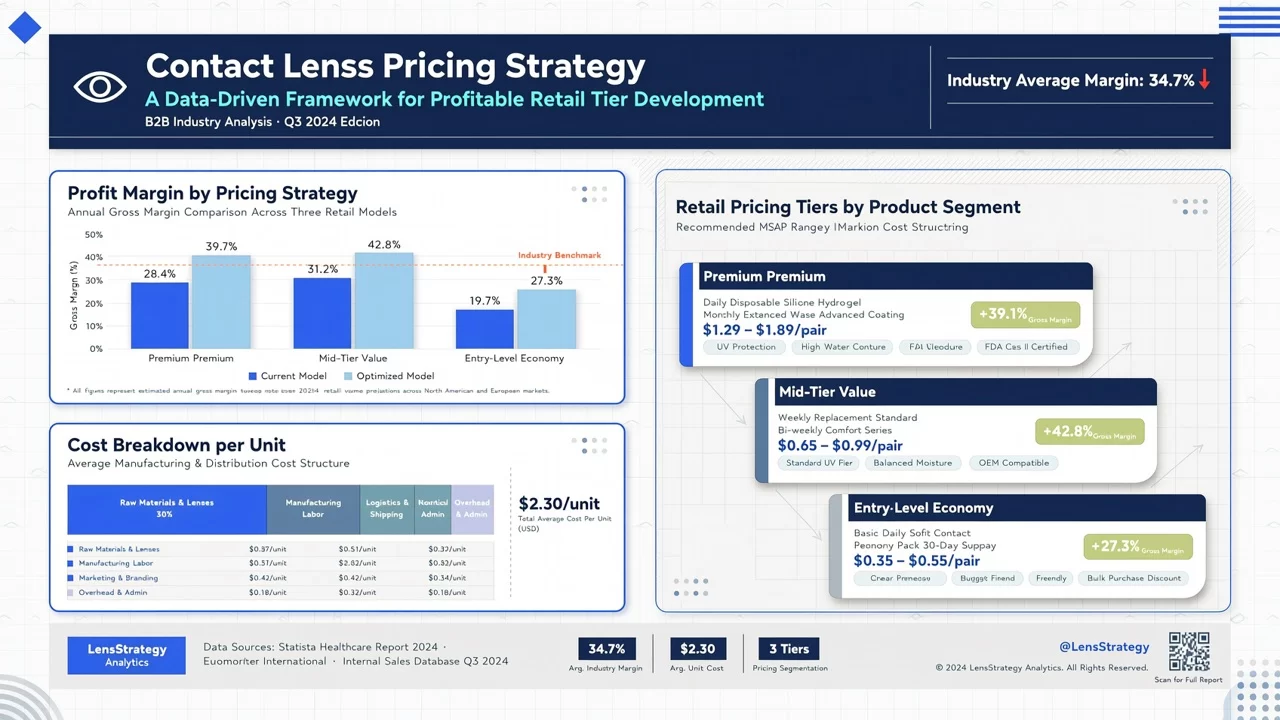
We recommend our B2B partners think about pricing in three tiers:
Entry Tier ($5-12 retail)
This is volume territory. Think daily deals on Shopee, Lazada, or AliExpress. Customers here are price-sensitive and will switch brands for a $1 difference. Your margin per unit is thin, but you’re building market presence and getting reviews. Product specs are standard: common diameters (14.0-14.2mm), popular colors, basic packaging.
Mid Tier ($15-35 retail)
This is where most successful new brands live. You’re offering something noticeably better — maybe it’s a unique color series, better comfort (higher water content, silicone hydrogel), or more premium packaging. Your customer cares about quality and brand story, not just price. Margins are healthy enough to reinvest in marketing.
Premium Tier ($40-80+ retail)
This requires serious brand equity. You’re selling an experience — luxury packaging, exclusive designs, maybe partnerships with influencers or optical professionals. The product specs are top-tier: latest materials, extended wear options, specialized designs. Margins are high, but customer acquisition costs are also high because you’re competing with established luxury brands.
Most of our OEM partners start in the mid tier. It gives you room to build a brand without fighting a race to the bottom.
Pricing for Different Sales Channels
Your channel strategy directly affects your pricing. Here’s what we’ve seen work:
E-commerce platforms (Shopee, Lazada, Amazon)
Platform fees eat 5-15% of your revenue. You need to price high enough to absorb these fees and still make money. But you’re also competing on price transparency — customers can compare you with competitors in seconds. Many brands create platform-specific SKUs with slightly different packaging or bundle sizes to avoid direct price comparison.
Your own website (Shopify, WooCommerce)
No platform fees, but you’re paying for traffic. If you’re running Facebook or Google ads, your customer acquisition cost might be $5-15 per sale depending on your market. Your pricing needs to cover this. The advantage? You control the brand experience completely.
Wholesale to retail stores
Retailers typically expect 40-60% margin. If your retail price is $25, the store buys from you at $10-15. Your cost needs to be $4-7 for this to work. Wholesale volume is higher per order, but you’ll need to support your retail partners with marketing materials, training, and display units.
Distributors
Distributors take a cut too, usually 15-30% on top of the retailer’s margin. If you’re going through a distributor in a new market, your pricing needs to accommodate the entire chain. This often means your factory cost needs to be quite low — which is where working directly with a manufacturer (rather than a trading company) makes a real difference.
The MOQ Effect on Your Unit Cost
Here’s something that catches many new brand owners off guard: your unit cost drops significantly as your order quantity increases. But the relationship isn’t linear.
At 100 pairs with fully custom packaging, you might pay $5-7 per pair because setup costs (printing plates, mold adjustments, design proofs) are spread across very few units. At 500 pairs, that drops to $3.50-4.50. At 2,000 pairs, you’re looking at $2.50-3.50. At 10,000 pairs, maybe $1.80-2.50.
This means your pricing strategy should evolve as you grow. Many successful brands start with a small batch to test the market, accept thinner margins initially, then reprice once they hit volume thresholds that bring costs down.
We’ve seen brand owners make two mistakes here:
- Ordering too much too soon, tying up cash in inventory before validating demand
- Staying at small quantities forever, never reaching the cost structure that makes the business profitable
The sweet spot for most new brands we work with is starting at 300-500 pairs, validating the market for 3-6 months, then scaling to 1,000-2,000 pairs once they know which SKUs sell.
Don’t Forget the Hidden Costs
Beyond landed cost, there are operational expenses that affect your real margin:
- Returns and replacements: Colored lenses have a 2-5% return rate depending on market. Budget for this.
- Marketing spend: Even organic social media takes time and content creation costs.
- Regulatory compliance renewal: Certifications need periodic renewal.
- Currency fluctuations: If you’re buying in USD and selling in local currency, exchange rate swings can eat your margin.
- Inventory write-offs: Trends change. Colors that are hot today might not sell in 12 months.
A good rule of thumb: add 10-15% to your calculated costs as a buffer for these hidden expenses.
A Quick Pricing Exercise
Here’s a framework we give our OEM partners. Fill in your numbers:
- Target retail price: $___
- Platform/channel fees (5-15%): $___
- Net revenue after fees: $___
- Factory cost per unit: $___
- Shipping + duties per unit: $___
- Packaging + inserts per unit: $___
- Marketing cost per sale: $___
- Total cost per unit (4+5+6+7): $___
- Gross margin per unit (3 minus 8): $___
- Margin percentage (9 divided by 3): ___%
If your margin percentage is below 40%, you probably can’t sustain the business long-term. If it’s above 60%, you might be pricing too high for your market. The sweet spot for most colored lens brands is 45-55% gross margin.
Final Thoughts
Pricing is not a one-time decision. It’s a conversation with your market. Start with a number that gives you room to operate, launch, gather data, and adjust.
The brand owners who succeed aren’t the ones who get pricing perfect on day one. They’re the ones who understand their costs, know their market, and are willing to adapt.
If you’re exploring a private label contact lens project and want to understand what the numbers look like for your specific situation, reach out to our team. We’ll walk you through the cost structure honestly — including what we think you should charge, not just what it costs us to make.
MIOMI Optical Ltd specializes in OEM/ODM colored contact lenses with low MOQ starting from 100 pairs. We serve brand owners across Southeast Asia, the Middle East, Europe, and North America. Contact us at sales@miomicon.com or WhatsApp +86 13862973905.