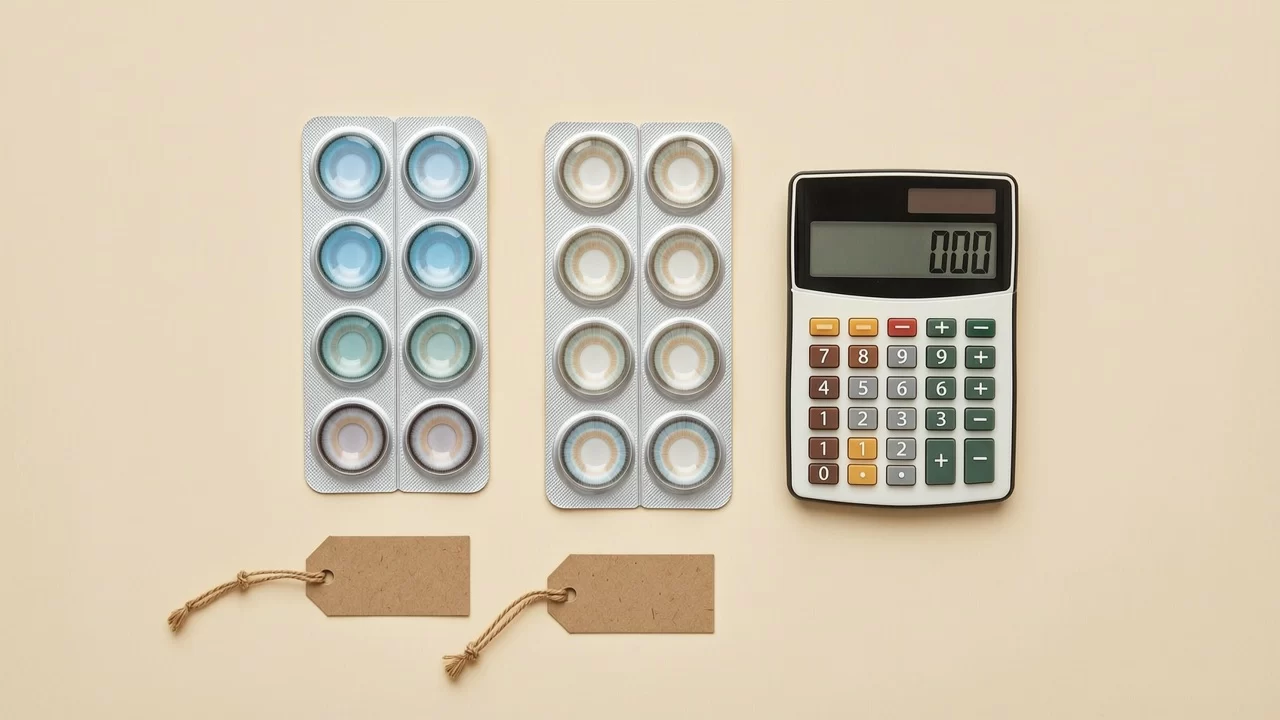
Every new colored contact lens brand asks the same question in its first month: what should our price be? It sounds like a simple math problem — cost of goods plus a margin. In practice, pricing is one of the most consequential positioning decisions a brand will make, because in the colored lens category, price is never read as just a number. Customers read it as a signal about safety, quality, and brand identity.
Price too low and buyers assume the product is unsafe. Price too high without the story to justify it and you simply get no first orders. Here is how experienced sellers actually think about colored contact lens pricing.
The psychology of the price point
Colored contact lenses occupy an unusual position: they are a medical device that customers shop for like a beauty product. That creates a specific pricing psychology. In most beauty categories, a low price is an advantage. In contact lenses, it triggers suspicion. The lenses go on the eye; customers have been educated about infection risk. A $6 pair of colored lenses raises an immediate question: what corners were cut?
Market data across platforms bears this out. The best-selling premium lens brands consistently price above the category average and convert better than discount competitors with identical products. Trust, in this category, is partially purchased through price.
Know your floor: the true cost of a pair
Before positioning, get the floor right. New brands routinely underestimate total cost per unit by only counting the factory price. A realistic cost stack looks like this:
- Product cost — the lens pair itself from your OEM/ODM partner, which varies with material (hydrogel vs. silicone hydrogel), design complexity, and order volume.
- Packaging and compliance — blister, outer box, inserts, and the labeling requirements of your target market. CE-marked or FDA-cleared products carry certification costs that cheap alternatives skip — a cost worth absorbing, and worth mentioning in your marketing.
- Shipping and duty — international logistics, especially for brands importing from Asia to Europe or the Americas.
- Payment and platform fees — typically 3–15% depending on channel.
- Return and service allowance — cosmetic lens returns are low but not zero.
Brands that price off the factory cost alone routinely discover at quarter-end that they sold at a loss after fees and logistics.
The three pricing tiers that work
Across the market, colored lens retail pricing clusters into three bands, each with a distinct customer and playbook:
Entry (roughly $10–18 per pair). High volume, trend-driven, often single-purchase customers. This band is dominated by established marketplaces and aggressive social sellers. Entering it as a new brand means competing on ad spend against incumbents with better cost structures — rarely a winning first move.
Mid-premium (roughly $20–35 per pair). The sweet spot for new direct-to-consumer brands. Customers here expect certified products, comfortable materials, and credible brand presentation — and will pay for them. This band supports enough margin to fund marketing and build repeat purchase programs. Most successful new brands of the last three years launched here.
Premium ($35+). Reserved for brands with genuine differentiation: proprietary designs, superior materials like silicone hydrogel, strong creator partnerships, or a fashion positioning. Premium pricing works, but it requires every other element of the brand to match — photography, packaging, and proof of safety.
Pricing across channels
One rule above all others: keep your price consistent. Customers compare. If your lenses are $28 on your website and $19 on a marketplace, you have taught them to never buy from your website again.
That does not mean identical promotions everywhere. A sound approach is one base price across all channels, with channel-specific value-adds instead of discounts: bundles on marketplaces, loyalty points on your own store, exclusive colors for wholesale partners. This protects margin and protects your wholesale relationships, which collapse quickly when retail undercutting appears.
Wholesale pricing without killing your brand
For brands selling both retail and wholesale, the standard structure is a wholesale price that leaves distributors a healthy margin while sitting meaningfully above your cost floor. The discipline that matters: never let your own retail price drop below what distributors sell at. Once that happens, distributors stop ordering and start competing with you.
Low-MOQ sourcing makes this easier for new brands — you can start with small wholesale orders to test partner markets before committing to volume pricing agreements.
The takeaway
In colored contact lenses, price is a safety signal first, a margin decision second. Build your floor from true total cost, launch in the mid-premium band where trust pays, keep pricing consistent across channels, and let value-adds — not discounts — do your promotional work.
If you are working out your first pricing structure, the numbers start with your sourcing model. MIOMI supports small-batch and low-MOQ orders across material and design tiers, so you can build a cost structure that matches the price point you want to own.
Email sales@miomicon.com with your target retail price — we’ll help you reverse-engineer the product spec that makes it work.