Why OEM/ODM Makes Sense for Contact Lenses Right Now
The contact lens market has shifted dramatically over the past five years. Color lenses, in particular, have moved from a niche product to a mainstream fashion accessory. Young consumers don’t just want corrective lenses anymore — they want lenses that express their style, and they’re willing to pay a premium for brands they trust.
For entrepreneurs and optical retailers, this creates a real opportunity. Instead of competing on price with established brands, you can build something differentiated — your own packaging, your own color designs, your own brand story. OEM (Original Equipment Manufacturing) and ODM (Original Design Manufacturing) make this possible without requiring you to build a factory or invest millions in R&D.
The difference between the two is straightforward: with OEM, you provide the design and the manufacturer produces it. With ODM, the manufacturer offers existing designs that you can customize and put your brand on. Most new brands start with ODM because it’s faster and requires less upfront investment.
Step 1: Know Your Market Before You Order a Single Box
This is where most people skip ahead and regret it later.
Before you even talk to a manufacturer, you need to answer three questions:
Who are you selling to? A brand targeting Gen Z consumers on TikTok needs completely different lens designs than one selling through optical clinics to professionals in their thirties. Your target customer determines everything — color palette, packaging aesthetic, price point, even which certifications matter most.
Where are you selling? If your market is the European Union, you need CE marking and ISO 13485 certification. For the United States, FDA clearance is non-negotiable. Southeast Asian markets have their own regulatory requirements that vary by country. Your manufacturer should already hold these certifications, but you need to confirm they apply to your specific market.
What makes you different? The contact lens market is crowded. If your answer is “we’ll just sell cheaper,” you’re already losing. Think about what you can offer that others don’t — unique color combinations, superior comfort technology, eco-friendly packaging, a compelling brand story that connects with your audience.
Take at least two weeks on this step. Talk to potential customers. Look at what competitors in your target market are doing. Identify the gap.
Step 2: Choose the Right Manufacturing Partner
Not all manufacturers are created equal, and the cheapest option almost always costs more in the long run.
Here’s what to evaluate:
Certifications first. If a manufacturer can’t show you current CE, FDA, or ISO certificates, move on. This isn’t just about compliance — it’s about whether they take quality seriously enough to maintain these standards consistently.
Product range. A good manufacturer offers multiple lens types: daily disposables, monthlies, yearlies, spherical, toric, and a solid color lens catalog. The more options they have, the more flexibility you’ll have as your brand grows.
MOQ (Minimum Order Quantity). This is usually the first question entrepreneurs ask, and it should be. Traditional OEM used to require 10,000+ units per design. Today, many manufacturers offer low MOQ options — sometimes as low as 500-1,000 pairs for certain product lines. This makes it possible to test the market before committing to large volumes.
Sampling process. Before any production run, you should receive physical samples. Test them yourself. Send them to people in your target demographic. Get feedback on comfort, color accuracy, and packaging quality. A manufacturer that rushes you past this step isn’t one you want to work with.
Communication and responsiveness. You’ll be working with this team for months or years. If they’re slow to respond now, they’ll be slower when you have a problem at 2 AM before a product launch.
Step 3: Design Your Product Line
This is where the fun starts — and where your brand identity really takes shape.
Most new brands launch with 6-12 SKUs. That’s enough variety to attract different preferences without overwhelming your inventory or confusing your customers.
For color lenses, consider offering:
- 2-3 natural enhancement colors (hazel, grey, brown variants) for everyday wear
- 2-3 bolder colors (blue, green, violet) for fashion-focused customers
- 1-2 limited edition or seasonal colors to create urgency
For each SKU, you’ll need to decide on diameter (usually 14.0mm to 14.5mm for color lenses), base curve (8.5mm or 8.6mm are most common), water content (typically 38-55%), and replacement cycle (daily, monthly, or yearly).
Your manufacturer will guide you on what’s technically feasible. Don’t try to design something impossible — work within their capabilities and push the boundaries of what looks good, not what the manufacturing process can’t handle.
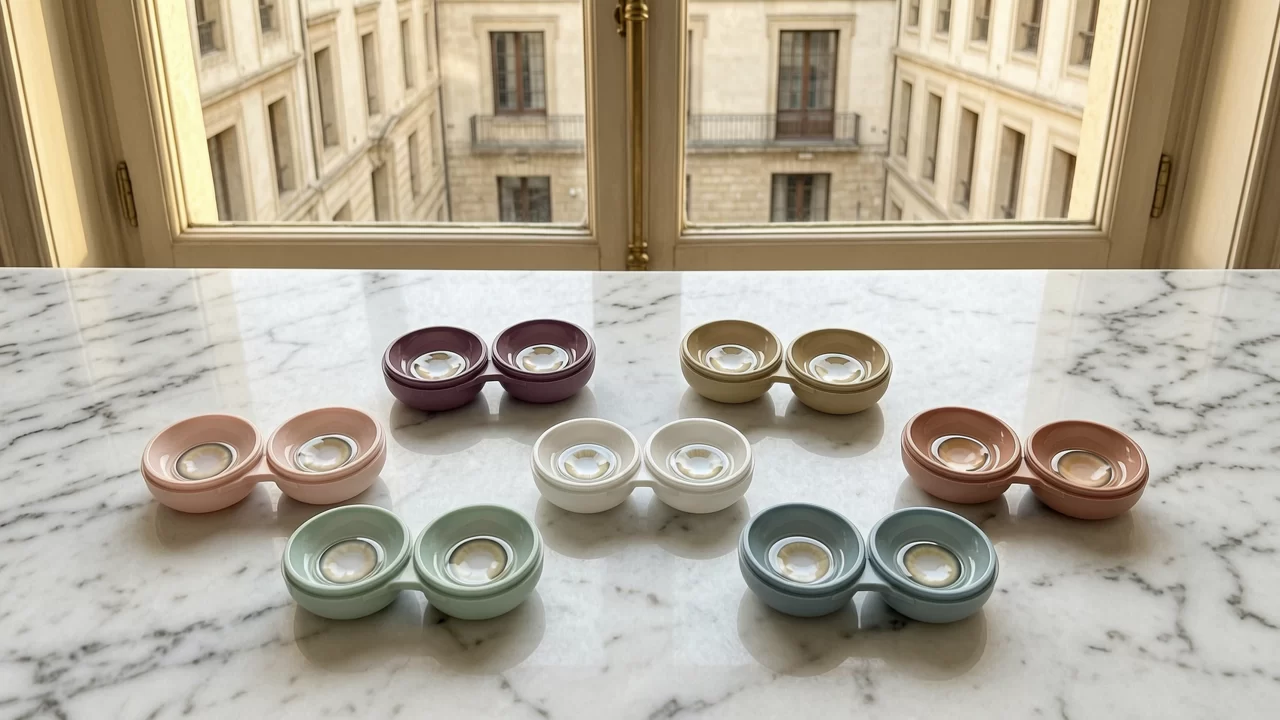
Packaging is equally important. This is the first physical touchpoint your customer has with your brand. Invest in good design. Think about the unboxing experience. Make it something people want to photograph and share.
Step 4: Navigate Certification and Compliance
If you’re selling in regulated markets, this step is not optional.
Europe (CE marking): Your manufacturer should already have CE certification for their products. You need to ensure your specific brand and product line are registered under their certification umbrella. This typically involves submitting your labeling, packaging, and product specifications for review.
United States (FDA): The FDA regulates contact lenses as medical devices. Your manufacturer’s facility needs to be FDA-registered, and each product needs 510(k) clearance. This process can take several months, so factor it into your timeline.
Other markets: Each country has its own requirements. Your manufacturer should be able to tell you which markets they’re already approved for and what additional steps might be needed for yours.
Budget for certification costs and timeline. It’s tempting to skip this or find shortcuts, but the risk of having your products seized at customs or facing legal action isn’t worth it.
Step 5: Build Your Go-to-Market Strategy
You’ve got the product. Now you need the customers.
Most successful contact lens brands in recent years have followed a similar pattern:
Start with one channel. Don’t try to be everywhere at once. Pick your strongest channel — whether that’s your own e-commerce site, a marketplace like Amazon or Shopee, or social commerce through Instagram and TikTok — and dominate it before expanding.
Leverage social proof early. Send free samples to micro-influencers in your niche. Not the ones with millions of followers — the ones with 10,000 to 50,000 engaged followers who actually listen to their recommendations. Real reviews from real people convert far better than polished ads.
Tell your story. Why did you start this brand? What problem are you solving? People buy from brands they feel connected to. Share the journey — the product development, the design choices, the behind-the-scenes moments. Authenticity beats perfection every time.
Plan your pricing carefully. Factor in manufacturing cost, shipping, duties, platform fees, marketing spend, and your desired margin. Many new brands underprice themselves because they forget to account for customer acquisition costs. A healthy gross margin of 60-70% gives you room to run promotions and still stay profitable.
What to Expect in Your First Year
Here’s a realistic timeline:
- Months 1-2: Market research, manufacturer selection, initial discussions
- Months 3-4: Product design, sampling, revisions
- Months 5-6: Certification, packaging finalization, pre-launch marketing
- Months 7-8: First production run, inventory received, launch
- Months 9-12: Marketing push, customer feedback collection, second product line planning
Your first year revenue will depend heavily on your marketing budget and channel. Brands that invest seriously in social media marketing and influencer partnerships from day one typically see their strongest growth between months 6 and 12.
The brands that struggle are the ones that launch and then wait for customers to find them. That doesn’t happen. You need to be actively promoting, testing, and adjusting your strategy every single week.
The Bottom Line
Starting your own contact lens brand through OEM/ODM is one of the more accessible ways to enter the optical industry today. You don’t need a factory. You don’t need a chemistry degree. You need a clear vision of who you’re serving, a reliable manufacturing partner, and the willingness to put real effort into building a brand — not just slapping a logo on a box.
The market rewards brands that stand for something. Figure out what that something is, build a product you’re genuinely proud of, and treat every customer like they’re the reason you started this in the first place. Because they are.