So you’ve got a great concept for a contact lens brand. Maybe you’ve spotted a gap in your local market—perhaps there’s demand for a specific color palette that nobody’s offering, or you want to create a premium daily disposable line with better comfort than what’s currently on shelves.
The next question is obvious: who’s going to make these lenses for you?
If you’re new to the contact lens industry, finding a manufacturer feels deceptively simple. A quick search turns up dozens of factories claiming they can do everything from custom colors to private-label packaging. But here’s what I’ve learned after years of working with brand owners across Southeast Asia, the Middle East, and Europe: choosing the wrong manufacturer doesn’t just delay your launch. It can kill your brand before it starts.
Let me walk you through what actually matters when you’re evaluating a contact lens manufacturer—not the marketing pitch they send you, but the real factors that determine whether you’ll have a product you’re proud to sell.
Start with Certifications (This Is Non-Negotiable)
Before you look at anything else—pricing, MOQ, color options, whatever—check their certifications. This isn’t bureaucracy. This is basic risk management.
Contact lenses are medical devices. In most markets, you can’t legally sell them without proper regulatory clearance. The US requires FDA registration. Europe demands CE marking under the Medical Device Regulation (MDR). South Korea has KFDA. If your manufacturer can’t provide the documentation needed for your target market, you don’t have a partnership—you have a liability.
But here’s where it gets tricky. Some factories will say “we have FDA certification” when what they actually have is a registration for a different product line, or a certificate that expired two years ago, or documentation for a lens design that bears no resemblance to what they’re quoting you.
Ask for the actual certificate. Check the scope. Verify the expiration date. If you’re selling to the US, cross-reference their registration number on the FDA database yourself—it takes five minutes and saves you from a customs seizure later.
A legitimate manufacturer won’t flinch when you ask for this. They’ll send it over without hesitation. If they get defensive or vague, move on.
Understand Their Production Capabilities (Beyond the Brochure)
Every manufacturer’s brochure says they can do custom colors, various diameters, different water contents. That’s table stakes in 2026. What you need to understand is what they’re actually good at—and where their limitations lie.
Here’s what to dig into:
Lens material expertise. Not all factories have the same depth of experience with different materials. Some specialize in hydrogel lenses and have decades of formulation knowledge. Others have invested heavily in silicone hydrogel production. If you’re building a brand around high-oxygen-transmissibility daily disposables, you want a manufacturer whose core competency matches that—not one that’s just adding SiHy to their catalog because the market is moving that way.
Color technology. This matters more than people realize. The way a factory applies color to lenses affects everything from how natural the pattern looks to how the lens feels during wear. Some use sandwich printing (pigment sealed between layers), which is safer and more comfortable. Others use surface printing, which is cheaper but can cause irritation. If your brand positioning is premium, the color application method isn’t a detail—it’s your entire value proposition.
Diameter and parameter range. Most factories can produce lenses in the 14.0-14.5mm diameter range with standard base curves. But if you’re targeting markets where larger diameters are popular (14.8mm, 15.0mm), or you need non-standard base curves for better fit on specific populations, you need a manufacturer with that tooling capability. Ask for their full parameter range, not just the standard options.
Production capacity and lead times. If you’re planning to scale quickly, you need to know whether your manufacturer can handle your growth. A factory that maxes out at 50,000 pairs per month might work for your launch, but what happens when you hit 200,000 pairs? Will they prioritize your order or bump you for a bigger client? Get clarity on capacity constraints before you commit.
Evaluate Their Sampling Process
This is where you’ll quickly separate serious manufacturers from order-takers.
A good sampling process looks like this: you send them your specifications (target diameter, base curve, water content, color design or reference images, material preference). They produce samples within 7-14 days. You evaluate those samples for fit, comfort, color accuracy, and visual effect. You request adjustments if needed. They produce revised samples. You approve.
A bad sampling process looks like this: they produce something vaguely close to what you described, tell you it’s “standard,” and pressure you to place an order. When you ask for changes, they say that’ll cost extra and take another month.
The difference isn’t just about speed. It’s about whether the manufacturer treats sampling as a collaborative design process or a bureaucratic hurdle. You want a partner who asks questions during sampling—Who’s your target customer? What’s the competitive positioning? What markets are you selling into?—because those details should inform their recommendations.
Pay for samples. Don’t try to get them for free. A manufacturer who charges for sampling (typically $200-500 per design) is signaling that they invest real resources into getting it right. One who offers free samples is often cutting corners.
Assess Their Communication and Responsiveness
This sounds soft, but it’s not. Communication quality predicts production quality.
Think about it: if a manufacturer is slow to respond to your emails before you’ve placed an order, what happens after you’ve committed $20,000 to production? If they can’t clearly explain their capabilities in English, how will they handle your custom specifications? If their sales team oversells and their production team underdelivers, who’s dealing with the fallout?
You.
During the evaluation phase, pay attention to:
- Response time (within 24 hours on business days is reasonable)
- Technical accuracy (do they understand your specs, or do they just say yes to everything?)
- Proactive problem-solving (do they flag potential issues, or do they wait for you to discover them?)
- Transparency about limitations (a good manufacturer will tell you what they can’t do as clearly as what they can)
If you’re working across time zones—which most brand owners are—communication becomes even more critical. You need a manufacturer who respects deadlines and provides updates without being chased.
Look at Their Existing Client Base (Carefully)
You probably won’t get a list of their current clients—confidentiality agreements prevent that. But you can learn a lot indirectly.
Ask which markets they primarily serve. A manufacturer focused on the European market will have different quality standards and documentation practices than one focused on Southeast Asia. Neither is inherently better, but you want alignment with your target market.
Ask about their experience with brands similar to yours. If you’re building a premium colored lens brand, you want a manufacturer who’s done that before—not one whose core business is clear prescription lenses and who’s adding colored lenses as a side project.
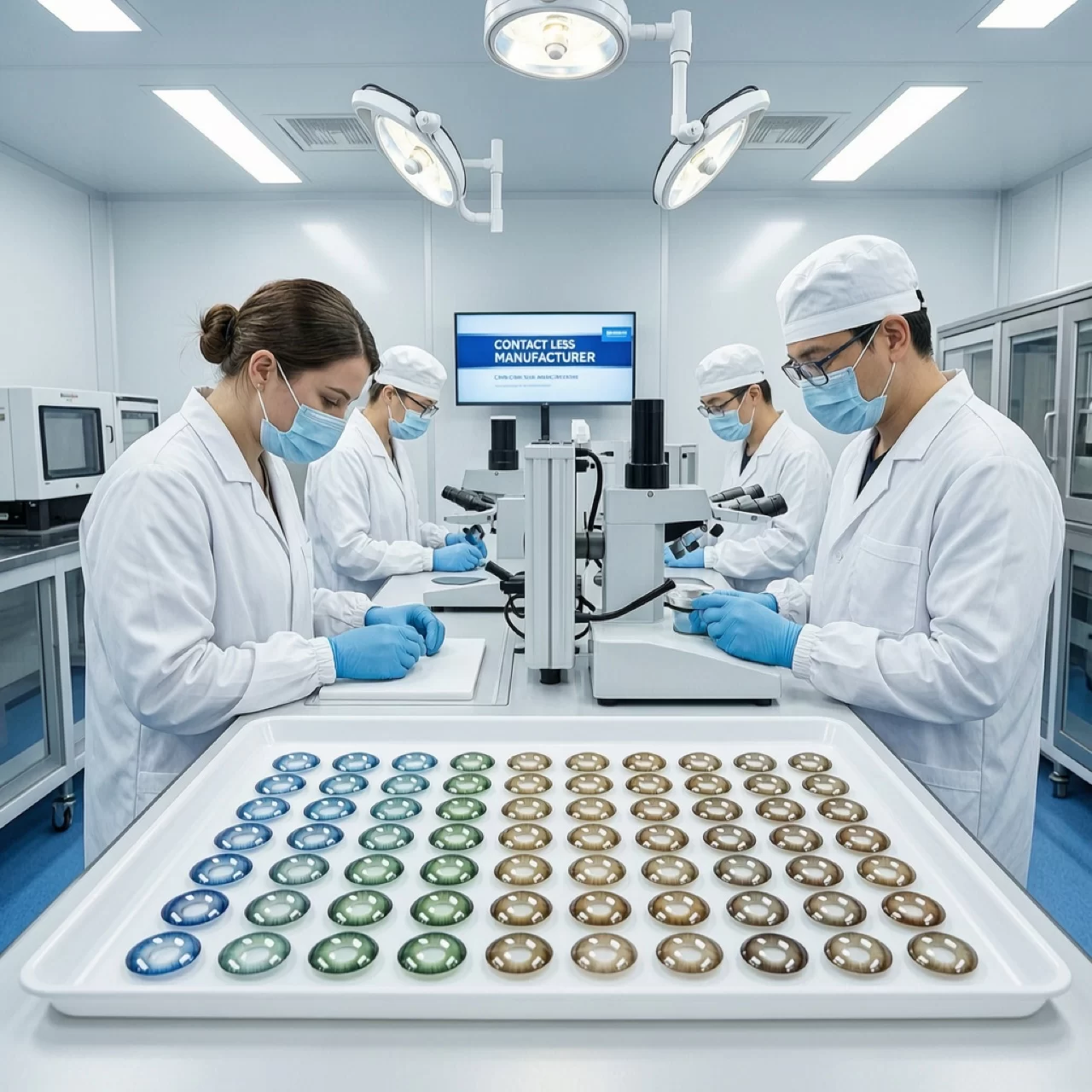
If possible, visit the factory. Nothing replaces seeing production facilities in person. You’ll notice things you’d never learn from a video tour: how organized the production floor is, how workers handle quality control, whether the cleanroom protocols are actually followed.
Pricing: Understand What You’re Actually Paying For
Let’s talk about money, because this is where a lot of brand owners make mistakes.
The cheapest quote is rarely the best deal. Here’s why:
A manufacturer quoting you $0.80 per pair might be using lower-grade materials, cutting corners on quality control, or planning to charge you extra for everything you assumed was included (packaging design, custom blister cards, sterilization, shipping documentation).
A manufacturer quoting you $1.20 per pair might include all of that, use better materials, and have stricter quality control that means fewer defects and fewer customer complaints.
When you compare quotes, make sure you’re comparing apples to apples. Ask for a detailed breakdown:
- Unit price for lenses
- Packaging costs (blister cards, boxes, inserts)
- Custom design fees (if any)
- Sampling costs
- Quality control and certification documentation
- Minimum order quantity requirements
- Lead times for sampling and production
- Payment terms
Then calculate your landed cost per unit, including shipping, duties, and any other import fees. That’s your real cost basis for pricing your product.
Trust Your Gut (But Verify Everything)
After you’ve done all this analysis, you’ll probably have two or three manufacturers you’re considering. At that point, some of the decision comes down to fit.
Do you feel like they understand your brand vision? Are they excited about your project, or do you feel like just another order? Do they push back when you ask unreasonable things (a good sign) or agree to everything (a red flag)?
But gut feeling doesn’t replace verification. Before you sign anything:
- Request references from other brand owners they’ve worked with
- Get a written quality agreement that specifies defect rates, inspection protocols, and remedies for non-conforming product
- Clarify intellectual property ownership (especially for custom color designs)
- Understand their force majeure and delay policies
- Confirm who handles regulatory documentation for your target markets
The Bottom Line
Choosing a manufacturer is the most important decision you’ll make when launching a contact lens brand. It’s not just about finding someone who can make lenses—it’s about finding a partner who can scale with you, maintain quality as volume grows, and help you navigate the regulatory complexity of different markets.
Take your time. Do the due diligence. Visit factories if you can. Ask hard questions.
Because six months from now, when you’re holding your finished product and seeing your brand name on the packaging, you’ll want to know you chose well.
At MIOMI Optical, we’ve helped dozens of brand owners across Southeast Asia, the Middle East, and Europe launch their contact lens lines. Whether you’re looking for OEM customization or ODM partnership, we guide you through every step—from specification to certification to delivery. Get in touch to discuss your project.