How to Choose the Right Contact Lens Manufacturer: 10 Red Flags and Green Flags for Brand Owners
Let me start with a story. A few years back, a brand owner came to us after burning through nearly $40,000 with a “factory” they found on Alibaba. The samples looked great. The price was unbeatable. The MOQ was impossibly low. Then the bulk order arrived — and 30% of the lenses had visible defects. The factory stopped replying. The brand had to refund every customer and rebuild their reputation from scratch.
If you’re building a colored contact lens brand, your manufacturer isn’t just a supplier — they’re the foundation of your entire business. Pick the right one, and you’ll sleep at night knowing your products are safe, consistent, and compliant. Pick the wrong one, and you’re one bad batch away from losing everything.
After eight years in this industry and working with hundreds of brand owners and wholesalers, I’ve seen every mistake in the book. Here’s my no-BS guide to spotting the good manufacturers and avoiding the bad ones.
First, Let’s Talk About Certifications — Because Nothing Else Matters Without Them
I’m putting this first because I see so many new brand owners skip it. If you’re selling in any regulated market — the US, Europe, Australia, Japan — your manufacturer must have the right certifications. No exceptions.
- FDA clearance (US market) — the manufacturer needs 510(k) clearance or applicable FDA registration for contact lenses.
- CE marking under MDR (EU market) — the old Medical Device Directive (MDD) is gone. If your factory only has MDD certificates, they’re expired for the EU.
- ISO 13485 — the quality management standard for medical devices. Every serious manufacturer has this.
- KFDA / CFDA / TGA — depending on your target markets (Korea, China, Australia respectively).
✅ Green flag: The manufacturer provides certificate numbers that you can verify independently on the FDA database or EU EUDAMED. They don’t just send you a pretty PDF.
❌ Red flag: “We have all certifications, don’t worry about it.” If they won’t show you the actual documents with verifiable numbers, walk away.
1. Do They Actually Make The Lenses, Or Are They A Trading Company?
This is the #1 trap on Alibaba and B2B marketplaces. Half the “manufacturers” you’ll find are actually trading companies — middlemen who don’t own a factory. They’ll mark up prices by 30-50%, and when something goes wrong, they can’t fix it because they don’t control production.
How to tell the difference:
- Ask for the factory address and offer to do a video tour. Real factories will say yes. Trading companies will make excuses.
- Check their business license (in China, look for “生产” = production vs “贸易” = trading in the business scope).
- Ask about their production capacity in specific terms — “how many lens molds do you have?” or “what’s your monthly output for custom designs?” Trading companies won’t know these numbers.
- If their product catalog includes everything from eyelashes to nail polish to contact lenses, they’re definitely a trading company.
That said, not all trading companies are bad. Some are excellent partners with quality control systems and long-term factory relationships. But you should know what you’re paying for, and you should be getting value beyond just a markup.
2. What’s Their Real MOQ — And Is It Honest?
You’ll see “MOQ 100 pairs” advertised everywhere. Here’s the truth: no real factory has an MOQ of 100 pairs for custom OEM designs. Lens molds alone cost thousands of dollars per design. A 100-pair MOQ on custom designs doesn’t make economic sense.
What’s actually happening with those low MOQs:
- They’re selling you stock designs with private label packaging (that’s not true OEM — that’s private labeling).
- They’re quoting the 100-pair price but the quality is terrible (thinned-out material, skipped QC, no sterilization verification).
- They’ll take your order, then ghost you when they realize they can’t produce it profitably.
✅ Green flag: The manufacturer is transparent about different MOQ tiers — stock items (lower MOQ), semi-custom (medium MOQ), fully custom designs (higher MOQ). They explain why each tier has its minimums.
For reference, realistic MOQs in 2026 are roughly:
| Product Type | Typical MOQ Range |
|---|---|
| Stock designs + private label | 100 – 300 pairs per design |
| Semi-custom (existing mold + custom color) | 500 – 1,000 pairs per design |
| Fully custom OEM | 1,000 – 3,000 pairs per design |
| Prescription colored lenses | 2,000 – 5,000 pairs per design |
If someone quotes significantly below these ranges, ask questions. A lot of questions.
3. The Sample Test: Your Most Important Due Diligence Step
Never place a bulk order without testing samples. I don’t care how good their website looks or how many glowing reviews they have. Samples are non-negotiable.
Here’s what to check when samples arrive:
- Visual inspection — Hold the lens up to a light. Is the color even? Are there specks or defects? Does the pattern look sharp or blurry at the edges?
- Parameter accuracy — If you ordered 14.2mm diameter and 8.6mm base curve, verify with a lensmeter (any optometrist can do this). I’ve seen “14.2mm” lenses that were actually 14.5mm.
- Wear test — Put them in (or have someone with healthy eyes test them). How do they feel after 4 hours? 8 hours? Dryness, irritation, or movement issues are deal-breakers.
- Packaging quality — Are the blister packs sealed properly? Is the printing clear? Do the expiration dates and lot numbers match what’s on the packaging?
- Color accuracy — Does the lens color match the photos they sent? Natural colors on dark eyes is the hardest thing to get right — test on real eyes, not just the lens case.
✅ Green flag: The manufacturer encourages sample testing and is willing to send 5-10 pairs at a fair sample price. They ask for your feedback and can explain any differences between sample photos and actual lenses.
❌ Red flag: They push you straight to bulk order without samples. Or the samples look incredible but the MOQ is suspiciously low — the samples might have come from a different (better) factory than your bulk order will.
4. Communication Speed and Quality: The #1 Predictor of Problems
Here’s a rule I’ve never seen broken: if communication is slow and sloppy during the sales process, it gets worse after you pay.
Pay attention to:
- Response time — Do they reply within 24 hours on business days? If they’re taking 3+ days during the “dating phase,” imagine what happens when you have a production emergency.
- English proficiency — Can you actually understand each other? Miscommunication in this industry causes expensive mistakes. I’ve seen orders of “natural gray” turn into “neon gray” because of a language gap.
- Attention to detail — Do they answer every one of your questions, or do they skip the hard ones? Do they confirm specifications in writing?
- Proactive communication — Do they tell you when there’s a delay, or do you have to chase them for updates?
Good manufacturers treat you like a partner. Bad ones treat you like a transaction.
5. Production Process and Quality Control: What Actually Happens In The Factory?
You don’t need to understand every detail of contact lens manufacturing, but you should understand enough to ask intelligent questions. A manufacturer that can’t explain their own process clearly is one you don’t want to work with.
Key questions to ask:
- “What’s your QC process at each stage of production?” (The answer should involve multiple checkpoints — raw material inspection, in-process checks, post-curing inspection, final inspection before packaging.)
- “What’s your defect rate and how do you track it?” (A good factory knows their numbers. A bad one says “zero defects” — which is impossible in any manufacturing.)
- “What sterilization method do you use?” (Autoclave is standard. If they can’t explain the cycle parameters, that’s a problem.)
- “Do you have traceability — can you trace a single pair of lenses back to the production batch and raw materials?” (Regulators require this for medical devices.)
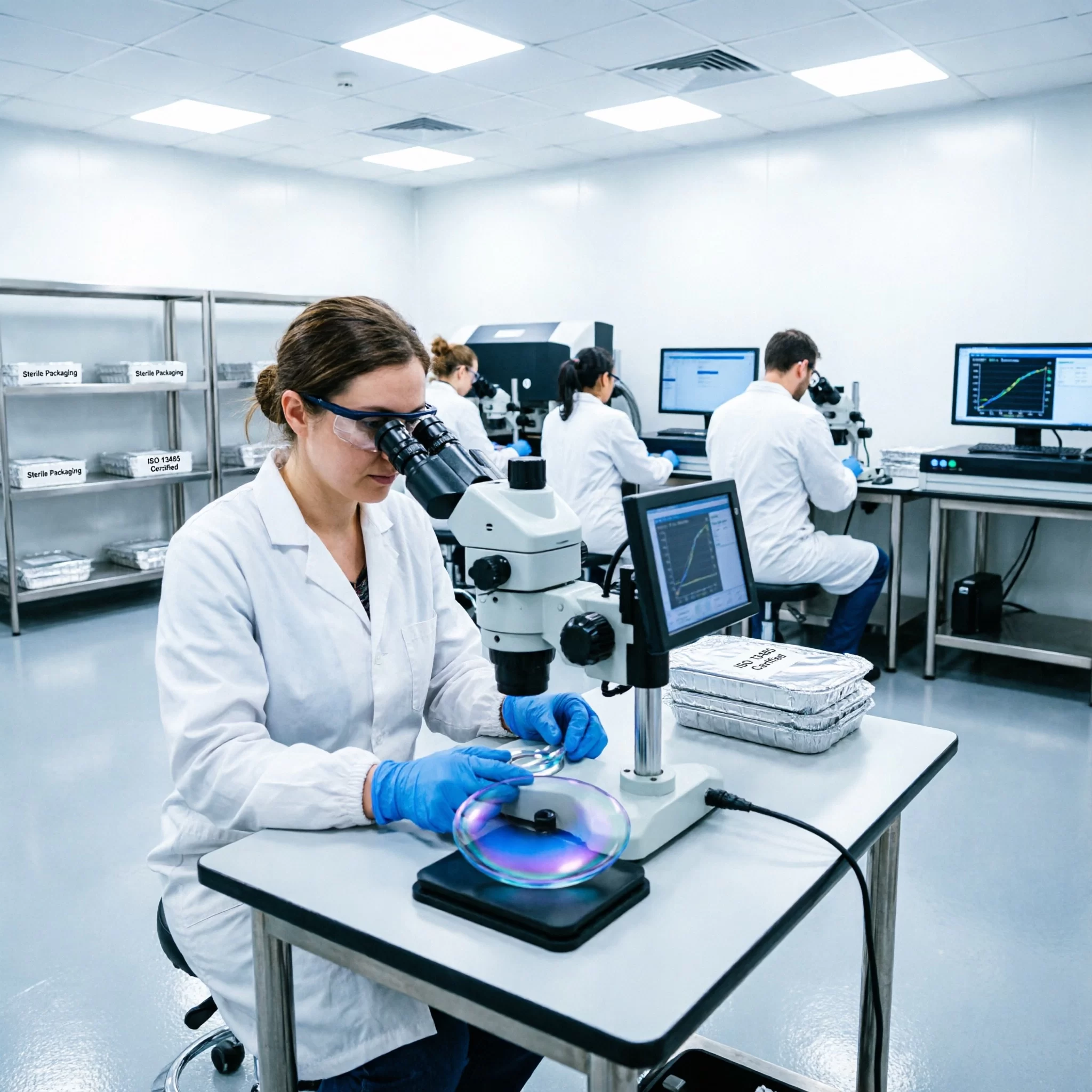
✅ Green flag: They walk you through the production line on a video call. You see clean rooms, workers in proper PPE, organized workstations, and equipment that looks well-maintained.
❌ Red flag: They refuse factory tours, video calls, or detailed production questions. Or the factory in photos looks suspiciously like stock images.
6. Pricing: Cheap Is Expensive
I get it — when you’re starting a brand, every dollar counts. But choosing the cheapest manufacturer is the fastest way to destroy your brand before it even launches.
Here’s what happens when you go with the lowest bidder:
- Quality is inconsistent batch to batch
- Customer complaints skyrocket (dryness, discomfort, defects)
- Returns and refunds eat into your margin
- Your reviews get destroyed
- You might face regulatory issues or lawsuits
In contact lenses, you’re literally putting a medical device on people’s eyes. If a pair of sunglasses breaks, it’s annoying. If a contact lens causes an eye infection, it’s a lawsuit waiting to happen.
That doesn’t mean the most expensive option is always the best. But if one factory is 40% cheaper than everyone else, there’s a reason. Find out what that reason is before you commit.
7. Lead Times: Realistic vs. Fantasy
“7 day delivery!” sounds great on a website. But for custom OEM colored contact lenses, 7 days is physically impossible. Here’s why:
- Mold fabrication: 3-7 days (for new designs)
- Lens casting and curing: 3-5 days
- Hydration and quality inspection: 2-3 days
- Sterilization: 1-2 days (plus incubation time to verify sterility)
- Packaging and labeling: 1-2 days
- Final QC and shipping preparation: 1 day
Add it up, and a realistic lead time for custom OEM is 20-30 days. Stock items with private label packaging can be done in 7-10 days, but that’s different from true custom manufacturing.
✅ Green flag: They give you a detailed timeline with specific stages, and they build in buffer time for unexpected issues. They’d rather under-promise and over-deliver than the other way around.
❌ Red flag: “10 days for fully custom OEM!” No. Just — no.
8. Client References: Talk To Real Customers
Any manufacturer can put “1000+ happy clients” on their website. The test is whether they’ll actually connect you with current or past clients.
Ask for 2-3 references — preferably brands in your target market with similar order sizes. Then actually talk to them. Ask specific questions:
- How long have you been working with this factory?
- Have you ever had a quality issue? How was it handled?
- How’s the communication when there’s a problem?
- Have lead times been consistent?
- Would you work with them for your next product line?
If the factory won’t provide references, that’s not automatically a deal-breaker — some factories protect their clients’ privacy. But it does mean you need to lean more heavily on the other evaluation methods in this article.
9. Payment Terms: Protect Yourself
Standard payment terms in this industry are 30-50% deposit, balance before shipment. That’s normal and fair — factories need to buy materials.
But watch out for:
- 100% upfront payment — especially for first orders. If they won’t budge on this, it’s risky.
- Bank transfer only, no trade assurance — Alibaba Trade Assurance or PayPal goods & services gives you some protection. If they insist on “T/T only” with a personal account, that’s a massive red flag.
- Mold fees that seem too high or too low — Custom molds typically cost $300-$800 per design. If it’s $5,000, they’re gouging. If it’s $50, they’re cutting corners.
✅ Green flag: They offer a reasonable payment structure (e.g., 40% deposit, 60% before shipping) and accept secure payment methods. The contract is clear about what happens if there are quality issues.
10. After-Sales Support: The Real Test of A Partner
Every manufacturer looks good when everything is going smoothly. The real test is what happens when something goes wrong — because something always goes wrong eventually.
Will they stand behind their product? Or will they disappear?
Ask these questions upfront:
- “What’s your policy if a batch has quality issues?” (The right answer involves replacement, refund, or rework — not “all sales are final.”)
- “How do you handle defective units discovered after delivery?”
- “Do you provide technical support for product questions from my customers?”
- “What happens if my order is delayed — do you compensate in any way?”
The best manufacturers proactively solve problems. They’ll catch issues before the order ships. They’ll communicate delays early. They’ll offer solutions instead of excuses.
My Final Advice: Start Small, Then Scale
You don’t need to find your “forever manufacturer” on the first try. Here’s what I recommend:
- Phase 1 (Test): Order samples from 3-5 different manufacturers. Compare quality, communication, and speed. Eliminate the bad ones.
- Phase 2 (Pilot): Place a small first order with your top 1-2 choices. See how the full process goes — from payment to delivery. This is where 80% of issues surface.
- Phase 3 (Scale): Once you’ve had 2-3 successful orders with a manufacturer, then you can start talking about larger volumes, better pricing, and deeper partnership.
Building a contact lens brand is a marathon, not a sprint. Your manufacturer is one of the most important decisions you’ll make. Take the time to get it right.
And if you’re currently evaluating manufacturers and want a second opinion on a specific factory or quote, feel free to reach out. We’re always happy to help a fellow brand owner avoid the mistakes we’ve seen cost people so much money and stress.
— The MIOMI Optical Team