How to Choose a Private Label Contact Lens Manufacturer Without Getting Burned
Choosing a private label contact lens manufacturer is one of those decisions that looks simple from the outside and gets complicated very quickly once real money is involved.
On the surface, most factories say similar things: low MOQ, fast delivery, OEM/ODM support, private label packaging, certifications available. If you only compare catalog photos and unit prices, it is easy to think one supplier is roughly the same as another.
They are not.
In contact lenses, the wrong manufacturing partner can cost you far more than a delayed order. It can damage your brand reputation, create compliance issues, trigger customer complaints, and leave you with inventory you cannot confidently sell.
This is especially true for new brands. When you are small, one bad batch can hurt badly. You may not have the cash flow, customer service team, or legal buffer to absorb serious quality problems.
So before you choose a private label contact lens manufacturer, slow down. Ask better questions. Look beyond the price sheet. Here is what to check.
1. Do They Understand Contact Lenses, or Just Packaging?
Some suppliers are strong at branding and packaging, but weak on actual product knowledge. They can show you attractive boxes, labels, influencer-style photos, and mockups. That is useful, but it is not enough.
Contact lenses are medical devices in many markets. Even colored cosmetic lenses that are sold for beauty use still touch the eye. Your manufacturer needs to understand lens material, water content, base curve, diameter, center thickness, oxygen permeability, coloring technology, sterilization, and stability testing.
Ask them to explain the difference between several lens specifications. For example:
- Why choose 38% water content instead of 55%?
- How does diameter affect comfort and visual effect?
- What base curve is most commonly used for your target market?
- How is the pigment isolated from the eye?
- What wearing cycle is best for your first product line?
If the answer is always “this one sells best” or “customers like this,” be careful. A serious manufacturer should be able to explain the technical and commercial trade-offs.
2. Check Certifications Properly
Certifications are not decorations for a website. They matter for import, sales channels, distributors, and customer trust.
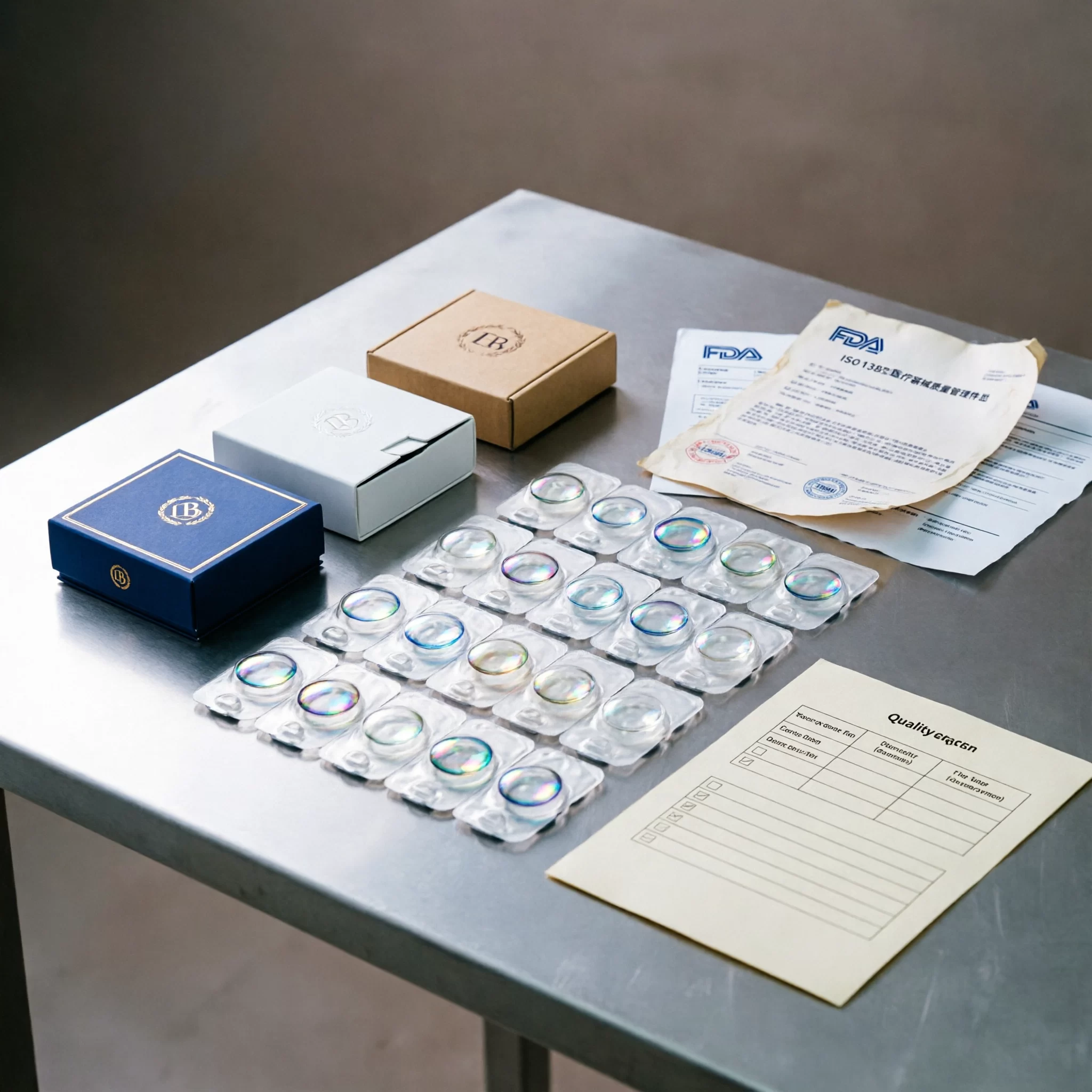
Depending on your target market, you may need documentation related to FDA, CE, ISO 13485, local medical device registration, or other regional requirements. The exact requirement depends on where you sell, how the lenses are classified, and whether you are selling clear, colored, prescription, or non-prescription products.
Do not just ask, “Do you have certification?” Ask for details:
- Which company name is on the certificate?
- Is the certificate valid and current?
- Does it cover the product type you are ordering?
- Can the manufacturer provide test reports and technical files if needed?
- Have they exported to your target market before?
This last question is important. A factory may have general documentation but no experience with your specific market. That can create delays later when your distributor or customs broker asks for paperwork.
3. Ask About Real MOQ Structure
Low MOQ is attractive, but it is often misunderstood.
A supplier may advertise “low MOQ,” but the actual minimum can vary by color, design, prescription range, packaging type, and production method. For example, stock designs with private label packaging may have a much lower MOQ than fully custom lens patterns. Adding prescription powers can change the numbers again.
Before you compare suppliers, clarify:
- MOQ per color
- MOQ per design
- MOQ per prescription power
- MOQ for custom packaging
- MOQ for custom lens design
- Sample cost and sample lead time
- Reorder MOQ after the first batch
A good supplier will explain the structure clearly. A risky one may give you a very low number at first, then add conditions later.
4. Look at Their Sampling Process
Sampling is where you learn how the manufacturer actually works.
A professional manufacturer should not rush you to bulk production before you test samples. They should help you review color effect, comfort feedback, packaging accuracy, labeling details, and specification choices.
For private label contact lenses, your sample review should include:
- Lens color on light and dark eyes
- Comfort after several hours of wear
- Blister and label accuracy
- Packaging print quality
- Instruction leaflet and warning text
- Barcode or SKU labeling if needed
- Photos under natural light and studio light
If the manufacturer treats sampling as a formality, that is a warning sign. The sample stage protects both sides. It is cheaper to fix a color name, diameter choice, or packaging mistake before production than after 5,000 pairs are packed.
5. Pay Attention to Communication Speed and Accuracy
Communication is not a small detail. It is part of operational quality.
If a supplier cannot answer clearly before they receive your money, do not assume communication will improve after payment. In most cases, it gets worse.
Watch for these signs:
- They avoid specific technical questions
- They send inconsistent prices
- They cannot confirm lead times clearly
- They promise everything too easily
- They push you to pay before confirming details
- They do not summarize decisions in writing
For a contact lens brand, small details matter. A wrong power range, wrong label, missing certificate, or unclear shipping mark can create expensive problems. You need a manufacturer that communicates carefully.
6. Understand Their Quality Control Process
Quality control should not be a vague promise. Ask what is actually checked.
At minimum, you should understand how the manufacturer handles:
- Raw material inspection
- Lens appearance checks
- Parameter consistency
- Sterilization process
- Packaging inspection
- Batch tracking
- Defect handling
- Pre-shipment inspection
You do not need to become a lab technician, but you do need enough knowledge to know whether the supplier has a real process or is just saying “quality guaranteed.”
Also ask what happens if there is a problem after delivery. A reliable manufacturer should have a clear complaint and traceability process. If they cannot explain how they handle defective products, be careful.
7. Do Not Choose Only by Lowest Price
Price matters. No serious buyer ignores cost. But in private label contact lenses, the cheapest supplier is not always the most profitable supplier.
A slightly higher unit price may be worth it if the manufacturer gives you:
- More stable quality
- Better documentation
- Lower complaint rate
- More accurate packaging
- Better reorder support
- Faster response when something goes wrong
Think in terms of total business cost, not just unit price. A cheap order that causes customer complaints, returns, and damaged reviews is not cheap anymore.
8. Ask About Reorder Support
Your first order is only the beginning. If the product sells, you need stable reorders.
Ask your manufacturer:
- Can you keep the same color effect across batches?
- How long do you keep production records?
- What is the reorder lead time?
- Can you reserve packaging materials for future batches?
- Can you help expand the product line gradually?
Many brands focus only on launch. The stronger brands plan for the second and third order before the first order arrives.
Red Flags to Watch For
If you see several of these warning signs, step back:
- Very low price with no clear explanation
- No valid documentation or vague certificate claims
- No sample process before bulk order
- Unclear MOQ conditions
- No batch tracking or quality control details
- Pressure to pay quickly
- Poor technical understanding
- Unwillingness to provide written confirmation
- Claims that sound too perfect
One red flag may be manageable. Several red flags together usually mean trouble.
The Bottom Line
A good private label contact lens manufacturer is not just a factory that puts your logo on a box. It is a partner that helps you choose the right product, avoid compliance mistakes, control quality, plan your MOQ, and build a line that customers will reorder.
If you are new to this business, do not rush the manufacturer selection process. Ask technical questions. Check documentation. Test samples properly. Compare communication quality. Understand total cost, not only unit price.
The right partner will make your brand easier to build. The wrong one will make every small problem expensive.
At MIOMI, we support private label and OEM/ODM contact lens projects with product specification guidance, low MOQ options, packaging support, and export documentation. If you are evaluating suppliers for your contact lens brand, contact us or email sales@miomicon.com.