# Daily vs. Monthly vs. Yearly Contact Lenses: A Brand Owner’s Guide to Replacement Cycles and Profit Margins
If you’re building a contact lens brand — or thinking about starting one — one of the first big decisions you’ll face is this: what replacement cycle should I focus on?
Daily disposables? Monthlies? Yearlies?
It’s not just a product decision. It shapes your entire business: pricing strategy, repeat purchase rate, inventory costs, regulatory path, even the kind of customers you attract.
After working with dozens of brand owners at MIOMI, I’ve seen people get this wrong in both directions. Some jump into dailies because “that’s what everyone buys” — only to drown in inventory costs. Others bet everything on yearlies because the per-unit margin looks great — then wonder why their customers never come back.
There’s no universally “right” answer. But there is a right answer for *your* brand, based on your market, budget, and long-term goals.
Let’s break it down.
—
## The Three Main Replacement Cycles: A Quick Refresher
Before we get into the business side, let’s make sure we’re on the same page about what each category actually means.
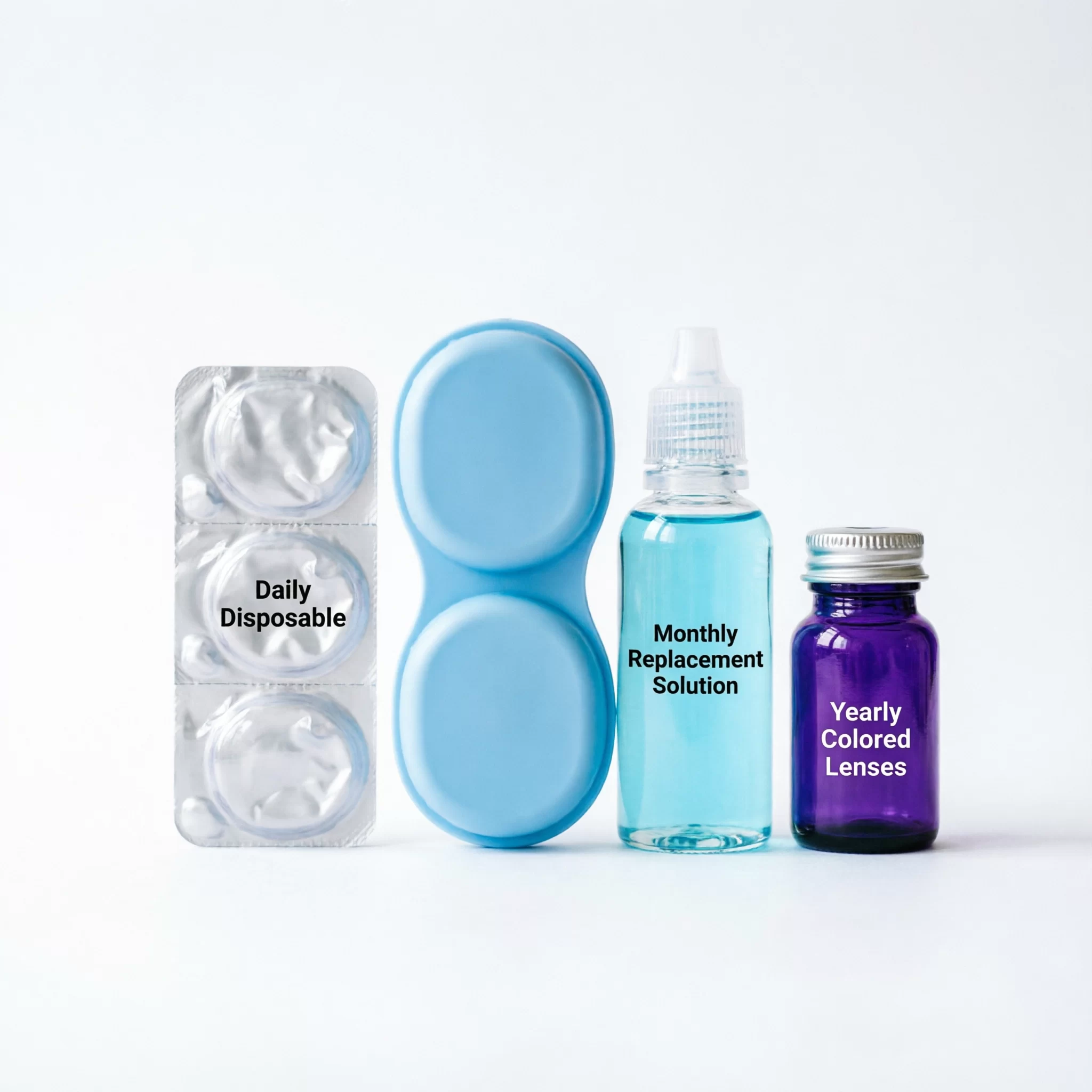
**Daily disposable lenses (1-day):** Worn once, then thrown away. Typically sold in boxes of 30 or 90 pairs. The user opens a fresh pair every morning and tosses them at night. No cleaning, no cases, no maintenance.
**Monthly lenses (1-month):** Worn daily for up to a month, then replaced. The user takes them out each night, cleans them with solution, and stores them in a case. Sold in boxes of 2 or 6 lenses (1 or 3 months’ supply per eye).
**Yearly / annual lenses (1-year):** Designed to last up to 12 months with proper care. Common in the colored contact lens space, especially in emerging markets. Sold individually or in pairs.
(There are also 2-week and quarterly lenses, but they’re less common in the OEM/ODM brand space, so we’ll focus on the big three.)
Now let’s look at each from a business perspective.
—
## Daily Disposables: The High-Volume, High-Commitment Play
Dailies are the fastest-growing segment in most mature markets — and for good reason. From a consumer standpoint, they’re the most convenient and hygienic option.
### The upside for brands
**Predictable recurring revenue.** This is the big one. A daily wearer who uses one box per eye per month is a customer who buys from you *every single month*. Your revenue isn’t a one-time sale — it’s a subscription-like relationship.
**Higher perceived value.** Consumers understand that dailies cost more per pair, and they’re generally willing to pay for the convenience. The hygiene story sells itself, especially since COVID-19 made everyone more aware of eye health.
**Lower barrier for new users.** First-time contact lens wearers often start with dailies because there’s no learning curve around cleaning and storage. If your brand targets younger demographics or first-time buyers, dailies make it easy for them to say yes.
**Strong subscription model potential.** Dailies and subscriptions were made for each other. Many successful DTC brands generate 60%+ of their revenue from subscription plans with auto-ship.
### The downsides nobody talks about
**Inventory is brutal.** If you offer 5 colors in 3 powers, that’s 15 SKUs. But dailies are sold in boxes of 30 or 90 pairs per *eye* — so you’re actually managing inventory per eye, per power, per color, per box size. It adds up fast. New brands often underestimate the working capital required.
**Minimum order quantities are higher.** Because daily disposable manufacturing requires different, faster production lines, MOQs tend to be higher than for monthlies or yearlies. If you’re just starting out with a limited budget, this can be a showstopper.
**Shrinkage and spoilage.** Dailies have expiration dates, and if inventory doesn’t move fast enough, you’re writing off expired stock. This isn’t a hypothetical — it’s a real risk for new brands still building their customer base.
**Price pressure is intense.** In mature markets, the big players (Acuvue, Alcon, CooperVision) dominate the daily space with massive marketing budgets. Competing head-on is expensive.
### Who should go with dailies?
Dailies make sense if you:
– Have enough capital to handle significant inventory
– Are targeting North America, Europe, or other mature markets
– Plan to build a subscription-based DTC model
– Have a marketing budget to drive repeat purchases
If you’re bootstrapping on a $10-20K budget, dailies as your primary product probably aren’t the right starting point.
—
## Monthly Lenses: The Balanced Middle Ground
Monthlies are the workhorse of the industry — popular with consumers and manageable for brands. They’re not as sexy as dailies, but they’re reliable and profitable.
### Why monthlies work
**Better margins per unit.** Monthly lenses have a higher price point per pair than dailies, and the manufacturing cost per pair is lower (since they’re designed for longer wear). The per-pair margin is usually better than dailies.
**Lower inventory complexity.** Compared to dailies, monthlies dramatically reduce your SKU count. A monthly box typically contains 2 or 6 lenses, not 30 or 90. You’re still managing colors and powers, but the volume per SKU is much lower.
**Reasonable MOQs.** Most OEM manufacturers, including MIOMI, can work with lower minimums for monthly lenses than for dailies. This makes them accessible for new brands that aren’t ready to commit to massive production runs.
**Still generates repeat purchases.** A monthly wearer buys new lenses every 1-3 months. It’s not the every-30-days cadence of dailies, but it’s regular enough to build a loyal customer base.
**Proven in both mature and emerging markets.** Monthlies sell well everywhere. In Europe and North America, they’re the “default” option for many wearers. In Southeast Asia and the Middle East, they’re a step up from yearlies as consumers upgrade.
### The challenges
**Not the “premium” option.** In consumers’ minds, dailies are the premium product. Monthlies sit in the middle — better than yearlies, not as convenient as dailies. This can make positioning trickier.
**Solution compatibility.** Monthly wearers need contact lens solution, which means either selling it yourself (more SKUs, more inventory) or sending customers elsewhere for a critical part of the experience.
**Lower purchase frequency than dailies.** The recurring revenue is there, but it’s slower. You need more customers to hit the same revenue numbers as a daily disposable brand.
### Who should go with monthlies?
Monthlies are a great fit if you:
– Want a balance between recurring revenue and manageable inventory
– Are targeting a mix of mature and emerging markets
– Have a modest but not massive starting budget
– Plan to expand into dailies later as you scale
Most new brands we work with start here, and it’s usually the right call.
—
## Yearly / Annual Lenses: The High-Margin, Low-Repeat Play
Yearly lenses are the oldest format and still dominate in many emerging markets. They’re especially common in the colored contact lens space — think of those “one pair, wear all year” cosmetic lenses.
### Why brands still love yearlies
**Highest per-unit margin.** This is the main attraction. A single pair of yearly colored lenses can sell for $30-80 USD (sometimes more for premium brands), and the manufacturing cost is relatively low. The margin per pair is fantastic.
**Lowest MOQs.** Yearly lenses typically have the lowest minimum order quantities, making them the easiest way to launch a brand with limited capital. You can start with just a few thousand dollars and a handful of designs.
**Simple inventory.** One SKU = one pair of lenses in one power. You’re not managing boxes of 30 or subscription plans. If you’re starting with 10 colors, that’s 10 SKUs (plus power variations, but still manageable).
**Popular in fast-growing markets.** Southeast Asia, the Middle East, Latin America, and parts of Africa still have strong yearly lens markets. Consumers there are accustomed to the format and price point.
### The harsh reality of yearlies
**Repeat purchases are glacial.** If someone buys a pair of yearly lenses, when do they buy again? In a year. Maybe. Maybe never, if they forget your brand or try something else. Customer lifetime value depends on them actually coming back 12 months later — which most won’t without serious marketing.
**Seen as “cheap” in mature markets.** In North America, Europe, and Australia, yearly colored lenses are often associated with low quality, Halloween costumes, or “fast fashion” lenses. Building a premium brand around yearlies in these markets is an uphill battle.
**Regulatory pressure is increasing.** Regulators worldwide are tightening rules on longer-wear lenses because of infection risks. Some markets have already restricted or banned certain types of yearly lenses. This trend is likely to continue.
**Higher return/exchange rates.** Since yearly lenses are worn for so long, customers are more likely to notice discomfort, fit issues, or color mismatch — and ask for refunds or exchanges.
### Who should go with yearlies?
Yearlies work best if you:
– Are targeting emerging markets where yearly lenses are the norm
– Have a low starting budget and need to prove your concept first
– Focus on fashion/color lenses where design variety drives sales
– Plan to upsell customers to monthlies or dailies over time
Yearlies can be a great *entry point* — but I’d advise building a plan to graduate customers to higher-frequency products.
—
## How to Actually Choose: A Framework for Decision-Making
Alright, so which one is right for you? Here’s the framework I walk new brand owners through.
### 1. Start with your target market
Where are your customers? This is the single biggest factor.
– **North America / Europe / Australia:** Start with monthlies, plan for dailies. Yearly lenses will be a hard sell outside the costume/Halloween niche.
– **Southeast Asia (Indonesia, Thailand, Philippines):** Yearlies and monthlies both work. Yearlies for price-sensitive buyers, monthlies as your premium offering.
– **Middle East (UAE, Saudi Arabia):** Monthlies are growing fast, but yearlies still have market share, especially for colored lenses.
– **Latin America / Africa:** Yearlies dominate most markets, but monthlies are gaining traction among middle-class consumers.
### 2. Be honest about your budget
How much capital do you actually have to work with?
– **Under $10K:** Start with yearly lenses. You can launch with a small selection and reinvest profits into expanding.
– **$10K – $50K:** Monthly lenses are your sweet spot. Enough margin, reasonable MOQs, decent repeat rate.
– **$50K+:** You can consider dailies, but still start with monthlies to validate the market before committing to daily disposable production.
### 3. Think about your long-term strategy
Where do you want your brand to be in 3-5 years?
If your vision is a subscription-based DTC brand with predictable recurring revenue — start with monthlies and use them as a stepping stone to dailies. Build your customer base with monthlies, then introduce dailies as a premium upgrade.
If you’re building a fashion-forward color lens brand targeting TikTok and Instagram shoppers — yearlies might be your bread and butter, especially if you’re selling in emerging markets. Just make sure you have a plan for customer retention (like email marketing and limited-edition designs).
### 4. Consider the hybrid approach
Here’s what I usually recommend to new brands: don’t pick just one.
Start with **monthly lenses as your core product** (stable, profitable, reasonable MOQs). Then add a **small selection of yearly colored lenses** for fashion-focused customers who want to try different looks without a big commitment.
Once you’ve validated demand and have cash flow, you can introduce **daily disposables** as your premium tier.
This three-tier approach lets you:
– Serve different customer segments
– Upsell from yearlies → monthlies → dailies
– Manage risk by not betting everything on one format
– Build average order value by offering multiple options
—
## The Real Secret: It’s Not About the Lens, It’s About the Customer
Here’s something I don’t hear enough people say: the replacement cycle isn’t the product. The *customer experience* is the product.
A brand selling dailies with a clunky website and no subscription option will underperform a brand selling monthlies with a seamless ordering process, helpful customer service, and smart retention marketing.
The format matters, but how you sell it matters more.
I’ve seen brands crush it with yearly lenses in markets where “everyone knows” yearlies are dead. I’ve seen brands fail with dailies in markets where dailies are supposedly taking over. The difference is always in the execution.
—
## Final Thoughts
Choosing a replacement cycle is one of the first and most important decisions for a new contact lens brand. But it doesn’t have to be permanent — most successful brands start with one format and expand over time.
My advice: start where your budget and market align, then expand from there. For most new brands, that means monthlies as the foundation, with yearly color lenses for fashion customers and dailies as a future premium offering.
And if you’re still not sure which path is right for your brand? Talk to someone who’s done this before. A good OEM partner won’t just sell you lenses — they’ll help you figure out the right product strategy for your specific market and goals.
At MIOMI, we work with brands at every stage, from first-time founders to established players expanding their product lines. If you’d like a second opinion on your product strategy, drop us a line — we’re happy to help you think it through.
—
*Got questions about choosing the right replacement cycle for your brand? Reach out to our team at sales@miomicon.com — we’ve helped dozens of brands launch and scale, and we can help you too.*