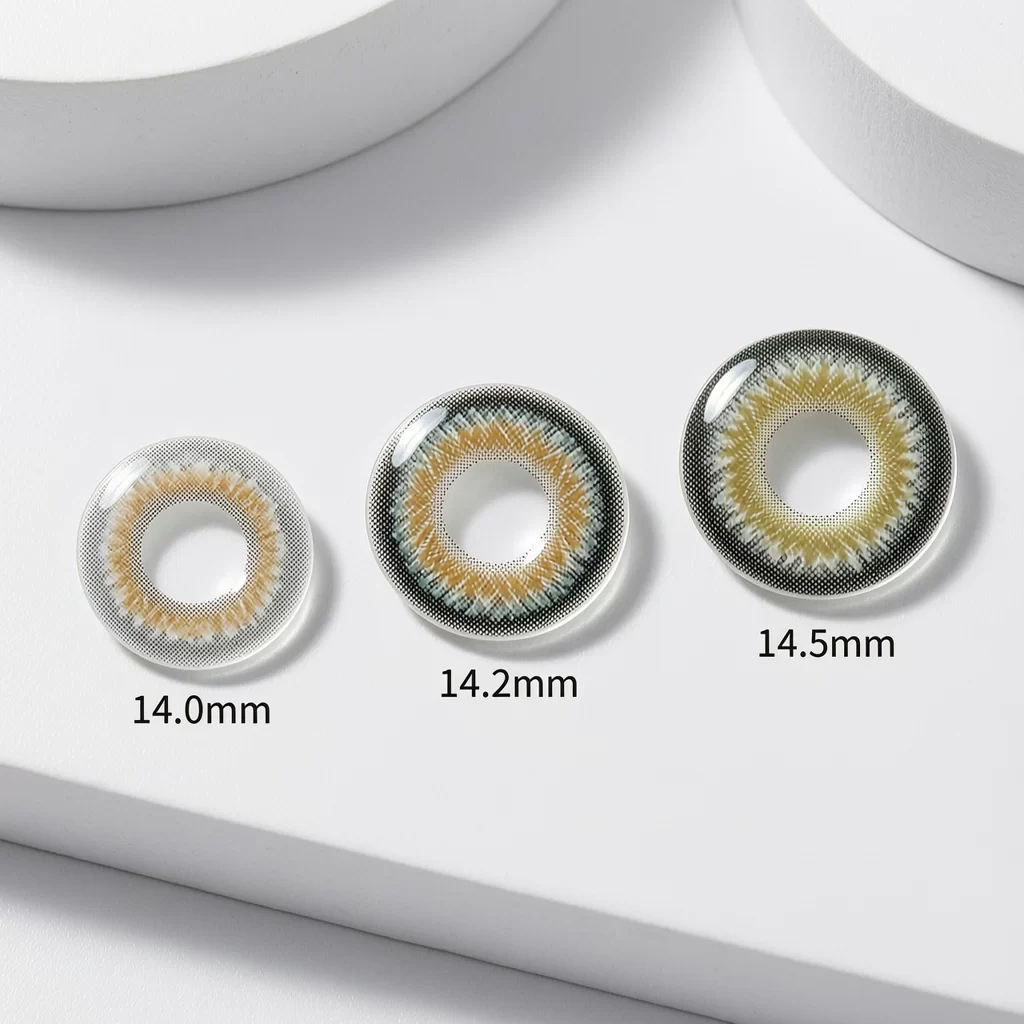
If you’ve ever gotten a customer complaint about colored contacts looking “too small” or “unnaturally big,” you already know diameter matters. But here’s the thing most brand owners don’t realize: choosing the right diameter isn’t just about aesthetics. It’s about matching your product to your target market’s anatomy, preferences, and regulatory environment.
I’ve spent the last five years helping brands launch colored contact lens lines across Southeast Asia, the Middle East, and Europe. And I can tell you that diameter selection is one of the most overlooked decisions in product development. Get it wrong, and you’ll face returns, bad reviews, or worse — safety issues. Get it right, and you’ll have a product that fits your market like it was made for them (because it was).
Let’s break down what you actually need to know.
The Basics: What Diameter Actually Means
Diameter (DIA) is the total width of the contact lens from edge to edge, measured in millimeters. For colored contact lenses, you’ll typically see three sizes on the market:
- 14.0mm — The standard “natural” size
- 14.2mm — The most popular middle ground
- 14.5mm — The “doll eye” or “big eye” effect
Some brands go as small as 13.8mm or as large as 15.0mm, but those are niche products. If you’re building a mainstream line, you’re working in the 14.0–14.5mm range.
Here’s what most product guides won’t tell you: diameter doesn’t just affect how big the lens looks. It affects how it sits on the eye, how it moves with each blink, and how comfortable it is after eight hours of wear.
Why 14.0mm Works for Some Markets
The 14.0mm diameter is your classic “no-makeup makeup” look. It’s subtle. It enhances the natural iris without dramatically changing the eye’s apparent size. This is the go-to size for:
Western markets (North America, Europe, Australia)
Most consumers in these regions want a natural enhancement. They’re not looking for a dramatic transformation — they want people to notice their eyes look brighter or more defined, not that they’re wearing contacts. A 14.0mm diameter covers the iris cleanly without extending beyond the limbus (the border between iris and sclera), which keeps the look understated.
Professional and mature demographics
If your target customer is a 35-year-old office worker or a 50-year-old executive, they’re rarely shopping for “big doll eyes.” They want sophistication. 14.0mm gives them that.
First-time colored lens wearers
When someone’s trying colored contacts for the first time, they’re usually nervous about looking “fake.” A 14.0mm diameter is the safest recommendation because it’s the closest to a clear lens in terms of coverage.
The trade-off: 14.0mm lenses have a smaller color zone, which means less room for creative designs. If your brand’s selling point is bold, artistic patterns, you’ll feel constrained at this size.
Why 14.2mm Is the Sweet Spot for Most Brands
If I had to recommend one diameter for a new brand entering the market, it would be 14.2mm. Here’s why:
It works across more eye shapes
The average human iris is about 11.8–12.5mm in diameter. A 14.2mm lens extends just 1–1.5mm beyond the iris on each side, which creates a noticeable but not exaggerated enlargement effect. This works well for both smaller and larger eyes, which is why it’s the best-selling size globally.
It gives designers more to work with
That extra 0.2mm might not sound like much, but in lens design, it’s the difference between a simple two-tone gradient and a complex three-layer pattern with limbal ring detail. Most of the “bestseller” colored lenses you see on Instagram — the ones with that defined outer ring and natural gradient — are 14.2mm.
It appeals to the widest demographic
Teenagers, young professionals, brides, social media influencers — 14.2mm hits all these groups without alienating anyone. It’s the “Goldilocks” size: not too subtle, not too dramatic.
Market data backs this up
In our production data at MIOMI, about 65% of the colored lens orders we fulfill for OEM clients are 14.2mm. The remaining 35% split between 14.0mm and 14.5mm, with 14.0mm slightly more popular than 14.5mm.
When 14.5mm Makes Sense
The 14.5mm diameter is your “statement” size. It’s designed to create a noticeable enlargement effect — the kind of look that gets compliments (or questions) like “Are you wearing contacts?”
This size dominates in specific markets:
East and Southeast Asia
In markets like China, South Korea, Japan, Thailand, and the Philippines, larger eyes are strongly associated with youth and beauty. The “doll eye” aesthetic is mainstream, not niche. A 14.5mm lens can make the eyes appear 20–30% larger, which is exactly what consumers in these regions are shopping for.
Younger demographics (18–28)
If your brand targets Gen Z or younger millennials, 14.5mm is often the preferred size. This demographic grew up with K-beauty and J-beauty influencers who popularized the big-eye look.
Cosplay and special-effect lenses
For costume lenses, character cosplay, or Halloween designs, 14.5mm (or even larger) is standard. The larger canvas allows for more dramatic patterns and colors.
The trade-off: 14.5mm lenses aren’t suitable for everyone. People with smaller eyes (corneal diameter under 11.5mm) may find that a 14.5mm lens extends too far beyond their natural iris, creating an unnatural “blackout” effect at the edges. They can also feel slightly less comfortable because there’s more lens material interacting with the eyelid during blinks.
The Anatomical Reality: One Size Doesn’t Fit All
Here’s something I wish more brand owners understood: diameter selection should be informed by the average corneal size of your target market.
The human cornea (the clear front surface of the eye) averages about 11.7mm horizontally and 11.0mm vertically, but there’s ethnic and individual variation. East Asian populations tend to have slightly smaller corneal diameters on average, which is why larger-diameter colored lenses (14.2–14.5mm) are more popular in those markets — they create the enlargement effect that local beauty standards favor.
Caucasian populations tend to have slightly larger corneas, which is why 14.0–14.2mm lenses are more popular in Western markets — they provide enhancement without looking oversized.
This doesn’t mean you can’t sell 14.5mm lenses in Europe or 14.0mm lenses in Asia. It means you should understand why certain sizes perform better in certain regions, and stock your product line accordingly.
What This Means for Your Product Line
If you’re launching a new colored contact lens brand, here’s how I’d approach diameter selection:
Scenario 1: You’re targeting a single market
Research that market’s preferences and lead with the most popular size. For Southeast Asia, start with 14.2mm and 14.5mm. For North America, start with 14.0mm and 14.2mm.
Scenario 2: You’re building a global brand
Launch with 14.2mm as your core size (it works everywhere), then add 14.0mm for Western markets and 14.5mm for Asian markets as you expand.
Scenario 3: You’re doing OEM/ODM for an existing brand
Ask about their target demographic and market. If they’re vague, guide them through the questions above. If they insist on one size for all markets, explain the trade-offs and document the conversation. You don’t want to be blamed when their 14.5mm line flops in Germany.
A Note on Safety and Compliance
Diameter isn’t just a cosmetic choice — it’s a safety parameter. A lens that’s too large for the wearer’s eye can cause:
- Excessive lens movement
- Corneal irritation
- Reduced oxygen transmission
- Discomfort and dryness
This is why reputable manufacturers (including MIOMI) always recommend that end users get fitted by an eye care professional. It’s also why some countries have specific regulations around maximum lens diameter.
When you’re developing your product line, make sure your technical documentation clearly states the diameter, and include guidance on who should and shouldn’t wear larger-diameter lenses. This isn’t just good practice — it’s liability protection.
The Bottom Line
Diameter selection is one of those decisions that seems small but has outsized impact on your product’s success. Choose the right size for your market, and you’ll have customers who love how your lenses look and feel. Choose the wrong size, and you’ll be dealing with complaints, returns, and a reputation hit.
If you’re unsure where to start, here’s a simple rule: 14.2mm is the safest bet for a new brand. It works across markets, demographics, and eye shapes. Once you’ve established your brand and understand your customers better, you can expand into 14.0mm and 14.5mm to capture additional segments.
And if you need help figuring out the right diameter for your specific market or product line, that’s exactly what we’re here for. Drop us a line at sales@miomicon.com or reach out on WhatsApp at +86 13862973905. We’ve helped dozens of brands navigate this exact decision, and we can help you too.
MIOMI Optical Ltd is a leading contact lens manufacturer specializing in OEM/ODM customization, small-batch wholesale, and private label production. We serve brands in over 30 countries across North America, Europe, Southeast Asia, the Middle East, and Africa.