CE Marking for Colored Contact Lenses: What Brand Owners Need to Know Before Selling in Europe
Selling colored contact lenses in Europe without a CE mark is like trying to board a flight without a passport. You won’t get far, and you’ll waste a lot of time figuring out why.
If you’re building a contact lens brand and Europe is on your expansion map, this guide walks you through exactly what CE marking means, why it matters, and how to get it — without the jargon overload.
What Is CE Marking, and Why Does It Matter for Contact Lenses?
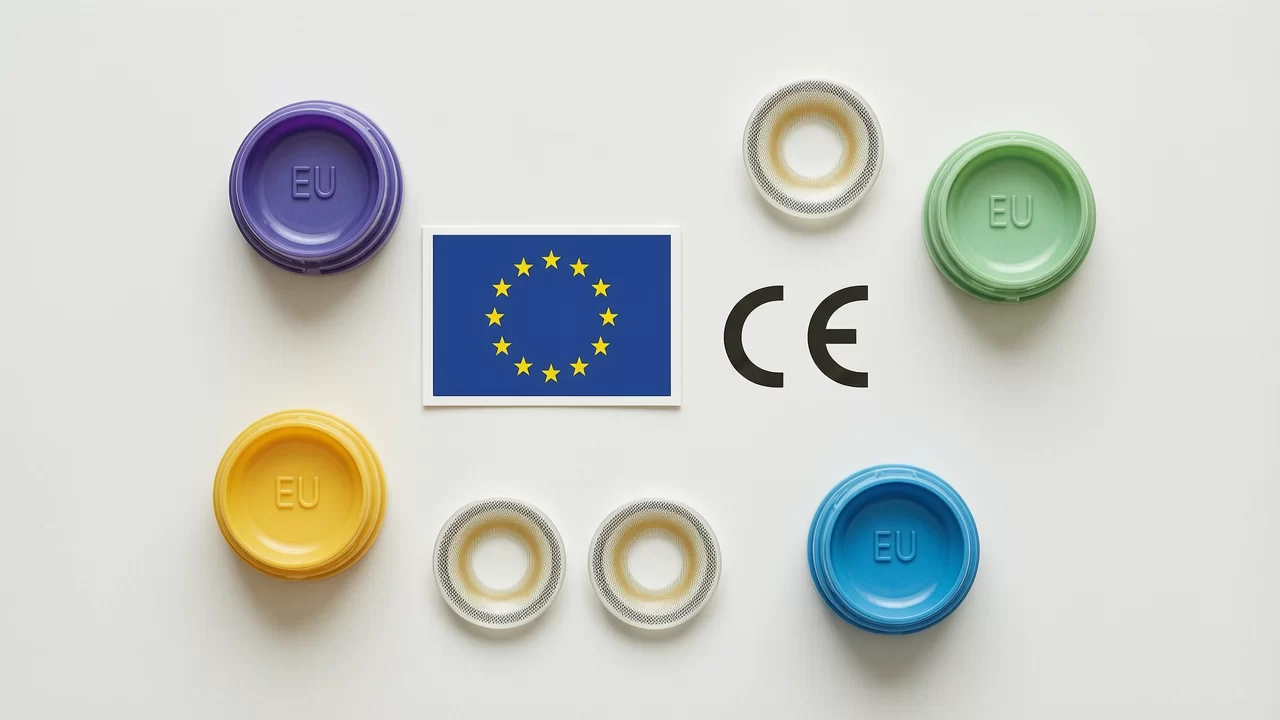
CE marking (Conformité Européenne) is a mandatory compliance mark for products sold within the European Economic Area (EEA). It tells regulators and customers that your product meets EU safety, health, and environmental protection requirements.
Contact lenses — including colored and cosmetic lenses — are classified as **medical devices** in the EU. That means they fall under the **EU Medical Device Regulation (MDR) 2017/745**, which replaced the older Medical Devices Directive in May 2021.
Under MDR, colored contact lenses are typically **Class IIa medical devices** (medium risk). This classification determines how rigorous your conformity assessment needs to be.
Here’s what that means in plain English: you can’t just print a CE logo on your packaging and call it a day. You need documented proof that your product has been assessed by an authorized body and meets all applicable requirements.
The MDR Transition: What Changed in 2021
The shift from the old directive to MDR wasn’t just paperwork shuffling. It fundamentally raised the bar for medical device manufacturers selling in Europe.
Key changes that affect contact lens brands:
**Stricter clinical evidence requirements.** Under the old directive, many contact lens manufacturers relied on equivalence with existing products. MDR significantly narrowed the equivalence pathway, meaning you now need more robust clinical data specific to your product.
**Enhanced post-market surveillance.** You can’t just get certified and forget about it. MDR requires ongoing monitoring of your product’s safety performance once it’s on the market. This means having a system for collecting and reporting adverse events.
**More rigorous Notified Body oversight.** The organizations that certify your product (called Notified Bodies) are themselves under tighter scrutiny. This has led to longer certification timelines and more thorough audits.
**Economic operator responsibilities.** MDR defines specific obligations for manufacturers, authorized representatives, importers, and distributors. If you’re a brand owner selling into Europe, you need to understand which role applies to you.
Step-by-Step: How to Get CE Marking for Your Contact Lens Brand
Step 1: Confirm Your Classification
Before anything else, confirm that your product is classified correctly. Colored contact lenses are generally Class IIa, but the exact classification depends on your product’s intended use and claims.
If you’re selling lenses purely for cosmetic enhancement (changing eye color without vision correction), they’re still medical devices under EU law. The classification doesn’t change just because the lens isn’t correcting vision.
Step 2: Appoint an EU Authorized Representative
If your manufacturing facility is outside the EU (which is common for contact lens brands working with Asian manufacturers), you **must** appoint an EU-based Authorized Representative (also called an EC-REP).
Your Authorized Representative acts as your regulatory point of contact within the EU. They hold your technical documentation and liaise with regulatory authorities on your behalf.
This is not optional. Without an EC-REP, you cannot legally place your product on the EU market.
Step 3: Prepare Your Technical Documentation
Your technical file is the backbone of your CE marking application. For colored contact lenses, it typically includes:
Step 4: Engage a Notified Body
For Class IIa devices, you need a Notified Body to conduct a conformity assessment. The Notified Body reviews your technical documentation, audits your quality management system, and issues a CE certificate if everything checks out.
Not all Notified Bodies are authorized for contact lenses. Look for organizations with specific scope for ophthalmic devices. The process typically takes 6 to 12 months, sometimes longer depending on the completeness of your documentation.
Step 5: Register Your Product
Once you have your CE certificate, you (or your Authorized Representative) need to register the product in the **EUDAMED** database — the European database for medical devices.
EUDAMED registration generates a Single Registration Number (SRN) that identifies your product in the EU system.
Common Mistakes Brand Owners Make with CE Marking
**Thinking CE marking is just a logo.** It’s not. The logo is the final step of a lengthy compliance process. Slapping it on your packaging without proper certification is a serious regulatory violation.
**Assuming FDA clearance equals CE marking.** The FDA and EU MDR have different requirements. Having FDA approval for the US market doesn’t automatically get you CE marking for Europe. You need separate compliance processes for each.
**Underestimating the timeline.** Many brands assume CE marking takes a few weeks. In reality, expect 6 to 12 months from start to finish. Plan accordingly.
**Skipping the Authorized Representative.** Some brands try to sell into Europe without an EC-REP, either because they don’t know it’s required or because they’re trying to save money. This is a fast track to having your product pulled from the market.
**Ignoring post-market obligations.** Getting the CE mark is only half the battle. You need to maintain compliance through ongoing surveillance, adverse event reporting, and periodic re-certification.
How Much Does CE Marking Cost?
Costs vary depending on your product complexity and the Notified Body you choose, but here’s a rough breakdown:
Total budget: roughly **€20,000 – €65,000** for initial certification.
That’s a significant investment, but it’s the cost of accessing a market of 450 million consumers.
Working with Your OEM Partner on CE Compliance
If you’re manufacturing through an OEM partner (as most new brands do), make sure CE compliance is part of your manufacturing agreement from day one.
Your OEM partner should be able to provide:
If your OEM partner has already certified similar products for the EU market, the process may be smoother. But remember — your specific product still needs its own assessment.
The Bottom Line
CE marking isn’t a barrier to keep you out of Europe — it’s a framework to ensure that products on the EU market are safe and effective. For contact lens brands, it’s non-negotiable.
If Europe is part of your growth strategy, start the CE marking process early. Build it into your product development timeline, not as an afterthought. The brands that treat regulatory compliance as a competitive advantage — not a burden — are the ones that build lasting international businesses.
*Looking for a manufacturing partner who understands EU compliance? MIOMI Optical has experience producing contact lenses for brands targeting regulated markets. Reach out to our team at sales@miomicon.com to discuss your project.*