Here’s something most people in the industry won’t tell you: you don’t need to own a factory to build a contact lens brand anymore. In fact, some of the fastest-growing color lens brands today — the ones pulling seven figures on Instagram and TikTok — started with zero manufacturing capability. All they had was a brand name, a vision, and a manufacturer willing to put their logo on a well-made product.
And in 2026, that model is no longer a hack. It’s becoming the industry standard.
The Shift That Nobody Talked About
Five years ago, if you wanted to launch a contact lens brand, you needed serious capital. You were looking at massive minimum order quantities, long lead times, and the kind of upfront investment that only established distributors could handle. The barrier to entry wasn’t just high — it was practically a wall.
Something changed.
A handful of manufacturers in South Korea and China started offering what they called “private label programs” with MOQs as low as 500 to 1,000 pairs per design. They handled the production, the quality control, the regulatory documentation. You brought the brand, the packaging design, and the market knowledge.
It sounds simple. But the implications are massive.
Why This Matters for Anyone in the Beauty or Eyewear Space
Let’s put numbers on it. The global color contact lens market is projected to hit roughly $2.3 to $2.8 billion by 2027. That’s not a small niche anymore. That’s a real market — and it’s growing at about 7 to 9 percent annually, depending on the region.
But here’s the part that should catch your attention: growth isn’t happening evenly. The explosive growth is in private label and direct-to-consumer brands, not legacy wholesale. Consumers are buying into brands, not generic product catalogs. They want a story, an aesthetic, a reason to trust the name on the box.
If you’re a beauty brand owner, a salon chain, an influencer with a loyal audience, or even a distributor tired of competing on razor-thin margins — this is your opening.
What “Private Label” Actually Looks Like in 2026
There’s a common misconception that private label means “cheap generic product with a new sticker on it.” That was maybe true ten years ago. It’s not true now.
Here’s what a real private label arrangement looks like today:
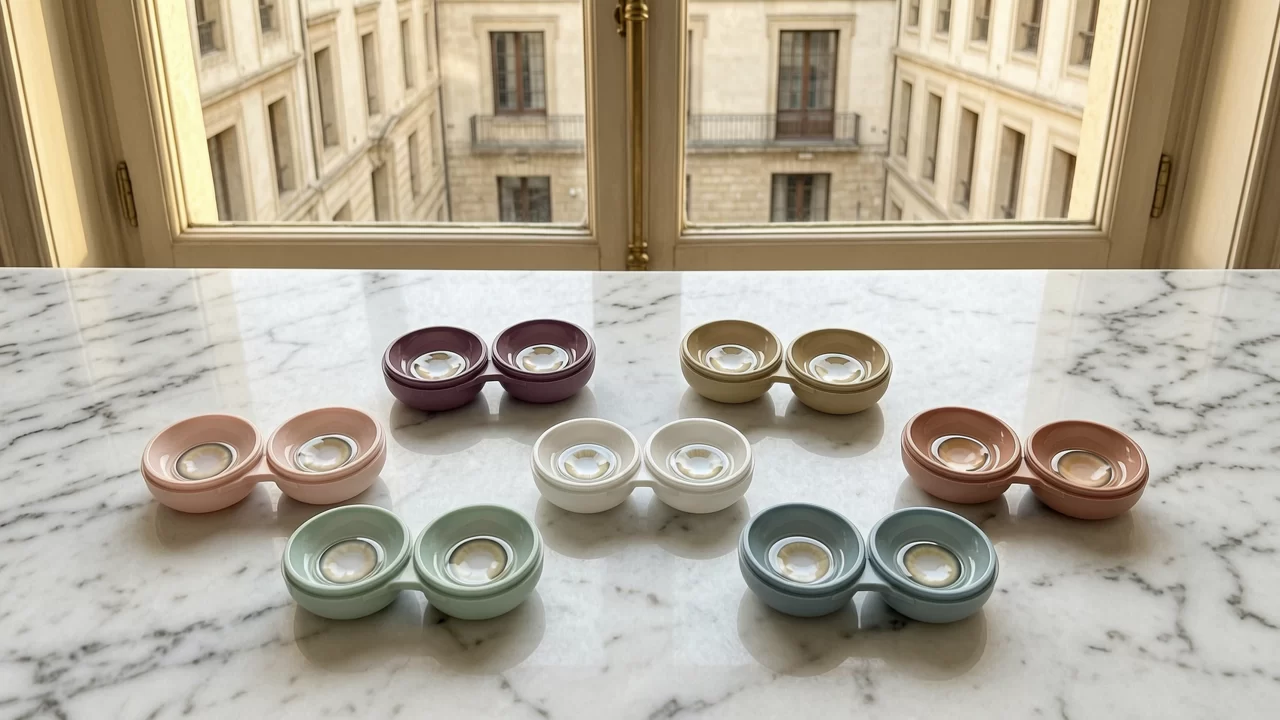
You choose the product. Manufacturers like MIOMI typically offer a catalog of 50 to 100+ lens designs — natural browns, dramatic grays, K-pop inspired patterns, the full range. You pick the designs that fit your brand. Some manufacturers also let you submit custom designs if you have a specific vision.
You control the specs. Diameter, base curve, water content, replacement cycle (daily, monthly, yearly) — these are your decisions. A good manufacturer will guide you, but the final call is yours based on your target market.
You design the packaging. This is where your brand lives. The box, the insert card, the blister pack labeling — it all carries your brand identity. Many manufacturers offer template support, but the design direction comes from you.
The manufacturer handles compliance. FDA documentation, CE marking, ISO certifications — the regulatory paperwork that makes your product legal to sell in target markets. This is critical. Never work with a manufacturer who can’t provide proper certification for your target market.
You get your own SKU. Your brand, your product code, your identity. Not a reseller tag. Not a “distributed by” footnote. Your brand.
The Economics — Let’s Talk Real Numbers
I’ll be transparent because that’s how business should work.
A typical private label order for a new brand looks something like this:
- MOQ: 500 to 1,000 pairs per design (some manufacturers go as low as 300 for existing catalog items)
- Unit cost: Roughly $0.80 to $3.50 per pair depending on lens type, material, and order volume
- Retail price: $15 to $45 per pair in most Western markets
- Margin: 70 to 90 percent if you’re selling direct-to-consumer
Let’s do the math on a modest launch: 5 designs × 500 pairs = 2,500 pairs total. At an average unit cost of $1.50, that’s $3,750 in product cost. Add packaging design, shipping, and maybe a simple Shopify site, and you’re looking at a total initial investment somewhere in the $5,000 to $8,000 range.
If you sell those 2,500 pairs at $20 each, that’s $50,000 in revenue. Even after accounting for marketing, shipping, and operational costs, the margin is substantial.
Now compare that to the traditional wholesale model, where you’d be buying generic stock and competing on price with dozens of other resellers selling the exact same product. The margin there might be 20 to 30 percent if you’re lucky.
Private label isn’t just different. It’s a completely different business model.
Who’s Winning at This Right Now
You’ve probably seen these brands without realizing it. They’re on Instagram with beautiful flat-lay photography. They’re on TikTok with try-on videos that get millions of views. They’re on Amazon with hundreds of five-star reviews.
What do they have in common? None of them own factories. All of them own brands.
Some started as beauty bloggers who realized their audience wanted lens recommendations. Instead of just recommending other brands, they launched their own. Others were salon owners who noticed clients asking about colored lenses and saw the margin opportunity. A few were distributors who got tired of being squeezed between manufacturers and retailers and decided to build their own name.
The pattern is consistent: find an audience that trusts you, give them a product under your brand, and build from there.
The Mistakes New Brands Make (And How to Avoid Them)
After working with dozens of brands at various stages, I’ve seen the same mistakes come up again and again. Let me save you the trouble:
Starting with too many designs. Five is enough. Three if you want to test the waters first. You’re not launching a full catalog — you’re testing what your audience responds to. You can always expand.
Ignoring certifications. If you’re selling in the US, you need FDA clearance. In Europe, CE marking. In the Middle East, GCC registration. Don’t cut corners here. A single compliance issue can shut down your entire operation. Always verify that your manufacturer holds the proper certifications and can provide documentation.
Underinvesting in packaging. Your packaging is your first impression. A generic box with your logo slapped on it won’t build trust. Invest in professional design. Your customers are buying a beauty product — the presentation matters.
Not ordering samples first. Never commit to a full production run without testing samples yourself. Check the color accuracy, comfort, packaging quality, and shelf life. If something feels off at the sample stage, it will be worse at scale.
Trying to compete on price. You can’t beat the big wholesalers on price, and you shouldn’t try. Your advantage is brand identity, curation, and customer relationship. Price competition is a race to the bottom that you will lose.
Where This Is Headed
A few trends I’m watching closely:
Customization beyond branding. Some manufacturers are starting to offer fully custom lens designs — not just your logo, but your pattern, your color palette, your specifications. This used to require orders of 10,000+ pairs. Now some will do it at 2,000.
Subscription models. Monthly lens subscriptions are growing. Brands that build recurring revenue through subscription boxes are seeing much higher lifetime value per customer.
Sustainability. Eco-friendly packaging and biodegradable lens solutions are becoming table stakes in European and North American markets. If you’re not thinking about this now, you will need to within two years.
Regulatory tightening. Markets that were previously loose are tightening up. Southeast Asia, the Middle East, South America — all are moving toward stricter certification requirements. Get compliant early. It’s easier than retrofitting later.
How to Get Started
If you’re reading this and thinking “this sounds like something I could do,” here’s the practical path:
- Define your brand. Who are you selling to? What’s your aesthetic? What problem are you solving that existing brands aren’t?
- Find a manufacturer. Look for ISO 13485 certified facilities with experience in private label. Ask for their catalog, their MOQs, their certification documents, and references from existing private label clients.
- Order samples. Test everything — the lenses, the packaging options, the documentation quality.
- Start small. Launch with 3 to 5 designs. Build your audience. Learn what sells.
- Scale what works. Double down on the designs and marketing channels that are generating sales. Add new designs based on customer feedback and market trends.
The Bottom Line
The contact lens industry is changing. The barrier between “manufacturer” and “brand” is dissolving. And the brands that will dominate the next five years aren’t the ones with the biggest factories — they’re the ones with the strongest connection to their customers.
You don’t need to be a manufacturer to build a contact lens brand. You need to understand your market, partner with the right people, and execute consistently.
At MIOMI, we’ve helped brands from over 20 countries launch their own private label lines. Some started with 500 pairs. Some are now ordering container loads. The difference between them wasn’t capital — it was the decision to start.
If you’re exploring private label for contact lenses, we’re happy to share our catalog, walk through the process, and help you figure out what makes sense for your market. No pressure, no hard sell. Just a conversation about what’s possible.
MIOMI Optical Ltd — ISO 13485 certified manufacturer specializing in private label, OEM, and small-batch customization of contact lenses. Serving brands across Southeast Asia, the Middle East, Europe, North America, and beyond.