Introduction: A Fast-Changing Industry
If you’ve been in the colored contact lens business for more than a couple of years, you already know this — the industry is changing faster than ever. What worked in 2023 might not work in 2025, and it definitely won’t work in 2026.
From where we sit at MIOMI — working with over 200 brands across 30+ countries — we get a front-row seat to what’s happening across the entire market. We see which product categories are growing, which marketing channels are driving sales, and which consumer demands are forcing manufacturers to innovate.
In this article, I want to walk you through the five most important trends we’re seeing right now, heading into the second half of 2026. These aren’t just “nice to know” observations — they’re shifts that will determine which brands grow and which get left behind.
Whether you’re already running a colored lens brand or you’re planning to launch one, understanding these trends will help you make smarter decisions about product development, marketing, and where to invest your resources.
Let’s dive in.
Trend 1: Prescription Colored Lenses Are Finally Having Their Moment
For years, colored contact lenses were mostly marketed as a fashion accessory — something you wore on weekends or for special occasions. Non-prescription lenses dominated the market, and if you needed vision correction, you were mostly out of luck unless you wanted to wear both glasses and colored lenses (not ideal).
That’s changing fast.
Prescription colored lenses are now the fastest-growing segment in the colored contact lens market, and for good reason: roughly 60% of contact lens wearers need some form of vision correction, and until recently, most of them had very few options when it came to colored lenses.
Why Now?
Several factors are driving this shift:
- Technology has caught up. Modern manufacturing techniques can now produce colored lenses with precise prescription powers (including astigmatism and multifocal options) without compromising color quality or wearing comfort.
- Consumers are speaking up. People who wear prescription lenses are tired of being an afterthought. They want the same Instagram-worthy eye colors as everyone else — and they’re willing to pay for it.
- The market is underserved. Walk into any optical store, and you’ll find hundreds of clear contact lens options but maybe 2–3 colored prescription brands. That’s a huge opportunity.
From our manufacturing perspective, we’ve seen prescription lens inquiries go up over 150% in the last 18 months. Brands that used to offer only plano (non-prescription) lenses are now adding prescription ranges, and new brands are launching with prescription as their core offering.
What This Means for Your Brand
If you’re not offering prescription lenses yet, you’re leaving a lot of money on the table. Here’s how to approach it:
- Start with the most common prescriptions. Most people fall between -0.50 and -6.00 diopters. You don’t need to offer every power from the start.
- Consider astigmatism options. About 1 in 3 people have some degree of astigmatism. Offering toric colored lenses is a strong differentiator.
- Price them appropriately. Prescription lenses cost more to manufacture, but customers expect to pay more for them. The margin profile is actually better than plano lenses.
Trend 2: The Rise of “Silent Beauty” and Natural-Looking Lenses
If you’ve paid attention to beauty trends over the past couple of years, you’ve probably noticed the shift away from heavy makeup and toward “clean girl” aesthetics, skinimalism, and what some people are calling “silent beauty.”
This trend has had a massive impact on the colored contact lens market.
Natural-looking, barely-there colored lenses are outpacing bold, dramatic styles by a significant margin. Consumers aren’t just buying lenses for Halloween or cosplay anymore — they’re wearing them every day to enhance their natural eye color, not completely change it.
What “Natural” Actually Means
When we talk about natural-looking lenses, we’re not just talking about brown and hazel. We’re talking about lenses with:
- Subtle limbal rings that define the iris without looking like a solid black circle
- Gradient color patterns that mimic the way real eye color fades from pupil to edge
- Realistic iris texture with flecks and variations instead of flat, uniform color
- Smaller color diameters (13.8–14.0mm) that enhance rather than overpower the natural iris
The fastest-growing colors right now? Honey brown, hazel, gray-green, and soft gray. Colors so subtle that people can’t quite tell you’re wearing colored lenses — they just think your eyes look really good.
Why This Matters for Brands
If your brand currently focuses on bold, opaque anime-style lenses, don’t panic — there’s still a market for those. But if you’re only offering bold styles, you’re missing out on the biggest growth opportunity.
Action items:
- Add 3–5 natural-looking colors to your lineup if you don’t have them already
- Market them as “everyday wear” rather than “costume” or “party” lenses
- Show them on real people with different eye colors — before/after photos work incredibly well
- Consider naming them with nature-inspired names (honey, hazel, olive, sand) rather than fantasy names
Trend 3: Virtual Try-On Technology Is Transforming the Customer Experience
Remember when buying colored lenses online meant scrolling through dozens of product photos, trying to imagine what they’d look like on your eyes?
Those days are ending.
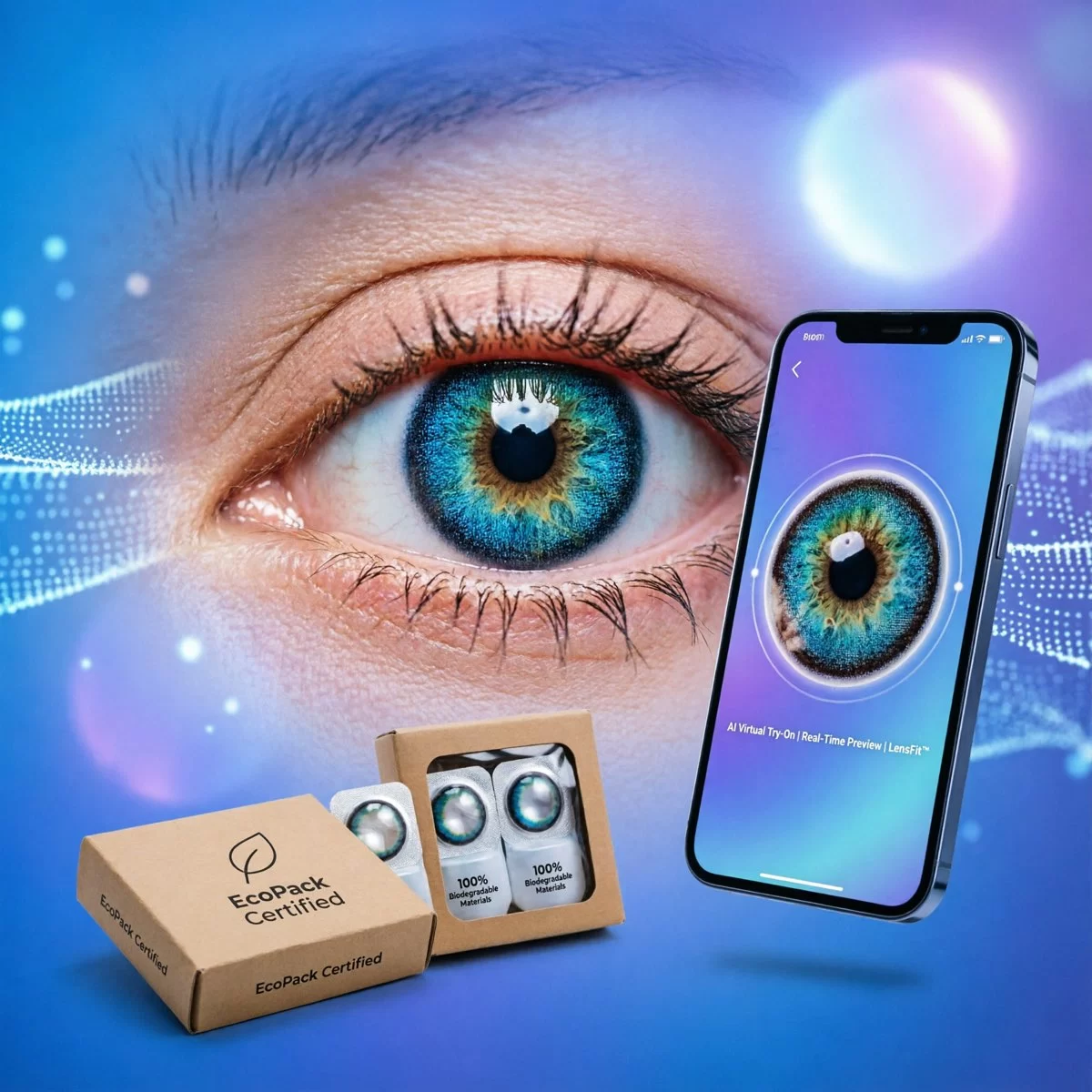
AI-powered virtual try-on technology has gotten genuinely good in the last 12–18 months, and it’s quickly becoming table stakes for direct-to-consumer contact lens brands.
How Good Is It Now?
The latest generation of virtual try-on tools can:
- Map your eye shape and iris size in real-time using just your phone camera
- Overlay lens colors with realistic lighting and reflection effects
- Let you toggle between different colors side-by-side
- Work on both photos and live video
- Integrate directly into Shopify and other e-commerce platforms
The impact on conversion rates is hard to ignore. Brands that have added virtual try-on report:
- 25–40% higher conversion rates on product pages
- Lower return rates (because customers have a better idea of what they’re getting)
- Higher average order values (people are more likely to try multiple colors)
- More time on site (people enjoy playing with the tool)
What This Means for You
You don’t need to build your own virtual try-on tool from scratch — there are several white-label solutions on the market. But you do need to think about adding this capability within the next 12–18 months.
A few tips:
- Make sure the tool works on mobile — that’s where 70%+ of your traffic will come from
- Test it with your actual lens photos — not every tool works well with highly detailed colored lens patterns
- Consider adding a “share your try-on” feature to drive social media exposure
This is one of those trends where early adopters will gain a real competitive advantage. Once customers get used to trying on lenses virtually, they won’t want to go back to guessing from product photos.
Trend 4: Sustainability Is No Longer a Niche Concern
Five years ago, if you mentioned sustainability in the context of contact lenses, people would look at you funny. Today, it’s one of the most common questions we get from brand founders and consumers alike.
The contact lens industry has a well-documented waste problem. Billions of lenses end up in landfills and waterways every year, and consumers are increasingly aware of this.
What’s Driving This Trend?
- Gen Z and millennial consumers care more about sustainability than previous generations, and they vote with their wallets
- Environmental media coverage of contact lens waste has increased awareness dramatically
- Regulatory pressure is building, with the EU and some US states considering extended producer responsibility rules for contact lenses
How Brands Are Responding
We’re seeing several approaches emerge:
1. Eco-friendly packaging
The low-hanging fruit. Switching from plastic clamshells to recycled paper packaging, using soy-based inks, and reducing excess packaging materials. This is relatively easy to implement and resonates well with consumers.
2. Lens recycling programs
Some brands are launching mail-back recycling programs, where customers can send back their used lenses and packaging to be recycled properly. This builds brand loyalty and generates positive PR.
3. Biodegradable lens materials
Still emerging, but several manufacturers are working on biodegradable hydrogel materials that break down faster in the environment. We’re probably 2–3 years away from this being mainstream, but it’s worth watching.
4. Carbon-neutral shipping
Partnering with logistics providers to offset shipping emissions. Easy to implement and a good marketing talking point.
Our Advice
You don’t need to become a fully zero-waste brand tomorrow. But you should start thinking about your sustainability story now. Even small steps — recycled packaging, a recycling program, transparent communication about your environmental impact — will resonate with a growing segment of consumers.
And here’s the honest truth: sustainability is a marketing advantage today, but it will be a minimum requirement in 3–5 years. Better to get ahead of it.
Trend 5: The DTC Model Is Maturing — and Omnichannel Is the Next Frontier
During the pandemic, direct-to-consumer (DTC) colored contact lens brands exploded. With physical stores closed, everyone shifted to online shopping, and new brands launched directly on Instagram and TikTok.
That wave has crested. DTC is still growing, but the landscape is getting more competitive, and customer acquisition costs are rising. The next phase? Omnichannel retail.
What’s Happening
Successful DTC brands are now expanding into physical retail in several ways:
- Pop-up shops and experiential stores — temporary retail locations that let customers try on lenses in person and generate social media content
- Optical store partnerships — placing your brand in independent opticians and optical chains
- Beauty retailer partnerships — getting your product into beauty stores and online beauty marketplaces
- Subscription models — not exactly a channel, but a way to increase retention and lifetime value
Why This Matters
The math is simple: customers who buy both online and in-store spend more and stay longer than single-channel customers. Having a physical presence also builds trust — people feel more confident buying a medical device from a brand they can find in stores.
That said, you don’t need to jump into retail tomorrow. If you’re a new brand, focus on nailing your DTC business first. But as you scale, keep omnichannel expansion on your roadmap.
Key areas to consider:
- Wholesale partnerships with optical retailers — low-risk, high-reward
- Pop-ups in major cities — test the waters before committing to permanent retail
- Influencer collaborations that bridge online and offline (in-person events, meet-and-greets)
What All This Means for Your Brand Strategy
Five trends, and they’re all important. But here’s what I don’t want you to do — I don’t want you to try to tackle all five at once. That’s a recipe for burnout and half-baked execution.
Instead, I want you to pick 1–2 trends that align with your brand’s positioning and focus on those first.
Here’s a quick framework:
| If your brand is… | Focus on these trends first |
|---|---|
| New and just launching | Trend 1 (prescription) — it’s the biggest underserved market |
| Fashion-forward and bold | Trend 2 (natural styles) — add a “natural essentials” line to broaden your audience |
| Tech-focused and innovative | Trend 3 (virtual try-on) — become known for the best customer experience |
| Eco-conscious positioning | Trend 4 (sustainability) — double down and make it your core differentiator |
| Established and scaling | Trend 5 (omnichannel) — expand your distribution channels |
The brands that win in 2026 and beyond won’t be the ones that chase every shiny new trend. They’ll be the ones that understand their customer deeply and make smart, focused investments in the trends that actually move the needle for their specific audience.
Final Thought: The Opportunity Is Still Huge
Despite all the change — or maybe because of it — this is still an incredible time to be in the colored contact lens business. The market is growing, consumers are spending more, and technology is opening up possibilities that didn’t exist five years ago.
The brands that succeed won’t just be selling lenses. They’ll be selling confidence, self-expression, and a little bit of magic — the feeling of looking in the mirror and seeing a version of yourself that you love.
If you’re building a brand in this space and you’d like to talk about how to navigate these trends — whether it’s adding prescription lenses, developing natural color lines, or finding the right manufacturing partner — we’re here to help. We’ve helped over 200 brands launch and scale, and we’d love to share what we’ve learned.
📧 Reach out to us at hello@miomicon.com or visit miomicon.com to learn more about our OEM/ODM services.
Here’s to a great second half of 2026.
— The MIOMI Optical Team