If you’re selling colored contact lenses in the Middle East without understanding these regional preferences, you’re leaving money on the table.
The GCC market isn’t just “another region” — it’s one of the fastest-growing beauty markets globally, with contact lens demand surging among young consumers who view lenses as essential beauty accessories, not just vision correction.
Here’s what we’re seeing across our partner network in the Middle East in 2026.
1. Dark Eye Enhancement Is Non-Negotiable
Let’s start with the obvious: most Middle Eastern customers have naturally dark brown eyes.
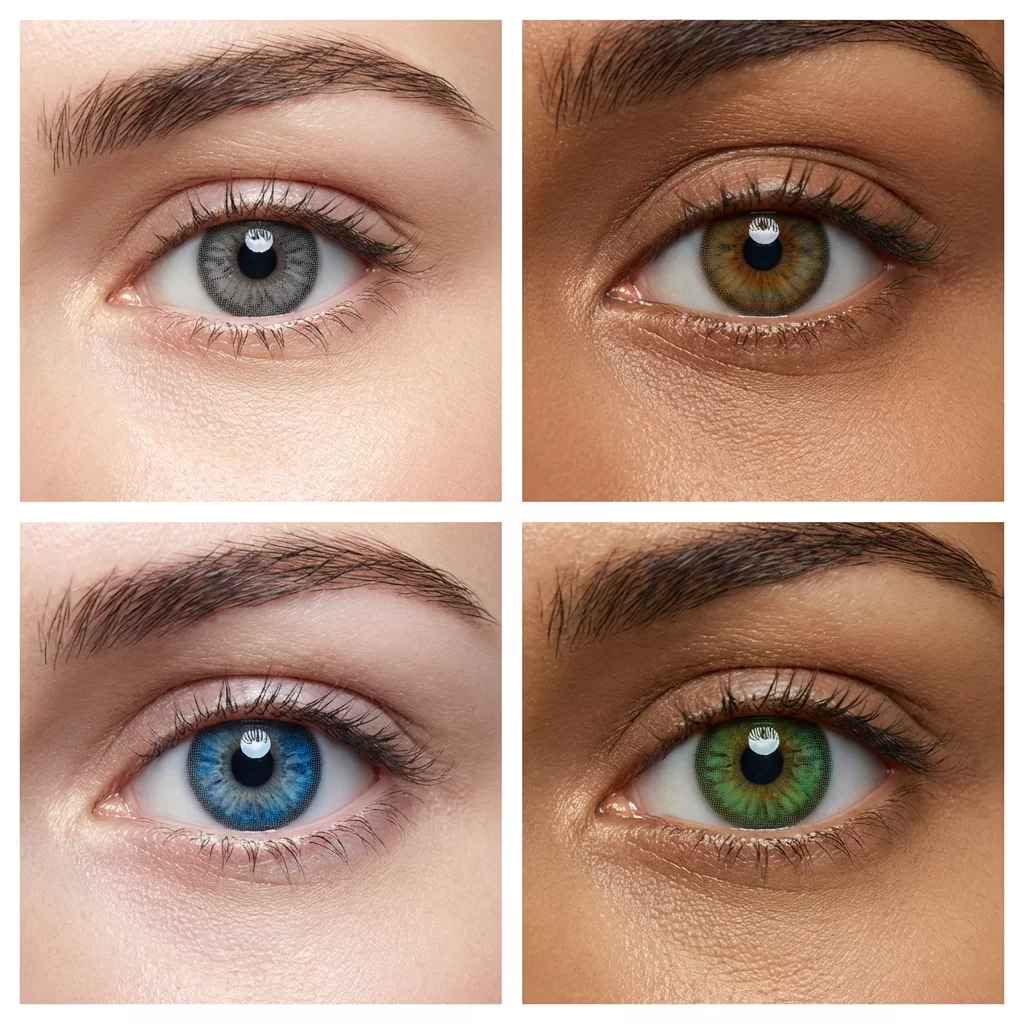
This means light colors (ash gray, ice blue, pastel green) that look stunning on light eyes often appear muddy or invisible on dark eyes. The winners in this market are brands that formulate specifically for high-melanin irises.
What works:
- Rich amber and honey tones — warm, natural enhancement that shows up
- Deep hazel and forest green — dramatic but wearable
- Three-tone gradient designs — outer ring + mid-tone + inner highlight for dimension
- Larger diameter options (14.2mm+) — the “doll eye” effect customers want
What doesn’t:
- Pale pastels that disappear on dark eyes
- Single-tone flat colors
- Diameters under 14.0mm (unless targeting the “natural daily wear” niche)
For brands: Your hero SKUs for the Middle East should be completely different from your European bestsellers.
2. Certification Requirements Vary by Country
This is where many brands stumble.
The Middle East isn’t a single regulatory market. Each country has its own requirements, and customs clearance can make or break your launch.
GCC Common Requirements:
- GSO Certification (Gulf Standardization Organization) — mandatory for all GCC countries
- CE Marking — widely accepted as proof of quality
- ISO 13485 — increasingly required for medical device classification
- Arabic labeling — product information must be available in Arabic
Country-Specific Notes:
- UAE (Dubai/Abu Dhabi): Most streamlined process, SFDA approval required
- Saudi Arabia: Strictest enforcement, plan for longer clearance times
- Kuwait/Qatar: Similar to UAE but smaller market size
- Oman/Bahrain: Growing markets with developing regulatory frameworks
Pro tip: Work with a manufacturer who has existing GCC distribution experience. The paperwork alone can take weeks if you’re doing it for the first time.
3. Influencer Marketing Drives 60%+ of Discovery
Traditional retail is still important, but here’s the reality: most Middle Eastern customers discover new lens brands through Instagram, TikTok, and Snapchat.
The region has some of the world’s highest social media penetration rates. Beauty influencers with 50K-500K followers (micro to mid-tier) often drive better ROI than mega-influencers because their audiences trust their recommendations.
What’s working in 2026:
- Unboxing videos — show the packaging, lens design, and wearing result
- Before/after comparisons — especially important for dark eye customers
- Tutorial content — “how to insert lenses” for first-time buyers
- Honest reviews — comfort, wear time, color accuracy
For new brands: Consider seeding 20-30 micro-influencers before launch. The UGC (user-generated content) you get is worth more than paid ads in this market.
4. Premium Positioning Wins Over Price Competition
Here’s something counterintuitive: the Middle East market responds better to premium positioning than to discount pricing.
Customers in the GCC are willing to pay more for:
- Perceived quality — certifications, professional packaging, brand story
- Exclusive designs — limited editions, influencer collaborations
- Customer service — WhatsApp support, fast responses, easy returns
- Fast shipping — 2-3 day delivery is expected, not a bonus
Pricing sweet spots (retail):
- Entry-level: $15-25 per pair (monthly)
- Mid-tier: $25-40 per pair (premium designs)
- Luxury: $40-60+ per pair (limited editions, collaborations)
The trap: Competing on price alone attracts the wrong customers and kills your margins. Build a brand, not a commodity.
5. Ramadan and Eid Are Peak Seasons
Timing matters more than you think.
The Middle East beauty market has clear seasonal peaks, and contact lenses are no exception. Planning your launches and promotions around these periods can 3-5x your sales.
Key periods:
- Ramadan (month-long): Evening gatherings, Eid preparation — lenses are part of the “getting ready” routine
- Eid al-Fitr: Gift-giving, celebrations — highest single-week sales period
- Eid al-Adha: Second major peak
- Wedding season (Oct-Mar): Brides and guests want to look their best
- Back-to-school (Aug-Sep): Younger customers refresh their look
Planning tip: Launch new collections 4-6 weeks before major holidays. This gives time for influencer content, customer reviews, and word-of-mouth to build before the peak shopping period.
What This Means for Your Middle East Strategy
If you’re entering or expanding in the Middle East market in 2026, here’s your checklist:
✅ Product: Formulate for dark eyes — rich colors, larger diameters, gradient designs
✅ Compliance: GSO + CE + ISO 13485, Arabic labeling ready
✅ Marketing: Influencer-first strategy, UGC-heavy content plan
✅ Positioning: Premium brand story, not discount pricing
✅ Timing: Launch calendar aligned with Ramadan/Eid/wedding season
Ready to Enter the Middle East Market?
At MIOMI, we’ve helped brands launch successful colored lens lines across the GCC and broader Middle East. We understand the regional preferences, certification requirements, and go-to-market strategies that work.
What we offer:
- Market-specific color development — formulations designed for dark eyes
- GCC-ready certifications — CE, ISO 13485, GSO documentation support
- Arabic packaging — compliant labeling and multilingual inserts
- Low MOQs — start with 300 pairs per SKU, test before scaling
- Fast sampling — 7-10 days for custom designs
Whether you’re a beauty brand expanding into lenses or an entrepreneur building your first collection, we’re here to help you do it right.
Get in touch — let’s discuss your Middle East launch plan.
About the author: Diana is the Overseas Business Strategy Director at MIOMI Optical Ltd, specializing in OEM/ODM colored contact lens partnerships for global markets.