Understanding how colored contact lenses are made — and why it matters for your brand.
When you’re building a contact lens brand, one of the most important technical decisions is: Which color technology should you use?
The answer affects everything: customer comfort, safety, color vibrancy, and even your regulatory compliance. Let’s break down the two main manufacturing methods.
Method 1: 3-Layer Sandwich Technology
How It Works
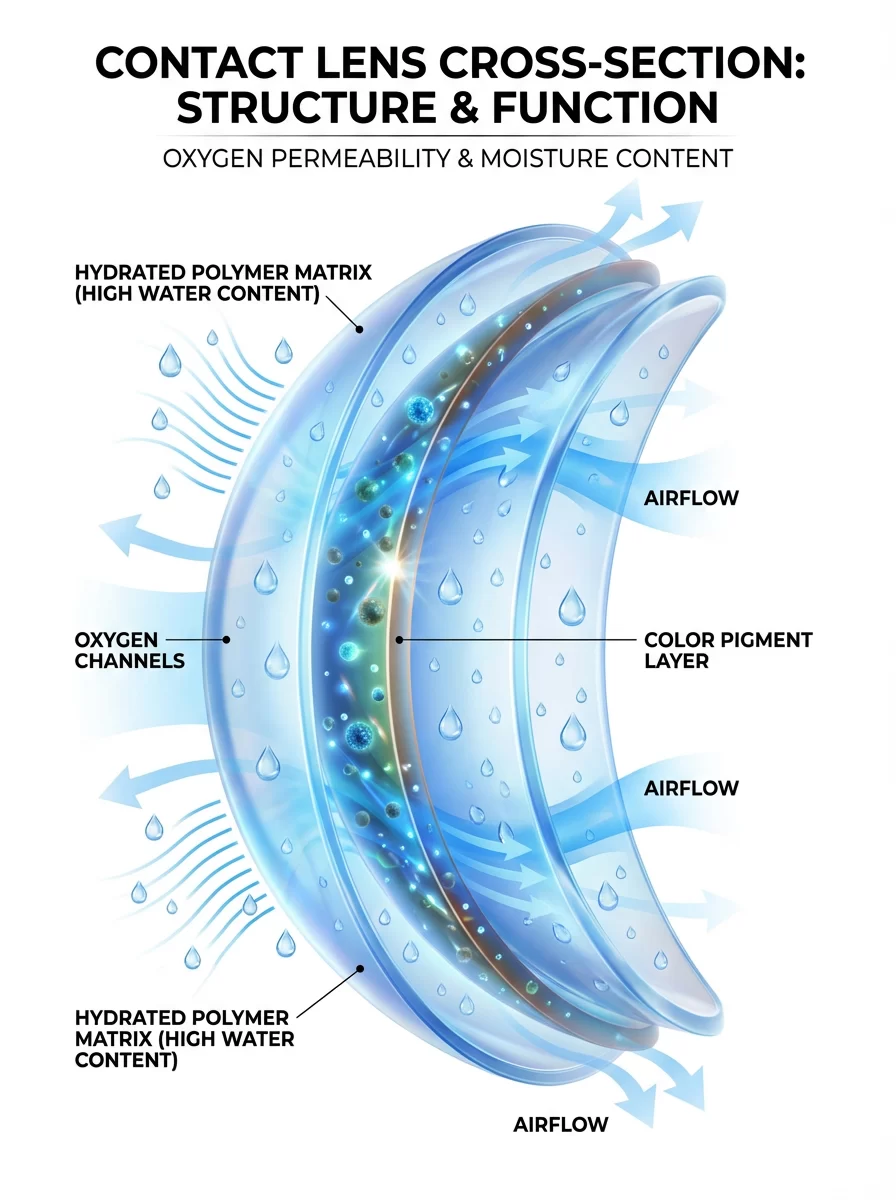
The color pigment is embedded between two clear lens layers — like a sandwich:
Clear Outer Layer → Color Pigment Layer → Clear Inner Layer (contacts your eye)
Key Advantages
- Safety: Pigment never touches your eye
- Durability: Color won’t fade or rub off
- Comfort: Smooth surface, no texture
- Oxygen Flow: Clear layers allow better permeability
Best For
- Premium brand positioning
- Customers with sensitive eyes
- Markets with strict safety regulations (EU, US, GCC)
- Brands emphasizing quality over price
Manufacturing Cost
- Higher: More complex production process
- MOQ: Typically 500+ pairs per color
- Lead Time: 20-30 days for custom colors
Method 2: Printed Color Technology
How It Works
The color is printed directly onto the lens surface using specialized inkjet or pad printing methods.
Key Advantages
- Cost: Lower production cost
- Color Variety: Easier to create custom designs
- Speed: Faster production turnaround
- Design Flexibility: Complex patterns possible
Potential Concerns
- Pigment may be closer to the eye surface
- Color may fade over extended wear
- Some customers report texture awareness
- May not meet strictest regulatory standards
Best For
- Budget-friendly brand positioning
- Fashion lenses (occasional wear)
- Markets with less strict regulations
- Testing new color designs before committing to sandwich production
Manufacturing Cost
- Lower: Simpler production process
- MOQ: Can be as low as 100-300 pairs per color
- Lead Time: 15-20 days for custom colors
Head-to-Head Comparison
| Factor | 3-Layer Sandwich | Printed |
|---|---|---|
| Safety | ⭐⭐⭐⭐⭐ | ⭐⭐⭐ |
| Color Vibrancy | ⭐⭐⭐⭐ | ⭐⭐⭐⭐⭐ |
| Durability | ⭐⭐⭐⭐⭐ | ⭐⭐⭐ |
| Comfort | ⭐⭐⭐⭐⭐ | ⭐⭐⭐⭐ |
| Cost | Higher | Lower |
| MOQ | 500+ pairs | 100+ pairs |
| Lead Time | 20-30 days | 15-20 days |
| Regulatory Compliance | Excellent | Varies |
What This Means for Your Brand
If You’re Positioning as Premium
Choose 3-Layer Sandwich:
- Justifies higher price points ($30-50+ per pair)
- Supports safety-first marketing claims
- Better for building long-term brand trust
- Required for certain market certifications
If You’re Testing the Market
Start with Printed:
- Lower upfront investment
- Faster iteration on color designs
- Can upgrade to sandwich later
- Good for fashion/event lenses
If You’re Building a Hybrid Line
Offer Both:
- Premium line: 3-layer sandwich for daily wear
- Fashion line: Printed for special occasions
- Clear differentiation in marketing
- Captures multiple price segments
Regulatory Considerations
European Union (CE Mark)
- 3-Layer Sandwich: Generally easier to certify
- Printed: Requires additional biocompatibility testing
- Both methods can achieve CE with proper documentation
United States (FDA)
- 3-Layer Sandwich: Preferred method for FDA clearance
- Printed: May face additional scrutiny
- Pigment composition must be fully disclosed
Middle East (GCC)
- Both methods accepted with CE certification
- Some countries prefer sandwich for import approval
- Always check country-specific requirements
Customer Communication Tips
How to Explain the Difference
For 3-Layer Sandwich:
“Our lenses use premium 3-layer technology — the color is safely embedded between two clear layers, so pigment never touches your eyes. This means all-day comfort and vibrant color that lasts.”
For Printed:
“Our fashion lenses feature vibrant printed colors perfect for special occasions. Designed for occasional wear with proper care and handling.”
What NOT to Say
- ❌ “Printed lenses are unsafe” (they’re not — just different use cases)
- ❌ “Sandwich lenses never fade” (all lenses have a replacement schedule)
- ❌ Make medical claims without certification
Making Your Decision
Questions to Ask Yourself
- What’s your target price point?
- Under $25/pair → Printed may work
- $30+/pair → Sandwich justifies premium
- Who is your target customer?
- Daily wearers → Sandwich for comfort
- Occasional/event wear → Printed is acceptable
- What markets are you entering?
- EU/US/GCC → Sandwich preferred
- Southeast Asia → Both acceptable
- What’s your brand positioning?
- Quality/Safety first → Sandwich
- Fashion/Variety → Printed works
The MIOMI Approach
At MIOMI, we manufacture using both technologies — because different brands have different needs.
Our 3-Layer Sandwich Line
- ✅ CE + FDA + ISO 13485 certified
- ✅ 50+ standard colors available
- ✅ Custom color development (MOQ 500 pairs)
- ✅ Full documentation for regulatory submission
Our Printed Fashion Line
- ✅ CE certified options available
- ✅ 100+ design variations
- ✅ Low MOQ (100 pairs per design)
- ✅ Fast turnaround (15-20 days)
What We Recommend
For most new brands, we suggest:
- Start with 3-5 hero colors in 3-layer sandwich — Build trust with quality
- Add printed fashion designs later — Expand variety once you have customers
- Clearly differentiate in marketing — Help customers choose based on their needs
Ready to Choose Your Technology?
The right choice depends on your brand vision, target market, and budget.
At MIOMI, we’ll help you:
- Understand the trade-offs for your specific situation
- See physical samples of both technologies
- Calculate landed costs for your target market
- Navigate regulatory requirements
📧 Contact us: eye@miomi.cc
🌐 Learn more: miomicon.com
About the Author: Diana is the Overseas Business Strategy Director at MIOMI Optical Ltd. With 14+ years in contact lens manufacturing, MIOMI supports brands worldwide with both 3-layer sandwich and printed color technologies.
Disclaimer: This article is for informational purposes. Always verify manufacturing specifications and regulatory compliance with your chosen supplier.