The Contact Lens Industry at a Crossroads: What 2026 Taught Us About 2027
If you’ve been in this industry long enough, you know the rhythm. Trade shows in spring. Sampling seasons. The quiet scramble before Q4 holidays. But 2026 didn’t just follow the rhythm — it rewrote parts of the score.
As someone who fields inquiries from brand owners, distributors, and startup founders across six continents, I’ve had a front-row seat to the shift. The questions changed. The urgency changed. The definition of “minimum viable order” changed.
Here’s what 2026 taught us, and why it matters for what you’re planning in 2027.
The MOQ Conversation Finally Shifted
Five years ago, “low MOQ” meant 5,000 pairs per design. Three years ago, some factories dropped to 1,000. In 2026, we regularly fielded — and fulfilled — requests for 300 pairs per SKU for launch collections.
This wasn’t a race to the bottom on pricing. It was a structural response to how brands actually launch now. TikTok Shop, Instagram drops, micro-influencer seeding — these channels reward speed and variety over volume. A brand testing five color designs at 300 pairs each learns more in six weeks than one committing to 5,000 pairs of a single design learns in six months.
The factories that adapted aren’t just “flexible.” They’ve rebuilt their plating lines, their packaging workflows, their QC sampling protocols around small-batch economics. The ones that didn’t are losing the next generation of brands to competitors who can.
What this means for 2027: If your supplier still quotes 1,000+ MOQ as their “standard,” ask what their actual small-batch capability is. Not “can you do it” — “what’s the lead time, the per-unit cost delta, and the color consistency tolerance at 300 pairs?” Get it in writing.
Daily Disposables Ate the Market’s Lunch
We saw it in the inquiry mix. Three years ago, maybe 15% of new brand projects asked about daily disposables. In 2026, it was north of 60%.
The drivers are practical, not just marketing. Consumers in Southeast Asia and the Middle East — our two fastest-growing regions — associate daily disposables with hygiene and convenience in humid climates. Subscription models (hello, recurring revenue) work naturally with dailies. And regulators in multiple markets are tightening reuse-related compliance, making monthly/yearly lenses a steeper compliance climb for new entrants.
But here’s the catch most brands miss: daily disposable tooling is different. The mold costs, the packaging automation, the sterilization validation — it’s a parallel supply chain. If your OEM partner primarily runs monthly/yearly lines, your “daily disposable launch” becomes their learning curve.
What this means for 2027: Before you sign a design brief for dailies, audit your supplier’s daily disposable track record. How many SKUs have they launched? What’s their reject rate? Do they own the blister packaging line or outsource it?
Color Science Became a Differentiator, Not a Given
“Natural look” used to be a checkbox. In 2026, it became a technical specification.
We had brand owners sending us spectral reflectance targets. Pantone references. Side-by-side comparisons against competitor lenses shot under D65 lighting. The sophistication of the ask jumped because the market penalizes “fake-looking” colors brutally — return rates, bad reviews, TikTok callouts.
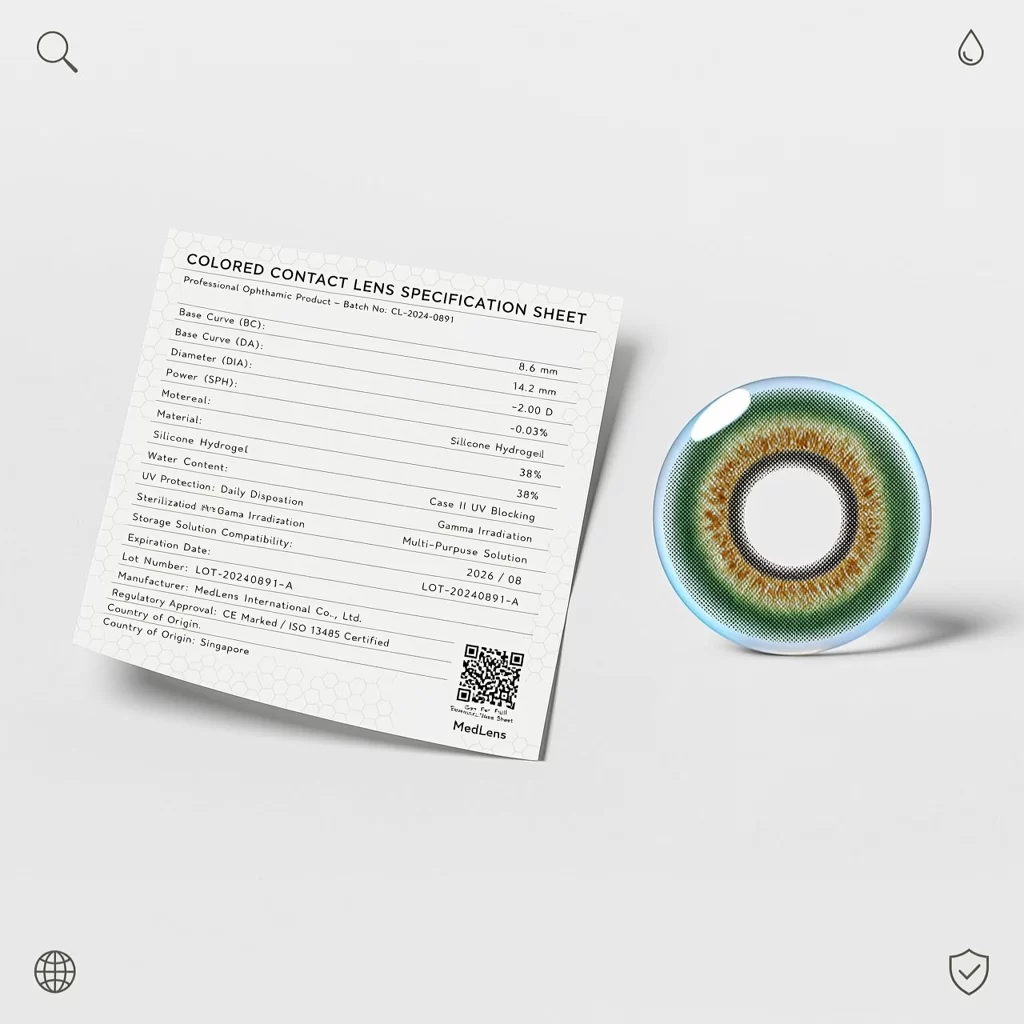
The winners invested in three-layer sandwich printing (pigment encapsulated between lens layers), not surface printing. They specified chroma targets, not just “brown” or “gray.” They asked for in-vivo photos, not just studio renders.
What this means for 2027: If your color development process is “pick from our catalog,” you’re selling 2020 product in 2027. Build a color library with measurable specs. Partner with suppliers who can iterate on chroma, limbal ring definition, and transition zones — not just swap pigments.
Regulatory Divergence Created a New Moat
Here’s the uncomfortable truth: the regulatory map fragmented in 2026.
- The EU MDR transition tightened clinical evidence requirements for Class IIb lenses.
- Saudi SFDA mandated Halal certification pathways for colored lenses.
- Indonesia’s BPOM introduced local testing requirements for imported cosmetics-class lenses.
- The US FDA held the line on 510(k) but signaled scrutiny on direct-to-consumer marketing claims.
Brands that treated compliance as a checklist got stuck. Brands that treated it as a market-entry strategy — securing Halal certs before launching GCC, running pilot clinicals for EU before scaling — moved faster because they didn’t have to retrofit.
What this means for 2027: Map your target markets’ regulatory requirements before you finalize product specs. A lens designed for US 510(k) clearance often needs different materials or documentation for EU MDR. Design once for your hardest market, adapt down — don’t design for the easiest and try to upgrade.
The “Factory vs. Partner” Distinction Hardened
We’ve always had two tiers of inquiry:
Tier 1: “Price for 1,000 pairs of these parameters, shipped to Dubai.”
Tier 2: “We’re launching a brand targeting Gen Z in Vietnam. Here’s our mood board, our price architecture, our launch timeline. Can you help us spec the right product?”
In 2026, Tier 1 inquiries converted at under 5%. Tier 2 converted above 40%.
The difference isn’t budget — it’s whether the buyer views the factory as a vendor or a product development partner. The brands that won brought their supplier into the room before specs were frozen. They shared marketing calendars. They asked “what’s possible at this price point?” instead of “what’s your price for this spec?”
What this means for 2027: If you’re a brand owner, involve your OEM at the concept stage. If you’re a distributor, find factories willing to co-develop. The transactional model is shrinking; the collaborative model is where the margin lives.
Data Finally Reached the Factory Floor
This one surprised me. Multiple factory partners started sharing — unprompted — their sampling yield rates, color consistency metrics, defect categorization dashboards.
Why? Because sophisticated buyers started asking for it. And because the factories that could provide it closed deals faster.
We’re not talking Industry 4.0 buzzwords. We’re talking: “Here’s the Delta E distribution for your last three production runs. Here’s the rejection rate by defect type. Here’s the trend.”
What this means for 2027: Ask for the data. If a supplier can’t show you their color consistency numbers or their sampling yield trends, they’re not managing to those metrics. And if they’re not managing to them, you’re the one absorbing the variance.
The Southeast Asia Pivot Is Real
Everyone talks about Southeast Asia. Fewer people understand the nuance.
Indonesia: volume play, price-sensitive, Muslim-majority (Halal matters), local influencer ecosystems that move product faster than paid media.
Thailand: beauty-obsessed, higher ARPU, regulatory clarity, but fiercely competitive on brand differentiation.
Vietnam: fastest-growing middle class, TikTok Shop native, but import logistics and local distributor exclusivity can trap unwary entrants.
Philippines: English-speaking, high social media penetration, but fragmented geography makes fulfillment a genuine operational challenge.
The brands that succeeded in 2026 didn’t “enter Southeast Asia.” They picked one market, built a local playbook, then expanded.
What this means for 2027: Stop treating SEA as a monolith. Pick your beachhead. Budget for local regulatory, local fulfillment, local marketing — not just “regional.”
What We’re Watching for 2027
Three signals we’re tracking closely:
- Myopia management lenses entering the colored space. The tech exists. The regulatory pathway is clearing. The first brand to credibly combine “slows myopia progression” with “looks amazing” unlocks a massive parent-buying demographic.
- AI-assisted color design. We’re testing tools that simulate in-eye appearance across iris colors, lighting conditions, and camera sensors. Early results suggest 40-50% fewer physical sampling rounds.
- Circular economy pressure. EU packaging directives, brand sustainability pledges, consumer backlash against single-use plastic blisters. The first viable recyclable/biodegradable daily disposable packaging at scale wins a narrative moat.
The Bottom Line
2026 wasn’t a revolution. It was a clarification. The brands that grew were the ones who treated their supply chain as a strategic asset, not a cost center. Who asked better questions. Who invested in color science, regulatory strategy, and partner depth instead of just chasing the lowest unit price.
The playbook for 2027 is already visible in the 2026 data. The only question is whether you’ll act on it before your competitors do.
Looking to launch or scale a colored contact lens brand in 2027? MIOMI Optical works with brand owners, distributors, and retailers worldwide — offering OEM/ODM customization from 300 pairs per SKU, daily disposable and monthly/yearly modalities, CE/FDA/KFDA/SFDA compliant, with in-house color development and regulatory support. Start a conversation or reach us at sales@miomicon.com.