Contact Lens Parameters Explained: Diameter, Base Curve, Water Content — What Brand Owners Need to Know in 2026
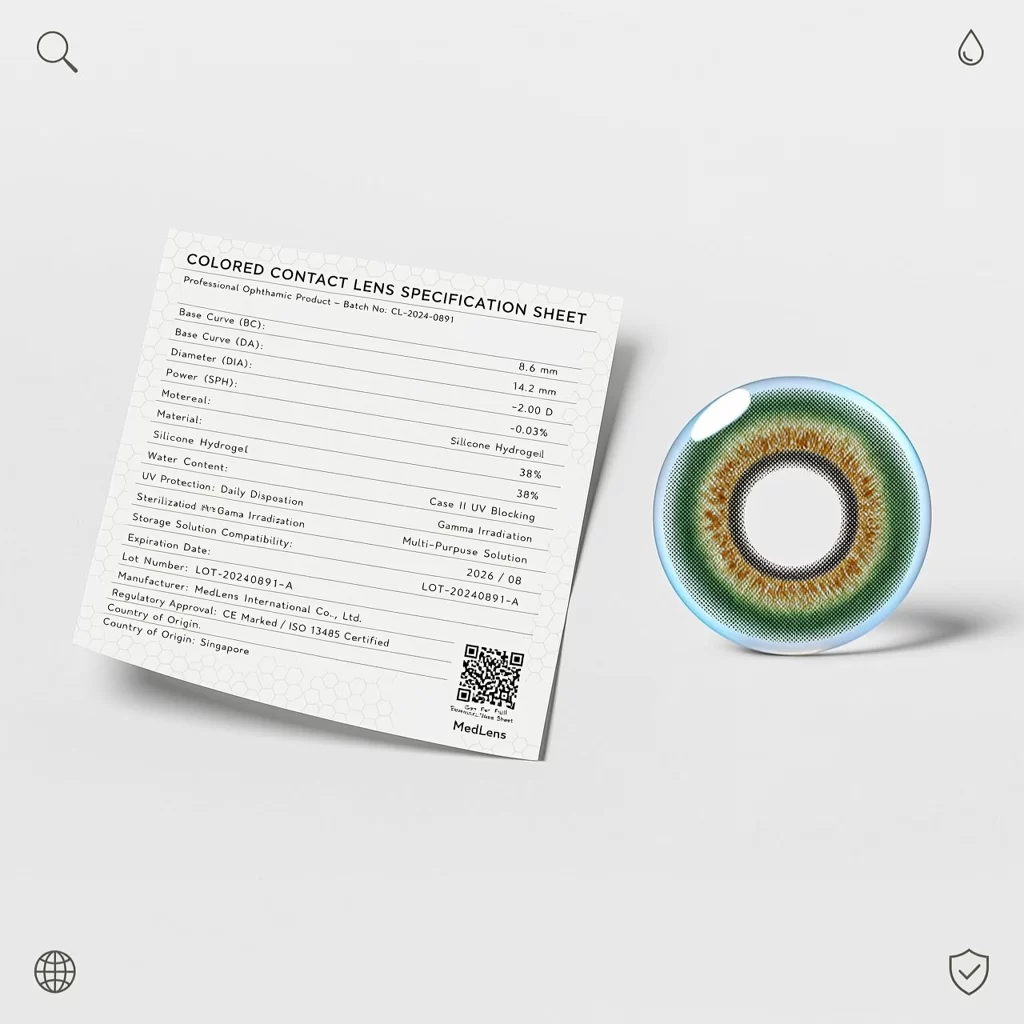
If you are building a contact lens brand, sourcing from an OEM partner, or negotiating wholesale terms, you will stare at specification sheets every week. The numbers look straightforward on paper: 14.2mm diameter, 8.6mm base curve, 38% water content. But in practice, those three parameters drive comfort, fit, oxygen transmission, and ultimately whether your customers reorder or churn.
This guide breaks down what each parameter actually means for your product, your customers, and your supply chain decisions — without the fluff.
Why Parameters Matter More Than Marketing
Most brand owners start with color designs, packaging concepts, and Instagram strategies. Those matter. But the spec sheet is the contract between your factory and your customer’s eyes. Get it wrong, and no amount of branding fixes the returns, the comfort complaints, or the regulatory pushback.
In 2026, buyers are sharper. Wholesalers ask for spec sheets before they request samples. Retail partners want to know the water content because their customers ask. Marketplaces like Amazon and Shopee flag listings that omit base curve data. If you cannot explain your parameters confidently, you are not ready to sell.
Diameter: The Visible Number
What it is: The total width of the lens from edge to edge, measured in millimeters. Standard range for colored lenses: 13.8mm to 14.5mm.
What it does: Diameter determines how much of the cornea (and limbal ring) the lens covers. A larger diameter creates a more dramatic enlargement effect — the “doll eye” look that drives demand in East Asia and Southeast Asia. A smaller diameter sits closer to the natural iris size, preferred in Europe and North America for a subtle enhancement.
The trade-offs you need to know:
| Diameter Range | Typical Market | Fit Considerations |
|—————-|—————-|———————|
| 13.8–14.0mm | Europe, North America, Australia | Easier fit, less edge awareness, more natural look |
| 14.2–14.5mm | East Asia, Southeast Asia, Middle East | Stronger enlargement, higher edge sensation risk, tighter fit on smaller eyes |
Factory reality: A 0.2mm difference changes the mold tooling. If you want to offer both 14.0mm and 14.5mm in the same color, that is two separate mold sets — double the tooling cost, double the MOQ per color. Most low-MOQ OEM partners (like MIOMI) standardize on 14.2mm as the sweet spot: large enough for the enlargement market, small enough to fit most eyes comfortably.
Pro tip: If your brand targets multiple regions, pick one diameter per product line and own it. Do not try to please everyone with a single SKU. Launch a “Natural Fit” line at 14.0mm and a “Glamour” line at 14.5mm. Your factory will thank you, and your customers will understand the difference.
Base Curve: The Hidden Fit Factor
What it is: The radius of curvature of the lens back surface, measured in millimeters. Standard range: 8.4mm to 8.9mm.
What it does: Base curve (BC) determines how tightly the lens hugs the cornea. A steeper curve (lower number, e.g., 8.4mm) fits a steeper cornea. A flatter curve (higher number, e.g., 8.8mm) fits a flatter cornea. Match it wrong, and you get either tight lens syndrome (redness, blurred vision on removal) or excessive movement (discomfort, decentration, unstable vision).
The dirty secret: Most colored lens factories produce one base curve per diameter. Typically 8.6mm for 14.2mm lenses. They do not stock multiple base curves because each BC requires separate molding, separate QC, separate inventory.
What this means for you:
- If you are a brand owner: You cannot offer “multiple base curves” as a selling point unless you commit to high MOQs (usually 3,000+ pairs per color per BC). Accept the factory standard and design your marketing around it.
- If you are a wholesaler: Ask your supplier what base curve they use. If they cannot tell you, walk away. A reputable factory knows their BC offhand.
- If you serve medical/optical channels: You need multiple base curves. That means higher MOQs, longer lead times, and a factory with medical device licensing. Budget accordingly.
Regional cornea data (approximate averages):
– East Asian eyes: steeper corneas → prefer 8.4–8.6mm BC
– Caucasian eyes: flatter corneas → prefer 8.6–8.8mm BC
– The 8.6mm standard splits the difference reasonably well for global distribution.
Edge case: If a client demands 8.4mm or 8.8mm specifically, ask for their order volume first. If it is under 2,000 pairs per color, the tooling cost will kill their margin. Suggest they test the standard 8.6mm first — most wearers adapt within a week.
Water Content: The Comfort Marketing Number
What it is: The percentage of the lens weight that is water. Standard hydrogel range: 38% to 58%. Silicone hydrogel: typically lower (24% to 48%) because the silicone matrix transmits oxygen directly.
What buyers think it means: “Higher water = more comfort.” This is the single biggest misconception in the industry.
What it actually means:
– High water (50%+): Feels great initially. But high-water lenses dehydrate faster on the eye, especially in air-conditioned offices, dry climates, or during screen time. They pull moisture from the tear film. Result: mid-day dryness, lens awareness, dropout.
– Mid water (38–45%): More stable hydration. Less evaporation. Better end-of-day comfort for most wearers. Slightly lower initial “wow” feel, but higher retention.
– Silicone hydrogel (low water, high Dk/t): Oxygen transmits through the material, not the water. These can run at 33% water and still deliver 100+ Dk/t. Best for extended wear and sensitive eyes. Higher cost.
The marketing trap: Competitors will advertise “58% water content!” as a premium feature. Do not match them blindly. If your target market is daily disposable wearers in humid Southeast Asia, 58% might work. If you sell monthly lenses to office workers in Dubai or London, 38–42% hydrogel or 33% silicone hydrogel will outperform on actual comfort.
What to put on your spec sheet: Be honest. List the water content. But in your B2B conversations, lead with Dk/t (oxygen transmissibility) and material type (hydrogel vs silicone hydrogel). Water content alone is a vanity metric.
The Parameter Triangle: How They Interact
You cannot optimize one parameter in isolation.
| Change | Effect on Diameter | Effect on Base Curve | Effect on Water Content |
|——–|——————-|———————|————————|
| Larger diameter | More coverage, tighter fit | May need flatter BC to compensate | Higher water helps comfort on larger lens |
| Steeper BC (lower number) | Feels tighter | Better centration on steep eyes | Minimal direct effect |
| Higher water | Slightly thicker lens | Minimal direct effect | Better initial comfort, worse dehydration |
Real example from our factory floor: A European brand wanted 14.5mm diameter + 8.4mm BC + 55% water. The result: lenses that fit like suction cups on flatter European corneas, dehydrated by 2 PM, and generated a 18% return rate. We redirected them to 14.2mm / 8.6mm / 42% hydrogel. Returns dropped to 3%.
Your job as a brand owner: Understand the triangle. When a factory says “we can do that combination,” ask for the sample data. How many eyes was it tested on? What was the dropout rate? If they have no data, you are the test subject.
What to Ask Your OEM Partner (Before Sampling)
- “What is your standard base curve for this diameter?” If they hesitate, they are reselling someone else’s stock.
- “Do you have clinical fit data for this parameter combination?” Legitimate factories test on 20+ eyes minimum before releasing a new spec.
- “What material are you using — hydrogel or silicone hydrogel? What is the Dk/t?” If they only quote water content, they are selling on marketing, not performance.
- “Can you produce 14.0mm and 14.5mm in the same color? What is the MOQ per diameter?” This reveals their actual mold flexibility.
- “How do you handle base curve tolerance?” ISO 18369 allows ±0.2mm. Ask what their actual process capability is. Tight tolerance = better consistency.
Spec Sheet Red Flags
When reviewing a supplier’s spec sheet, watch for these:
- ❌ Only diameter listed, no base curve → they don’t control the fit
- ❌ Water content listed as a range (e.g., “38–58%”) → they are mixing materials
- ❌ No Dk/t value for silicone hydrogel → they may be using older-generation material
- ❌ “Custom base curve available” with no MOQ stated → tooling cost will surprise you
- ❌ Center thickness not listed → affects oxygen transmission and comfort
Building Your Brand’s Parameter Strategy
Step 1: Define your primary market.
– North America/Europe → 14.0–14.2mm, 8.6mm BC, 38–42% hydrogel or 33% SiHy
– East Asia/Southeast Asia → 14.2–14.5mm, 8.6mm BC, 38–45% hydrogel
– Middle East → 14.2–14.5mm, 8.6mm BC, prefer SiHy for dry climate
Step 2: Choose your material tier.
– Entry: Standard hydrogel, 38–42% water, 20–25 Dk/t
– Mid: High-Dk hydrogel, 45–55% water, 30–40 Dk/t
– Premium: Silicone hydrogel, 33–48% water, 100+ Dk/t
Step 3: Lock your spec and communicate it.
Put the full parameter set on your B2B portal, your wholesale catalog, and your Amazon backend. Wholesalers copy-paste this data. Make it easy for them.
Step 4: Test, don’t guess.
Order 500 pairs in your chosen spec. Fit them on 10–15 real wearers across your target demographics. Track comfort at 2 hours, 8 hours, and end of day. Use that data to negotiate your next production run.
The Bottom Line
Diameter, base curve, and water content are not just numbers on a spreadsheet. They are the engineering decisions that determine whether your customer says “these are amazing” or “my eyes hurt by noon.”
In 2026, the brands that win are not the ones with the prettiest packaging. They are the ones who can look a wholesale buyer in the eye (or on a Zoom call) and say: “We chose 14.2mm diameter with 8.6mm base curve and 42% water hydrogel because that combination fits 85% of our target demographic, delivers stable all-day comfort in air-conditioned environments, and keeps our MOQ at 500 pairs per color. Here is the fit data.”
That is the conversation that closes B2B deals.
MIOMI Optical provides OEM/ODM colored contact lenses with standardized parameters (14.2mm diameter, 8.6mm base curve, 38%/42% hydrogel, 33% silicone hydrogel options), low MOQ starting at 500 pairs per color, and full CE/FDA documentation. Contact our team for spec sheets, sampling, and production timelines.