Every brand owner in the contact lens space faces the same fork in the road. You have the designs, you know your market, and now you need to decide: do you go with private label, or do you invest in custom OEM?
It is not just a vocabulary difference. The choice shapes your margins, your speed to market, your quality control, and ultimately whether your brand can survive past the first trend cycle.
I have guided dozens of brand owners through this decision at MIOMI. Some started with private label and never looked back. Others started there, hit a ceiling, and moved to custom OEM. A few jumped straight to custom and regretted the cash burn.
Here is the practical breakdown for 2026, so you can choose with eyes open.
What Private Label Actually Means
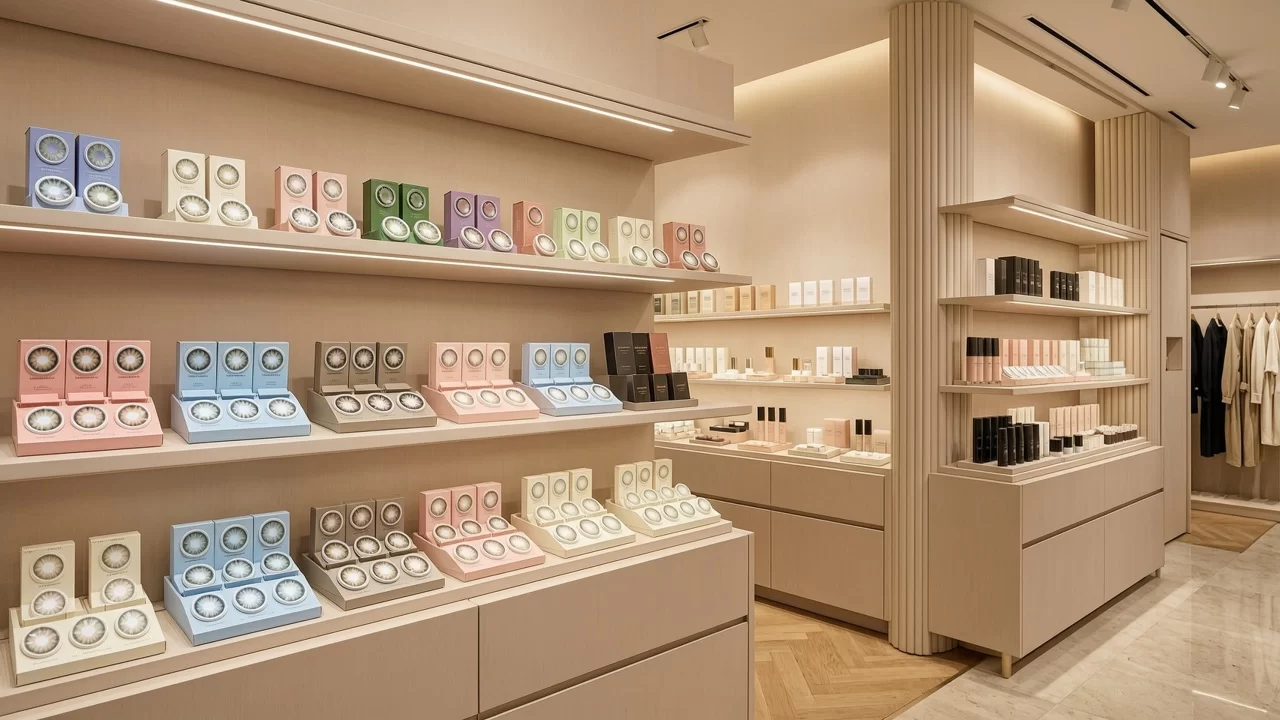
Private label is straightforward. The factory has existing lens designs — specific base curves, diameters, water contents, color patterns — already tooled, validated, and in production. You pick from their catalog, put your logo on the box, and they ship.
What you get:
- No mold costs. The tooling is already paid for.
- Fast lead times. Stock items ship in 7 days; custom packaging adds 1-2 weeks.
- Proven quality. The design has batch history, stability data, and regulatory clearance.
- Lower MOQs. Often 500-1,000 pairs per SKU because the factory runs these designs regularly.
What you don’t get:
- Exclusivity. Your competitor can buy the exact same lens design.
- Parameter control. You cannot change base curve, diameter, or optical zone.
- Color ownership. The color pattern belongs to the factory. You cannot tweak the hue or print density.
- Material choice. You are limited to the materials the factory runs for that design.
What Custom OEM Actually Means
Custom OEM means you specify the lens parameters, the color design, the material, and the packaging. The factory builds molds for your design, runs validation, and produces exclusively for you.
What you get:
- Full parameter control. Base curve, diameter, power range, optical zone — your specs.
- Color exclusivity. Your pattern, your print density, your hue. No one else has it.
- Material selection. Hydrogel, silicone hydrogel, specific water content — you choose.
- Brand defensibility. This is your IP. Competitors cannot copy it without new molds.
What it costs:
- Mold fees. $800-2,500 per design depending on complexity. Multi-color prints cost more.
- Longer lead time. 6-10 weeks for first order (mold making, validation, sterilization, release).
- Higher MOQ. Typically 3,000-5,000 pairs per SKU for economic production.
- Validation burden. You own the regulatory documentation for your specific design.
The Decision Framework: 5 Questions
1. Is your differentiation in the lens or the brand?
If your edge is marketing, community, influencer relationships, and packaging — private label works. The lens is a commodity; your brand is the product.
If your edge is a specific optical design, a proprietary color technology, or a material innovation — you need custom OEM. The lens IS the product.
2. What is your cash flow reality?
Private label: pay for inventory + packaging. First order $3,000-8,000 typical.
Custom OEM: pay for molds + validation + first run + packaging. First order $15,000-40,000 typical.
Do not finance custom OEM with credit cards. If the first run does not sell, you own molds you cannot use.
3. How fast do you need to be in market?
Private label: 3-4 weeks from art approval to delivery.
Custom OEM: 8-12 weeks minimum. Add 4 weeks if you need CE technical file compilation for Europe.
If you have a seasonal window (Valentine’s, Halloween, back-to-school), private label is the only realistic path for year one.
4. Who owns the customer relationship?
If you sell direct-to-consumer through your own site and social — private label lets you test colors fast, kill losers, double down on winners.
If you sell through optical chains, pharmacies, or distributors — they often require exclusive designs. Custom OEM becomes a channel requirement, not a choice.
5. What is your regulatory strategy?
Private label: the factory’s existing CE/FDA/KFDA registrations cover the design. You add your brand to their technical file.
Custom OEM: you need your own technical file, your own Declaration of Conformity, potentially your own FDA listing. Budget $5,000-15,000 and 3-6 months for full multi-market compliance.
The Hybrid Path Most Brands Actually Take
Smart brands do not treat this as binary. They sequence it.
Phase 1 (Months 1-6): Private label launch. Pick 4-6 colors from the factory catalog. Launch fast. Build audience. Learn which colors actually sell. Collect customer fit feedback.
Phase 2 (Months 6-12): Custom color on existing parameters. Take your best-selling private label parameters. Commission a custom color print. Cost: one mold set ($800-1,500), 4-6 week lead time. Now you have exclusivity on your winner.
Phase 3 (Year 2+): Full custom design. If volume justifies it, invest in custom base curve/diameter for your target demographic. Asian-fit base curves, extended power ranges, silicone hydrogel upgrade. This is where margins expand and defensibility locks in.
I have seen brands skip Phase 1 and go straight to Phase 3. They burn $30,000 on molds for colors nobody buys. I have seen brands stay in Phase 1 forever and get copied by competitors who moved to Phase 2.
Practical Checklist Before You Decide
- [ ] Can you name the specific parameter (base curve, diameter) your target customer needs? If no → private label.
- [ ] Do you have $15K+ budget for first custom run without jeopardizing operations? If no → private label.
- [ ] Does your sales channel require exclusive designs? If yes → custom OEM.
- [ ] Can you wait 8-12 weeks for first delivery? If no → private label.
- [ ] Do you have regulatory support for custom technical files? If no → private label (or budget for consultant).
- [ ] Is your color concept truly unique, or a variation of existing trends? If variation → private label first.
What MIOMI Recommends
We offer both paths because different brands are at different stages.
If you are pre-revenue or under $100K ARR: start with our private label catalog. 500-pair MOQ, 7-day lead on stock, your branding on professional packaging. Use the cash you save to build marketing.
If you are $100K-500K ARR with proven color demand: let’s do custom color on proven parameters. One mold fee, 5-week lead, your exclusive print.
If you are $500K+ ARR with optical distribution: full custom OEM. We will walk you through the technical file, mold design, and validation protocol.
The factory does not care which path you choose. We care that you choose the one that lets you reorder.
Not sure which path fits? Send your brand deck and target markets to sales@miomicon.com. We will give you a straight answer — no pitch, just the trade-offs for your specific situation.
Meta Description: Private label vs custom OEM contact lenses — which path fits your brand in 2026? Real trade-offs on cost, lead time, exclusivity, and regulatory burden from MIOMI Optical.