How to Price Your Private Label Contact Lenses: A Margin Guide for New Brand Owners
So you’ve found a reliable OEM supplier, picked your lens parameters, and designed packaging that actually looks good on shelf. Now comes the part nobody warns you about: figuring out what to charge.
Pricing a private label contact lens line isn’t just about slapping a markup on your cost sheet. Get it wrong and you either scare off retailers with unrealistic margins or price yourself into obscurity. After working with dozens of brand owners across Southeast Asia, the Middle East, and Europe, I’ve seen the same pricing mistakes show up again and again.
Here’s what actually works.
Start With Your Landed Cost — Not Your Factory Quote
The biggest mistake new brand owners make is taking the factory price and multiplying by two. That’s not your cost. Your cost is your landed cost — everything it takes to get a finished, boxed lens from the factory floor to your warehouse door.
Here’s what goes into landed cost that people forget:
- Unit manufacturing cost — the lens itself (this is usually 30-40% of your total)
- Custom packaging — boxes, blister packs, inserts, user manuals
- Labeling and compliance — regulatory labels, language-specific inserts, barcodes
- Freight — international shipping, customs duties, import VAT
- Inspection and testing — third-party lab fees, batch testing
- Warehousing — receiving, storage, handling
When you add all of this up, the real per-unit cost is often 2.5x to 3x the factory quote. If your supplier says $0.80 per pair, your landed cost might be $2.00-$2.40. That number is your actual starting point.
Know Your Channel Margins Before You Set Retail Price
Every distribution channel takes a cut. If you don’t account for this, you’ll price your product at $12 retail, hand it to a distributor, and realize you’re making $0.30 per box.
Here’s a typical margin breakdown in the colored contact lens space:
Direct-to-consumer (your own website):
- You keep 100% of the margin
- But you pay for marketing, fulfillment, and customer service
- Typical net margin: 40-55%
Retail (optical shops, beauty stores):
- Retailer expects 40-60% margin
- You might net 20-35% after their cut
- But volume is higher and customer acquisition cost is lower
Distributor/wholesale:
- Distributor takes 25-40%
- You net 15-30%
- Volume is highest, but so is the pressure on your pricing
Marketplace (Amazon, Shopee, Lazada):
- Platform fees: 10-20%
- Fulfillment fees: 10-15%
- Advertising: 10-25%
- You might net 15-30% if you manage it well
The point is: your retail price needs to leave enough room for every player in the chain to make money. Work backwards from what the end customer pays, not forwards from what you spend.
The Three-Tier Pricing Strategy That Actually Works
Most successful private label contact lens brands I’ve worked with use a three-tier structure:
Tier 1: Entry-level (your “traffic” product)
- Priced aggressively to attract first-time buyers
- Think daily disposables, basic colors, simple packaging
- Margin: 25-35% — you’re not making much, but you’re building a customer base
- This is your “try us” product
Tier 2: Core range (your “bread and butter”)
- Mid-range pricing with your best-selling colors and designs
- Better packaging, maybe premium materials like silicone hydrogel
- Margin: 45-60% — this is where you make real money
- Most of your volume should come from here
Tier 3: Premium (your “brand builder”)
- Higher price point, limited editions, special effects, or advanced materials
- Premium packaging, maybe a collaboration or seasonal collection
- Margin: 60-75% — lower volume but high per-unit profit
- This tier makes your brand look aspirational
The key insight: your Tier 1 product exists to get people into your ecosystem. Your Tier 2 product is where they stay. Your Tier 3 product is what makes them tell their friends.
Don’t Ignore the Psychology of Lens Pricing
Contact lenses aren’t a commodity purchase — they’re a beauty and health product rolled into one. Buyers are making decisions based on trust, aesthetics, and perceived quality. Your pricing needs to reflect that.
A few things that matter more than you’d think:
Price anchoring. If your premium pair is $28 and your standard pair is $14, the $14 option feels like a deal — even if it’s priced above your competitors. Always show the premium option first.
Bundle pricing. Selling a box of 10 pairs at $85 feels better than $9.50 per pair, even though the math is identical. Buyers love feeling like they “saved” money.
The $20 threshold. In most markets I’ve worked in, there’s a psychological barrier around $18-$22 for a box of colored lenses. Price below it and you look cheap. Price above it and you need to justify why.
Currency and rounding. If you’re selling in multiple markets, round to clean numbers in each currency. $14.99 in USD, €14.90 in EUR, ¥1,980 in JPY. Nobody likes $14.37.
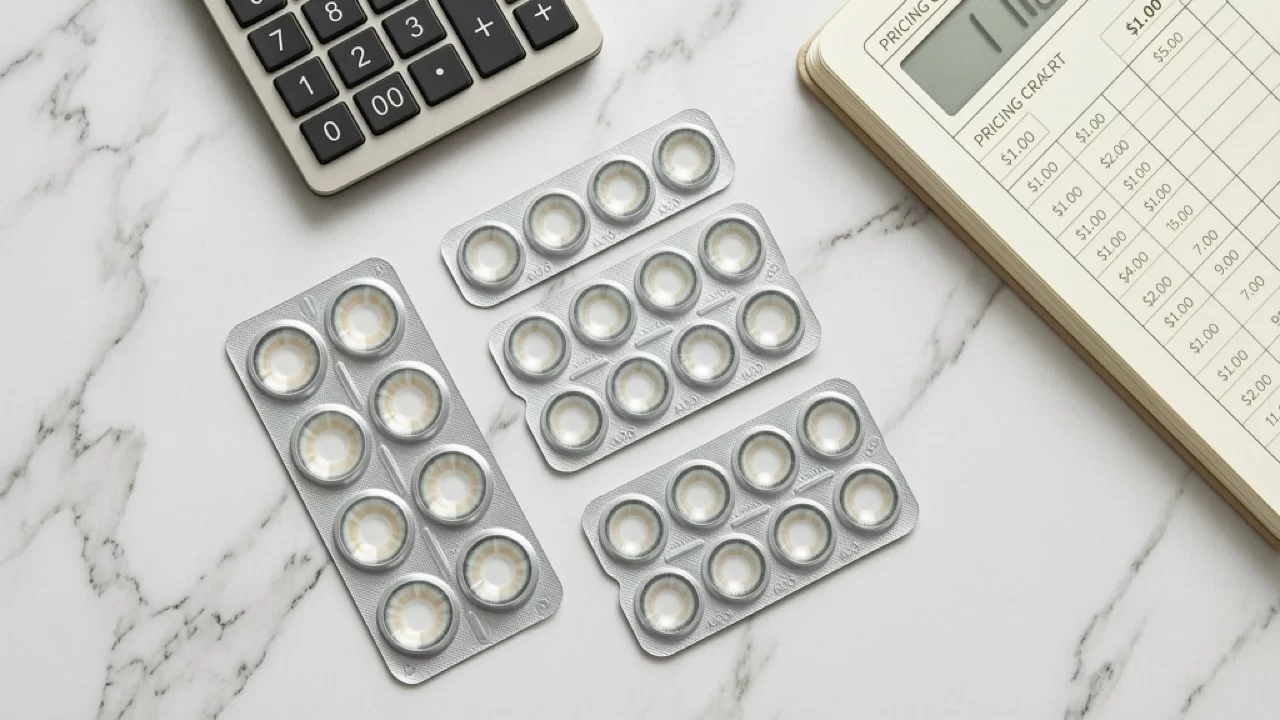
Build a Pricing Spreadsheet — and Update It Quarterly
I can’t tell you how many brand owners come to me six months after launch saying “I think I’m losing money but I’m not sure where.” They never built a proper pricing model.
Your pricing spreadsheet should include:
- Per-unit landed cost (updated with each production run)
- Channel-specific margins
- Marketing cost per acquisition (even a rough estimate)
- Return and complaint rate (budget 2-5% for colored lenses)
- Currency exchange buffer (3-5% if you’re buying in USD and selling locally)
Review it every quarter. Raw material costs shift. Shipping rates change. Exchange rates move. If you set your prices once and forget about them, you’ll slowly bleed margin without noticing.
When to Raise Prices (and When Not To)
New brand owners are terrified of raising prices. They think customers will leave. Here’s the truth: customers leave when quality drops or service gets worse. A 5-10% price increase once a year is normal and expected in this industry.
Good reasons to raise prices:
- Your supplier’s costs went up (and you can prove it)
- You’ve improved the product (better material, new colors, upgraded packaging)
- Your brand has grown (more reviews, more recognition, more trust)
- You’re entering a new market with higher purchasing power
Bad reasons to raise prices:
- You’re just not making enough money (fix your costs instead)
- A competitor raised their prices (that’s not a strategy)
- It’s a new year (customers don’t care about your calendar)
When you do raise prices, frame it around value: “We’ve upgraded our packaging and added three new colors” hits differently than “our costs went up.”
The Real Question: What’s Your Brand Worth?
Here’s something that took me years to internalize: pricing isn’t just math. It’s a signal.
When you price your colored contact lenses at $8 a box, you’re telling the market you’re a budget option. When you price at $24, you’re telling them you’re premium. Neither is wrong — but you need to pick one and commit.
The brands that struggle most are the ones stuck in the middle. Too expensive to be the “affordable” option, too cheap to be taken seriously as a premium brand. They satisfy nobody.
So before you open a spreadsheet, ask yourself: where does my brand sit in the market? Who is my ideal customer? What are they willing to pay for the experience I’m offering?
The numbers will follow the strategy. Not the other way around.
At MIOMI Optical, we help brand owners build private label contact lens lines with flexible MOQs and transparent pricing. Whether you’re launching your first collection or expanding into new markets, our team can walk you through the numbers. Reach out at sales@miomicon.com or WhatsApp us at +86 13862973905.