# The EU Regulatory Framework for Colored Contact Lenses: What Brand Owners Need to Know Before Entering Europe
The European market is tempting. High purchasing power, strong beauty culture, and a growing appetite for colored contact lenses across every age group. But here’s the thing nobody tells you when you’re excited about expanding into Europe: the regulatory barrier is real, and getting it wrong doesn’t just delay your launch — it can shut you out entirely.
I’ve watched brands rush into the European market with products that worked perfectly in Southeast Asia or the Middle East, only to hit a wall of compliance requirements they didn’t anticipate. Some recovered. Some didn’t.
If you’re thinking about bringing your colored contact lens brand to Europe, here’s what you actually need to understand.
## Why Europe Is Different (and Not Just “Stricter”)
Let’s clear something up first. When people say Europe has “strict regulations,” they usually mean it in a vague, hand-wavy way. But the specifics matter, because they directly affect your product design, packaging, labeling, and timeline.
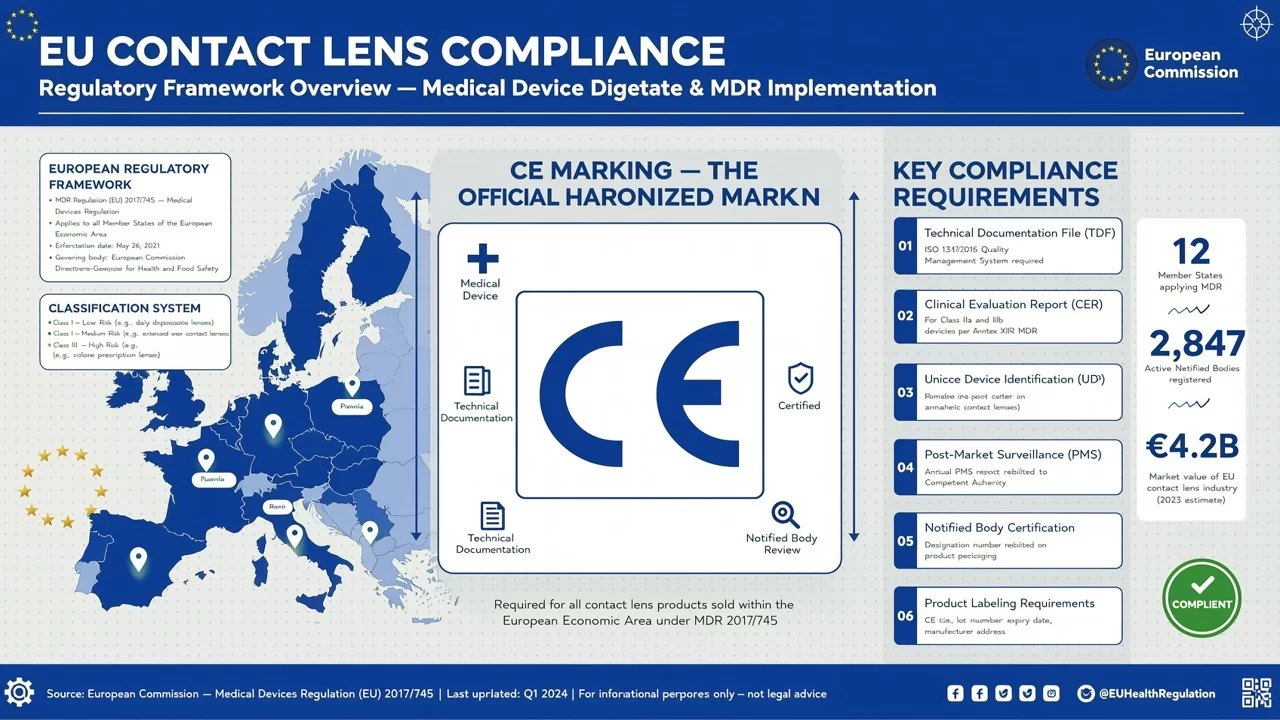
Colored contact lenses in the European Union are classified as **medical devices**. Not cosmetics. Not fashion accessories. Medical devices. This means they fall under the **Medical Device Regulation (MDR) 2017/745**, which replaced the older Medical Device Directive in 2021.
The MDR is not a gentle update. It’s a fundamental tightening of requirements across the board. If your OEM supplier is still operating under the old directive mindset, you have a problem.
## CE Marking: The Non-Negotiable Entry Ticket
You cannot sell colored contact lenses in the EU without a CE mark. Full stop.
But here’s where it gets nuanced. The CE mark for a medical device isn’t something you just slap on after a self-assessment. Colored contact lenses are typically classified as **Class IIa medical devices** under the MDR, which means:
– You need a **Notified Body** involved in the conformity assessment
– Your technical documentation must be thorough and auditable
– Your quality management system needs to meet MDR Article 22 requirements
– You need a designated **Person Responsible for Regulatory Compliance (PRRC)**
The Notified Body piece is critical. These are independent organizations designated by EU member states to assess medical devices before they hit the market. They’re not rubber-stamp operations. They will review your clinical evaluation, your risk assessment, your labeling, and your post-market surveillance plan.
Timeline reality check: getting CE certification under MDR for colored contact lenses typically takes **12 to 18 months** if you’re starting from scratch. If your OEM supplier already has CE certification for their platform designs, you’re looking at maybe 6 to 9 months for your specific variant. Plan accordingly.
## The Authorized Representative Requirement
Here’s something that catches a lot of non-EU brands off guard: if your company is based outside the European Union, you **must** have an **Authorized Representative (AR)** within the EU.
Your AR is not just a mailbox. Under the MDR, the AR is legally responsible for:
– Verifying that you have the correct conformity assessment and technical documentation
– Making your documentation available to competent authorities on request
– Registering your device in the European Database on Medical Devices (EUDAMED)
– Cooperating with market surveillance authorities
Choosing the wrong AR — or treating this as a box-checking exercise — is a mistake. Your AR is your regulatory anchor in Europe. If something goes wrong with your product, authorities will contact your AR first. Make sure they’re competent, responsive, and actually understand contact lenses as a product category.
## Clinical Evaluation: The Part Nobody Wants to Pay For
Under the MDR, every medical device needs a clinical evaluation. For colored contact lenses, this means you need to demonstrate that your product is safe and performs as intended based on clinical data.
Now, if your OEM supplier has already done clinical evaluations for similar products, you can potentially leverage that data through a literature-based approach. But you can’t just copy-paste someone else’s clinical report. You need:
– A systematic literature review covering relevant clinical evidence
– Equivalence arguments showing your product is comparable to devices with established safety records
– A clinical evaluation report signed off by a qualified evaluator
If your supplier can’t support this, walk away. Finding a new supplier mid-certification process is expensive and painful.
## Labeling and Language Requirements
European labeling requirements are detailed and specific. Your packaging and instructions for use must include:
– The product name and model identifier
– Lot number and expiration date
– Base curve, diameter, and water content
– Sterility status and storage conditions
– Warnings and contraindications
– The CE mark with the Notified Body number
– The manufacturer’s name and address
– The EU Authorized Representative’s name and address
And here’s the kicker: all of this needs to be in the **official language(s) of each member state** where you sell. Selling in Germany? You need German labeling. Selling in France? French. Selling in both? Both.
Some brands try to get away with English-only packaging. That works in some markets. In Europe, it’s a compliance violation that can trigger product recalls.
## Post-Market Surveillance: The Ongoing Obligation
Getting CE certification is not the finish line. Under the MDR, you’re required to maintain an active **Post-Market Surveillance (PMS) system**. This means:
– Collecting and analyzing data on your product’s performance in the market
– Tracking complaints, adverse events, and field safety corrective actions
– Periodically updating your clinical evaluation as new data emerges
– Submitting Periodic Safety Update Reports (PSURs) to your Notified Body
If you think of regulatory compliance as a one-time cost, Europe will teach you an expensive lesson. This is an ongoing operational requirement.
## What This Means for Your Timeline and Budget
Let me be practical about this. Entering the European market for colored contact lenses is not a three-month project. Here’s a realistic framework:
**Best case** (supplier already has MDR CE certification, you’re launching a variant):
– Timeline: 6-9 months
– Budget: $15,000-30,000 for regulatory compliance alone
**Typical case** (new product, supplier supports certification):
– Timeline: 12-18 months
– Budget: $30,000-60,000 for full regulatory program
**Worst case** (supplier not MDR-ready, starting from scratch):
– Timeline: 18-24+ months
– Budget: $60,000-100,000+
These numbers don’t include marketing, distribution, or inventory costs. Just the regulatory pathway.
## Choosing the Right OEM Partner for Europe
Not all contact lens manufacturers are created equal when it comes to European regulatory support. When evaluating suppliers, ask:
1. **Do you currently hold CE certification under MDR 2017/745?** (Not the old directive — the current regulation.)
2. **Can you provide a clinical evaluation report that supports my product registration?**
3. **Do you have experience working with EU Authorized Representatives?**
4. **What’s your process for handling post-market surveillance obligations?**
5. **Can you support multi-language labeling and IFU production?**
If the manufacturer hesitates on any of these questions, they’re not ready for Europe. Find one who is.
## The Opportunity Is Worth the Effort
I don’t want to leave you thinking Europe is too hard to enter. It’s not. It’s just more structured than other markets. The brands that do the regulatory work properly find that Europe rewards them with:
– Higher price points and margins
– Strong consumer trust in CE-marked products
– A regulatory framework that, once you’re in it, creates barriers for new competitors
– Access to a market of 450+ million consumers with significant disposable income
The key is going in with your eyes open. Understand the requirements. Budget for them. Choose partners who’ve done this before. And give yourself the time to do it right.
Europe isn’t a market you rush into. It’s a market you build properly.
—
*Looking to bring your colored contact lens brand to the European market? MIOMI Optical has supported multiple brands through EU MDR compliance and can guide you through the certification process. [Get in touch](https://miomicon.com/contact/) to discuss your European expansion strategy.*