If you’ve ever sourced colored contact lenses from a manufacturer, you’ve probably seen this spec on every product sheet: water content. It’s listed right there alongside diameter, base curve, and material type.
Most brand owners I talk to assume higher water content means better quality. They think, “If 38% is good, then 55% must be amazing, right?”
Wrong. And this misconception is costing brands money — and worse, it’s ending up in the hands of customers who end up disappointed.
Let me break down what water content actually means, why the “higher is better” myth persists, and how to make the right choice for your product line.
What Water Content Actually Measures
Water content is exactly what it sounds like: the percentage of water present in the hydrogel material when the lens is fully hydrated. A lens with 38% water content means 38% of its weight is water. Simple enough.
But here’s where it gets interesting. Water content isn’t just a comfort metric — it fundamentally changes how the lens behaves on the eye, how long it lasts, and even how it handles color pigments.
The Comfort Paradox: Why High Water Content Can Backfire
Here’s the counterintuitive truth: high water content lenses (55%+) often feel amazing for the first 30 minutes, then dry out faster than lower water content lenses.
Why? Because the water in the lens evaporates. And when it does, the lens starts pulling moisture from the tear film to compensate. If you’re in a dry environment — air-conditioned office, airplane, desert climate — that high-water lens becomes a moisture thief.
I’ve seen brands launch with 58% water content lenses because the spec sheet looked impressive, only to get complaints about dryness after 4-5 hours of wear. Meanwhile, their competitor using 42% water content lenses gets rave reviews for all-day comfort.
Material Matters: Hydrogel vs. Silicone Hydrogel
Water content interacts differently with different materials:
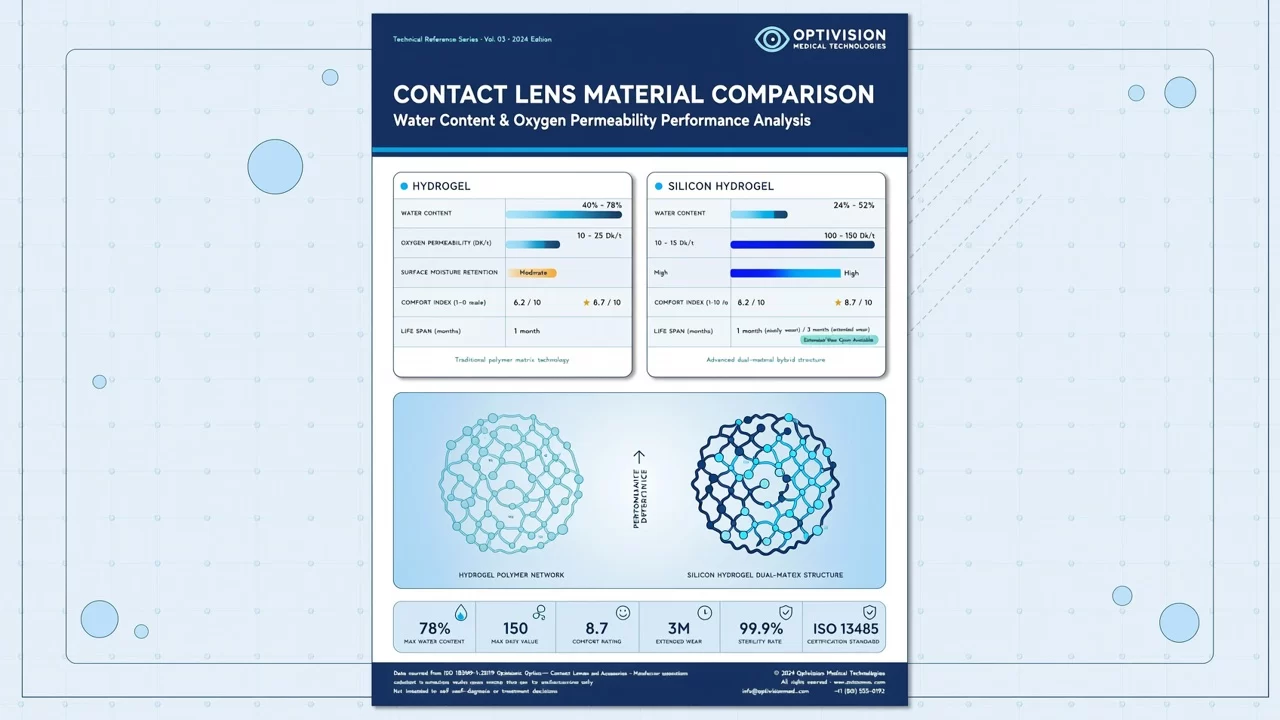
Traditional hydrogel (HEMA-based): These rely on water to transmit oxygen. Higher water content = more oxygen reaches the cornea. That’s why you see 55-62% water content in daily disposable hydrogel lenses. The trade-off? They’re fragile, harder to handle, and the evaporation problem I mentioned above.
Silicone hydrogel: These transmit oxygen through the silicone itself, not through water. So you can have lower water content (30-45%) but still get excellent oxygen transmission. These lenses are more stable, more durable, and often more comfortable for extended wear.
For colored contact lenses — which are often worn for cosmetic reasons rather than vision correction — silicone hydrogel with moderate water content (38-45%) is usually the sweet spot. The lens stays stable, the color pigments are better protected, and wearers get consistent comfort throughout the day.
How Water Content Affects Color Pigments
This is something most brand owners don’t think about until it’s too late.
Higher water content materials are more flexible and porous. That sounds good, but it means color pigments can migrate more easily within the lens matrix. Over time, especially if the lens dries out and rehydrates repeatedly, you can get slight color shifts or uneven pigment distribution.
Lower water content materials are more rigid and stable. The pigments stay locked in place. This is why most premium colored lenses use materials in the 38-45% water content range — the color stays consistent from first wear to last.
If you’re building a brand around vibrant, reliable color payoff (and you should be), this matters.
Matching Water Content to Your Target Market
There’s no universal “best” water content. It depends on your customer’s environment and wearing habits:
Dry climates (Middle East, Australia, southwestern US): Lower water content (38-42%) performs better. Less evaporation, more stable comfort.
Humid climates (Southeast Asia, tropical regions): Higher water content (45-50%) can work well because evaporation is slower. But don’t go above 50% unless you’re doing daily disposables.
Office workers in air-conditioned environments: Moderate water content (40-45%) with silicone hydrogel material. The AC dries everything out, so you want a lens that doesn’t rely on water for oxygen transmission.
First-time lens wearers: Moderate water content (40-45%) is forgiving and easy to handle. High water content lenses are floppy and harder to insert, which frustrates beginners.
What This Means for Your Product Line
If you’re launching a colored contact lens brand, here’s my recommendation:
Start with 38-42% water content in silicone hydrogel. This gives you:
- Stable color pigments that don’t migrate
- All-day comfort without the evaporation crash
- Easy handling for first-time wearers
- Good oxygen transmission without relying on water
- Durability for monthly or quarterly replacement schedules
You can always expand into higher water content daily disposables later, once you’ve established your brand and understand your customers’ preferences. But for your core product line — the lenses that define your brand’s reputation — moderate water content in silicone hydrogel is the safer bet.
The Marketing Trap to Avoid
Here’s what I see too often: brands put “55% Water Content!” on the packaging because it sounds impressive. Customers buy it, experience dryness after a few hours, and leave a bad review.
Don’t fall into this trap. Instead, educate your customers. Write product descriptions that explain why your 40% water content silicone hydrogel lens is better for all-day wear than a 55% hydrogel lens. Make it a feature, not a compromise.
Customers appreciate transparency. They’ll trust you more if you explain the science instead of just chasing big numbers.
Final Thoughts
Water content is one of those specs that looks simple but has huge implications for product performance, customer satisfaction, and brand reputation. The “higher is better” myth is just that — a myth.
As a brand owner, your job is to choose the right water content for your target market, your wearing environment, and your brand positioning. Not the highest number on the spec sheet.
If you’re sourcing colored contact lenses and want to discuss material options, water content trade-offs, or how to build a product line that actually delivers on its promises, let’s talk. We’ve helped dozens of brands navigate these decisions and launch lenses their customers love.
MIOMI Optical specializes in OEM/ODM colored contact lens manufacturing with low MOQ customization. We work with brand owners worldwide to develop products that balance performance, comfort, and market appeal.