Daily, Monthly, Yearly Contact Lenses: Which Disposal Schedule Should Your Brand Offer?
If you’re building a contact lens brand, one of the first product decisions you’ll face is this: what disposal schedule should your lenses follow? It sounds simple. It’s not. The choice between daily, monthly, and yearly lenses shapes your manufacturing costs, your pricing strategy, your target customer, and even how your brand is perceived in the market.
Here’s what you need to know before you commit to a product line.
Why Disposal Schedule Matters More Than You Think
Most people outside the industry treat contact lenses as a single product category. They’re not. A daily disposable lens and a yearly reusable lens are fundamentally different products — different materials, different manufacturing processes, different regulatory pathways, and completely different customer behaviors.
When you choose a disposal schedule, you’re not just choosing a product spec. You’re choosing a business model.
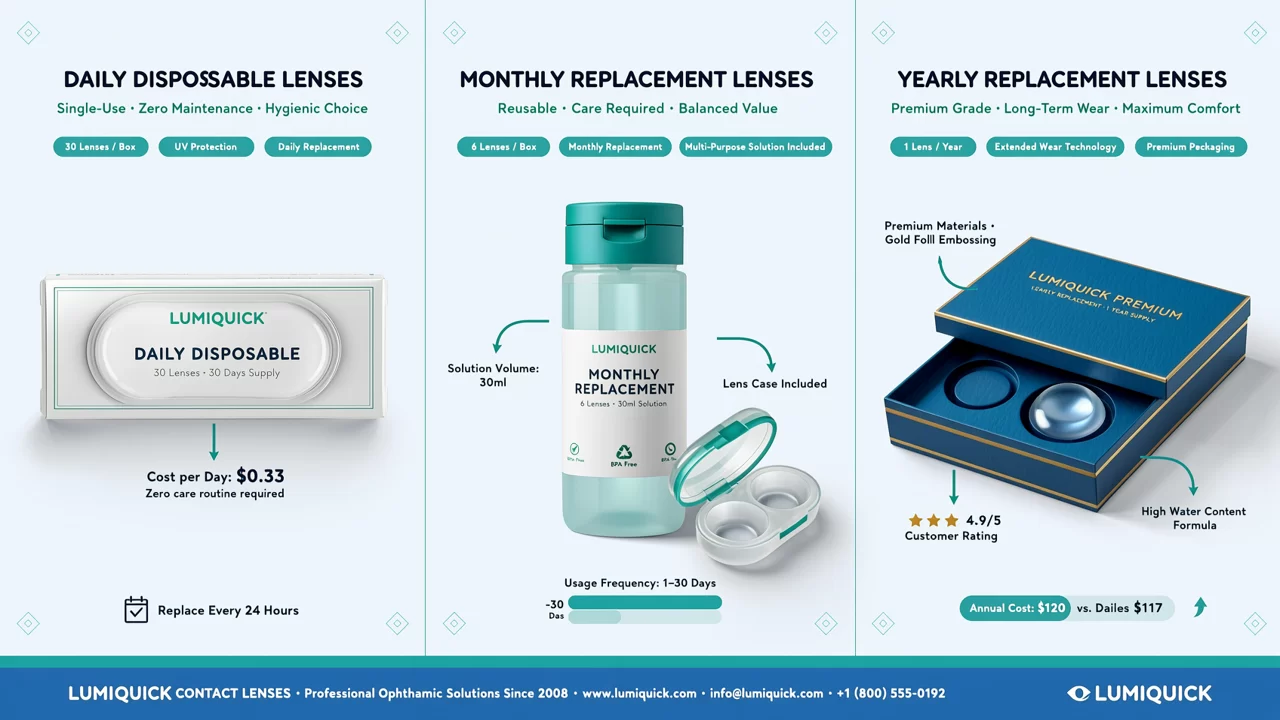
Daily disposables are a volume game. Customers buy boxes of 30 or 90 lenses, use one pair each morning, and toss it at night. The per-unit cost is low, but the repurchase frequency is high. It’s a subscription-friendly model that rewards brands that can maintain consistent supply and build habitual purchasing behavior.
Monthly lenses sit in the middle. Customers keep the same pair for 30 days, cleaning them nightly with solution. The per-unit cost is higher than dailies, but customers buy fewer units per year — roughly 12 pairs instead of 360. Monthly lenses tend to attract price-conscious customers who don’t mind the maintenance routine.
Yearly lenses (sometimes called traditional or reusable lenses) are the opposite end of the spectrum. One pair lasts 6 to 12 months. The upfront cost is higher, but the annual spend is the lowest of all three categories. These lenses appeal to customers in markets where cost-per-year matters more than convenience.
Each schedule has its place. The question is: which one fits your brand?
Daily Disposables: The Convenience Premium
Daily disposables have been growing steadily for the past decade, and the trend accelerated during the pandemic. Hygiene-conscious consumers loved the idea of opening a fresh, sterile lens every morning. No solution, no cases, no cleaning — just peel, wear, toss.
The business case for dailies:
- Higher customer lifetime value. A daily wearer goes through 365 pairs per year. Even at modest per-unit pricing, the annual spend adds up. If you can capture a customer early and keep them loyal, the revenue compounds.
- Subscription-friendly. Dailies are perfect for auto-replenishment models. Customers who subscribe rarely cancel if the product is good and the price is fair.
- Lower barrier to trial. A box of 30 daily lenses costs less upfront than a yearly pair. Customers can try your brand without a big commitment.
- Hygiene and safety positioning. From a marketing perspective, dailies are easy to sell. “Fresh lens every day” is a message that resonates across cultures and age groups.
- Manufacturing cost per unit is higher. Daily lenses are thinner and made from materials that prioritize comfort over durability. You’ll need high-volume production to keep unit costs down.
- Supply chain pressure. Your customers will run out every 30 to 90 days. If you have stockouts, they’ll switch brands immediately. Dailies don’t tolerate supply gaps.
- Competition is intense. The daily disposable market is dominated by large players. Differentiating requires either a niche focus (colored dailies, specialty designs) or aggressive pricing.
- Lower manufacturing complexity. Monthly lenses are thicker and more durable than dailies. They can be made from a wider range of materials, including conventional hydrogels that are cheaper to produce.
- Easier inventory management. Customers buy one pair per month. You’re shipping 12 units per customer per year instead of 360. Forecasting and fulfillment are simpler.
- Broader market appeal. Monthly lenses work in both price-sensitive and convenience-aware markets. They’re not the cheapest option, but they’re not the most expensive either.
- Good margin potential. If you’re doing OEM/ODM with a factory that offers competitive pricing on hydrogel or silicone hydrogel monthlies, the margin per unit can be attractive.
- Customers need to buy solution. Monthly lenses require care solution and lens cases. If you’re selling direct-to-consumer, you’ll need to bundle or recommend these accessories. If you’re selling B2B, your retail partners will expect you to support the full ecosystem.
- Compliance is a weak point. Studies consistently show that monthly lens wearers don’t replace lenses on schedule. They stretch a 30-day lens to 45 or 60 days. This creates eye health risks and makes customers less predictable as repeat buyers.
- Less “premium” perception. In markets where dailies are the norm, monthly lenses can feel like a budget option. Your brand positioning needs to account for that.
- Lowest cost-per-wear. For customers who calculate value on an annual basis, yearly lenses win. A pair that lasts 12 months at $30 is obviously cheaper than 365 daily lenses at $0.50 each.
- Simpler for first-time wearers in some markets. In regions where contact lens adoption is still growing, yearly lenses are familiar. Customers don’t need to be educated about disposal schedules or care routines — they already know.
- Lower shipping volume. One pair per customer per year means minimal logistics overhead. For brands shipping internationally, this reduces freight costs significantly.
- Durable product, fewer complaints. Yearly lenses are thick and robust. They don’t tear easily, they’re easy to handle, and they tolerate imperfect care routines better than thinner lenses.
- Declining in developed markets. In North America and Western Europe, yearly lenses are increasingly seen as outdated. Eye care professionals prefer to prescribe dailies or monthlies for hygiene reasons. If your target market is premium, yearly lenses may send the wrong signal.
- Regulatory scrutiny. Some regulatory bodies are moving toward shorter replacement schedules for safety reasons. If you’re planning to sell in the EU or US, check whether yearly lenses face additional compliance requirements.
- Lower annual revenue per customer. A customer buying yearly lenses spends $30–$60 per year with your brand. A daily wearer spends $200–$500. The volume economics are very different.
- Developed market with high hygiene awareness? → Daily or monthly.
- Price-sensitive emerging market? → Monthly or yearly.
- Mixed market with both premium and budget segments? → Offer multiple schedules.
- E-commerce / DTC? → Dailies work well with subscription models.
- Optical shops / clinics? → Monthlies are the standard dispensing option.
- Marketplace / retail? → Yearly lenses have the simplest logistics.
- Premium / health-focused? → Dailies.
- Value / practical? → Monthlies.
- Budget / accessible? → Yearly.
The challenges:
Best for: Brands targeting convenience-focused consumers in developed markets (North America, Western Europe, Japan, South Korea, Australia). Also works well for colored cosmetic lenses where hygiene is a selling point.
Monthly Lenses: The Balanced Choice
Monthly lenses are the middle ground, and for many brands, that’s exactly where they want to be. They offer a reasonable balance between manufacturing cost, retail price, and customer convenience.
The business case for monthlies:
The challenges:
Best for: Brands entering price-sensitive markets (Southeast Asia, Latin America, parts of Eastern Europe) where customers want quality but can’t justify daily pricing. Also a solid choice for optical shops and clinics that dispense lenses as part of a broader eye care service.
Yearly Lenses: The Long Game
Yearly lenses are the traditional end of the market. They’ve been around the longest, and in many developing markets, they’re still the default choice. A single pair costs more upfront, but the cost-per-day is the lowest of all three categories.
The business case for yearly lenses:
The challenges:
Best for: Markets where contact lens penetration is still low and price is the primary purchase driver (parts of Africa, South Asia, the Middle East, rural Southeast Asia). Also appropriate for brands that want to offer a budget tier alongside premium daily or monthly options.
How to Decide: A Framework for Brand Owners
If you’re still unsure which disposal schedule to offer, here’s a practical framework:
Step 1: Start with your target market.
Step 2: Consider your distribution channel.
Step 3: Think about your brand positioning.
Step 4: Talk to your OEM/ODM supplier.
Not all factories can produce all three schedules efficiently. Some specialize in high-volume daily lens production. Others have strong capabilities in traditional yearly lenses. Ask your supplier what they do best, and align your product strategy with their strengths.
The Hybrid Approach: Why Not Offer Multiple Schedules?
Here’s something many new brand owners overlook: you don’t have to choose just one.
Some of the most successful contact lens brands offer a tiered product line — dailies for premium customers, monthlies for the mainstream, and yearly lenses for budget-conscious buyers. This approach lets you capture a wider range of customers and increases the average order value when customers trade up.
The trade-off is complexity. You’ll need to manage more SKUs, more inventory, and more marketing messages. But if your OEM partner can support multiple product lines (and most experienced ones can), the incremental cost of adding a second or third schedule is often lower than you’d expect.
Final Thoughts
Choosing a disposal schedule isn’t about finding the “best” option. It’s about finding the right option for your market, your channel, and your brand positioning. Daily lenses offer convenience and recurring revenue. Monthly lenses offer balance. Yearly lenses offer affordability.
The worst decision is to choose blindly — to pick a schedule because it’s what you’re familiar with, or because your factory only offers one option. Take the time to understand your target customer’s priorities, and let that guide your product strategy.
If you’re exploring OEM or ODM options for colored contact lenses and want to discuss which disposal schedule makes sense for your brand, feel free to reach out. We work with brand owners across Southeast Asia, the Middle East, Europe, and North America to build product lines that match their market’s needs — whether that’s daily, monthly, or yearly.
MIOMI Optical Ltd. is a contact lens manufacturer specializing in OEM/ODM customization, low-MOQ wholesale, and private label production. Visit [miomicon.com](https://miomicon.com) to learn more.