# Hydrogel vs. Silicone Hydrogel Contact Lenses: What Brand Owners Need to Know Before Choosing a Material
If you’re building a colored contact lens brand, one of the first decisions you’ll face is material selection. Hydrogel or silicone hydrogel? It sounds like a technical detail best left to the lab, but trust me — this choice shapes everything from your product positioning to your customer retention rate.
I’ve watched brands make this decision based on cost alone, only to deal with complaints three months later. I’ve seen others over-engineer their first SKU with premium materials, then struggle with pricing that scares away their target market.
Let me break down what you actually need to know.
## The Basics: What’s the Difference?
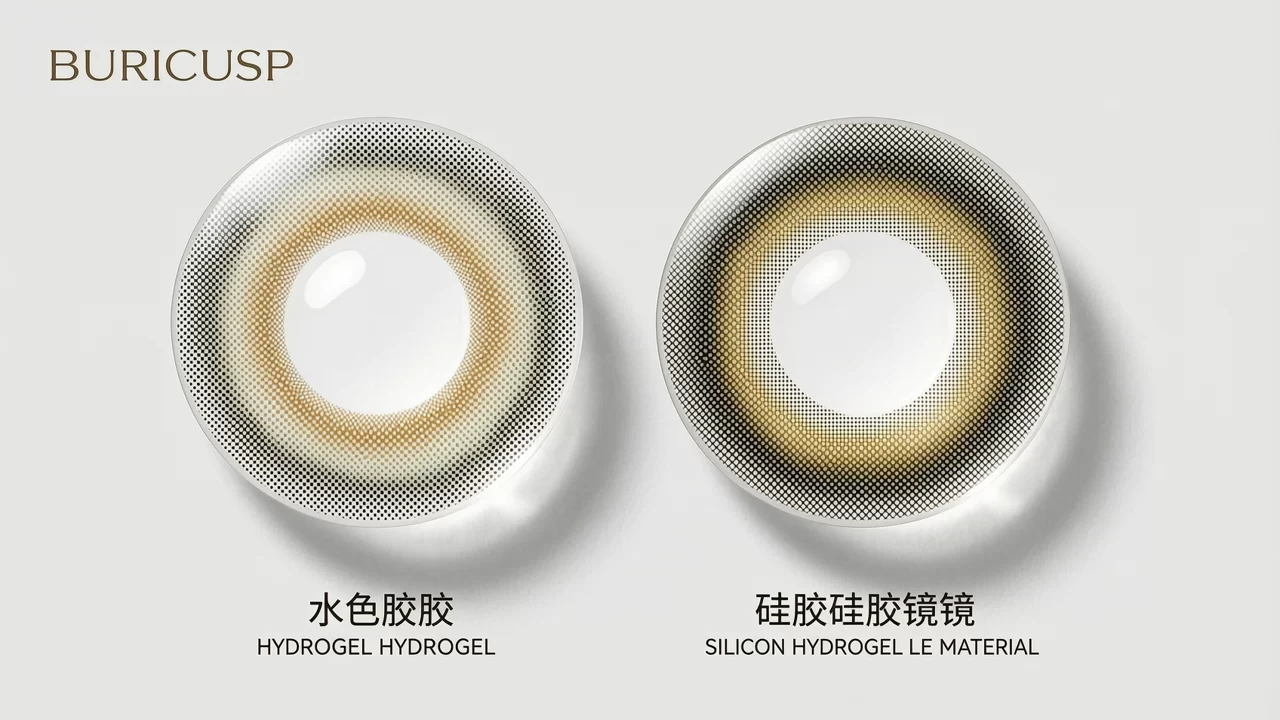
**Hydrogel lenses** are the traditional choice. They’re made from water-loving polymers that allow oxygen to pass through via water content. Think of them like a sponge — the more water they hold, the more oxygen reaches the cornea.
**Silicone hydrogel lenses** use a different mechanism. Silicone channels allow oxygen to flow through the lens material itself, independent of water content. This is a game-changer for breathability.
Here’s where most brand owners get confused: they assume higher water content always means better comfort. That’s not necessarily true, and I’ll explain why in a moment.
## Oxygen Permeability: The Number That Matters
When you’re evaluating materials, look at **Dk/t** (oxygen transmissibility). This measures how much oxygen actually reaches the cornea when the lens is on the eye.
– Standard hydrogel: Dk/t around 25-40
– High water content hydrogel: Dk/t around 40-60
– Silicone hydrogel: Dk/t around 100-180+
Why does this matter? Because the cornea has no blood vessels. It gets oxygen directly from the air. If your lens blocks too much oxygen, wearers experience redness, dryness, and in severe cases, corneal neovascularization (new blood vessels growing into the cornea — not something you want associated with your brand).
For daily wear colored lenses, hydrogel is usually sufficient. But if you’re positioning for extended wear or sensitive eyes, silicone hydrogel becomes the conversation.
## Comfort Isn’t Just About Water Content
Here’s the counterintuitive part: high water content hydrogel lenses can actually cause **more** dryness for some wearers.
The mechanism is called “dehydration feedback.” When a high-water lens starts to lose moisture (from air conditioning, screen time, dry environments), it pulls tears from the eye to maintain its water balance. The result? The wearer feels dry even though they’re wearing a “high water content” lens.
Silicone hydrogel lenses typically have lower water content (30-50% vs. 50-70% for hydrogel), but they maintain stable hydration because oxygen transmission doesn’t depend on water. For wearers in dry climates or office environments, this often translates to more consistent comfort throughout the day.
## What This Means for Your Brand Positioning
Let’s get strategic. Your material choice signals your brand positioning:
**Hydrogel positioning:**
– Accessible price point
– Daily replacement or short-term wear
– Fashion-forward colored lenses
– Target market: younger consumers, price-sensitive, style-driven
– Geographic fit: markets where daily replacement is the norm
**Silicone hydrogel positioning:**
– Premium segment
– Health and comfort focused
– Extended wear capability
– Target market: professionals, contact lens veterans, sensitive eyes
– Geographic fit: markets with higher disposable income, dry climates
Some brands try to straddle both segments. That’s possible, but you’ll need separate SKUs with clear positioning for each. Don’t confuse your customers by marketing a premium material at a budget price point, or vice versa.
## The Cost Reality
Let’s talk numbers, because this is where dreams meet reality.
Silicone hydrogel materials cost significantly more than standard hydrogel. We’re talking 2-4x the material cost per lens, depending on the specific polymer and your supplier.
But here’s what brand owners often miss: the **total cost structure** matters more than the per-unit material cost.
If you’re selling daily disposable colored lenses, the material cost is a smaller percentage of your total COGS because you’re already accounting for high-volume, low-margin production. The premium material becomes easier to justify.
If you’re selling monthly or quarterly replacement lenses, the material cost represents a larger chunk of your COGS, and you’ll need to price accordingly.
Work with your OEM partner to understand the full cost breakdown. A good supplier will help you model different scenarios based on your target retail price point.
## Regulatory Considerations
Different markets have different requirements for contact lens materials.
In the **United States**, the FDA classifies contact lenses as medical devices regardless of material. Both hydrogel and silicone hydrogel require 510(k) clearance, but silicone hydrogel may face additional scrutiny due to its different mechanism of action.
In the **European Union**, both materials fall under MDR (Medical Device Regulation), but you’ll need to demonstrate biocompatibility testing specific to your chosen material.
In **China**, NMPA has specific testing protocols for oxygen permeability claims. If you’re marketing “high oxygen transmission,” you’ll need test data to back it up.
Don’t assume your supplier handles all regulatory compliance. Ask specifically what testing they’ve completed for your target markets, and whether their certifications cover the exact material formulation you’re using.
## Making the Decision: A Framework
Here’s how I’d approach this decision if I were launching a new brand today:
**Step 1: Define your target customer.**
Who are they? How many hours per day will they wear lenses? What’s their budget? Are they new to contact lenses or experienced wearers?
**Step 2: Map your geographic markets.**
Dry climate (Middle East, Australia) → lean toward silicone hydrogel. Humid climate (Southeast Asia) → hydrogel may be sufficient.
**Step 3: Set your price positioning.**
Premium (>$30/box retail) → silicone hydrogel justifies the price. Budget (<$20/box) → hydrogel keeps you competitive.
**Step 4: Consider your product roadmap.**
Planning to expand into extended wear or sensitive eye segments later? Starting with silicone hydrogel gives you flexibility. Launching with fashion colors first? Hydrogel gets you to market faster.
**Step 5: Prototype and test.**
Don't commit to a material based on spreadsheets alone. Get samples, test them yourself, have testers wear them for a week. Real-world feedback beats theoretical advantages every time.
## The Bottom Line
There's no universally "better" material. There's only the right material for your specific brand strategy, target market, and price positioning.
Hydrogel gives you affordability and proven performance for daily wear colored lenses. Silicone hydrogel gives you premium positioning and extended wear capability.
The brands that struggle are the ones who make this decision in isolation — choosing material before they've defined their customer, their market, and their positioning.
Start with your customer. Work backward to the material. That's how you build a product line that sells, not just sits in inventory.
---
*Looking for an OEM partner who can guide you through material selection? MIOMI Optical offers both hydrogel and silicone hydrogel colored contact lenses with low MOQ for new brands. [Get in touch](https://miomicon.com/contact/) to discuss your project.*