Ask ten contact lens buyers what they look at first, and you’ll get ten answers: price, color, diameter, packaging. But here’s something that surprises most new brand owners — the single specification that drives the most customer complaints isn’t any of those. It’s water content.
Get it right and your customers say the lenses “feel like nothing.” Get it wrong and you get refund requests, dry eye complaints, and a reputation you’ll spend a year repairing. Yet water content is one of the least understood specs in the entire industry — even among people who sell lenses every day.
This guide is for wholesale buyers, brand builders, and anyone sourcing colored contact lenses for their own line. We’ll walk through what water content actually means, how it affects comfort and profit, and how to choose the right range for your target market. No textbook fluff — just the practical knowledge we’ve picked up from years of OEM/ODM production.
What Water Content Actually Means (And What It Doesn’t)
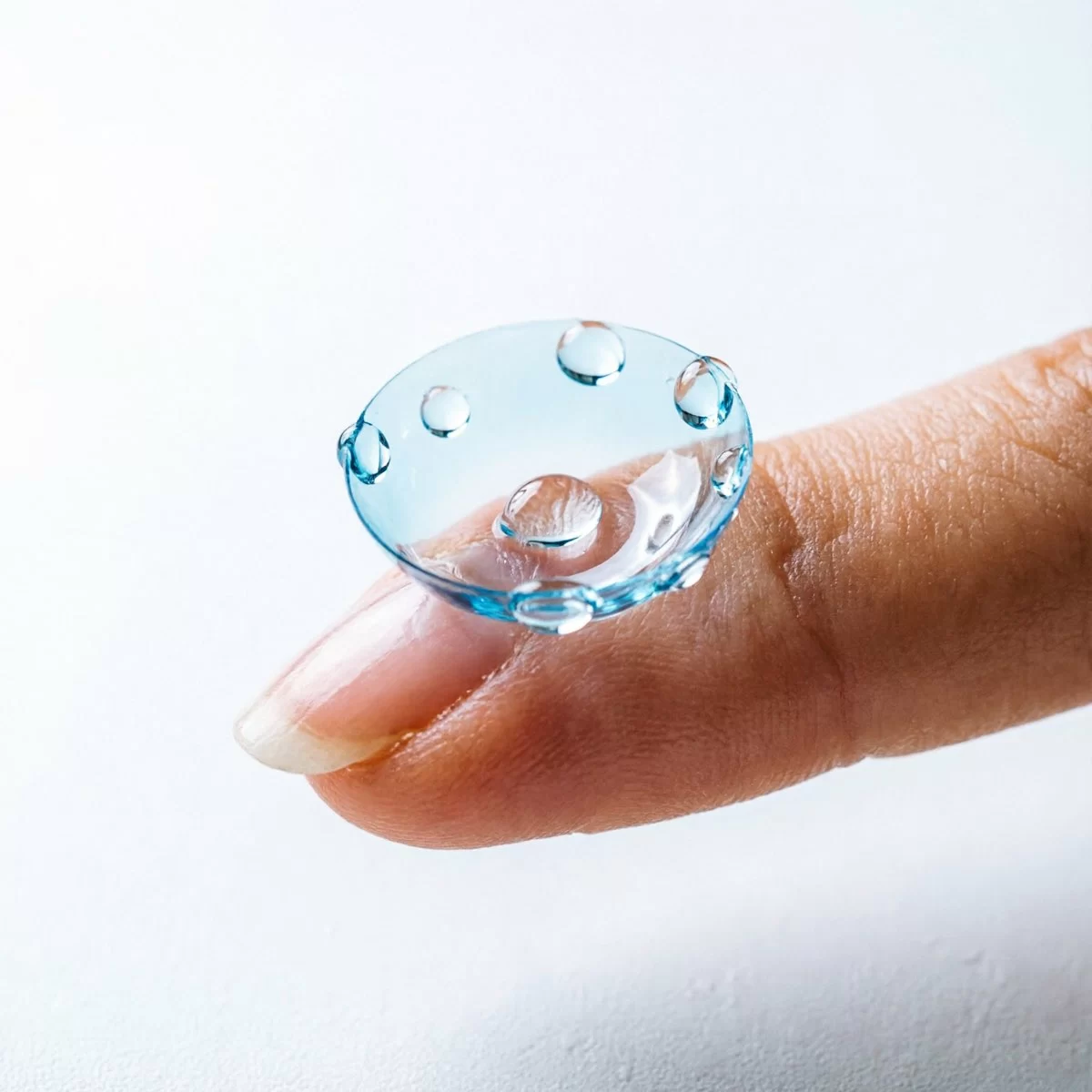
Water content is the percentage of water in the lens material, measured after the lens has fully hydrated in saline. A lens with 45% water content is, quite literally, 45% water.
Soft contact lenses are made from hydrogel or silicone hydrogel polymers — think of them as microscopic sponges that hold water in place. The water is what allows oxygen to pass through the lens to your cornea, which has no blood vessels of its own and depends on oxygen diffusing through the tear film.
Now here’s the part most people get backwards: higher water content does not automatically mean a more comfortable lens.
Why? Because a lens with high water content also absorbs more water from your eye. When you stare at a screen, your blink rate drops, your tear film thins, and a high-water lens starts pulling moisture away from the eye surface faster than it can be replenished. This is the classic “my lenses feel dry by 5pm” complaint — and more often than not, the customer is wearing a lens whose water content is mismatched to their lifestyle.
Comfort is a system: water content, material, lens thickness, base curve, and the wearer’s own tear film. Water content is one dial on the machine, not the machine itself.
The Four Common Ranges: What Works for Whom
Colored contact lenses on the market today generally fall into a few water content bands. Here’s how each behaves in the real world:
Low Water Content (35–42%)
The workhorse range, and the most common choice for colored lenses with a multi-year replacement cycle. Lenses in this band are more dimensionally stable — they hold their shape better, resist protein buildup more effectively, and stay comfortable through long wear sessions precisely because they don’t draw as much moisture from the eye.
This is why yearly and some monthly colored lenses tend to sit here. For buyers targeting markets where dry climates or heavy screen use are common — office workers in air-conditioned buildings, Middle Eastern markets with hot dry weather — low-to-mid water content lenses routinely generate fewer comfort complaints.
Mid Water Content (45–50%)
The balanced middle ground. Enough water to feel fresh at first insertion, not so much that the lens dehydrates during the day. Many of our monthly colored lens clients land in this band. It suits the widest range of wearers and is a safe default if you’re unsure of your target demographic.
High Water Content (55–70%)
These lenses feel incredibly comfortable in the first hour — soft, moist, barely noticeable. But they’re the most demanding to wear well. They dehydrate faster, they can be more fragile to handle, and they’re a poor match for dry environments or people with naturally low tear production.
High water content lenses are most commonly seen in daily disposables, where the lens is only worn for one day and is never rehydrated in a case. For a daily lens, that initial comfort is a huge selling point.
Ultra-High Water Content (70%+)
A niche category. Used in some daily lenses marketed for maximum comfort. They require excellent quality control — a 78% water content lens is mechanically delicate and has a narrower manufacturing tolerance. Not our recommendation for a first-time brand launch.
Water Content vs. Material: The Question Buyers Forget to Ask
Two lenses can have the same water content and behave completely differently. The reason is the polymer.
Traditional hydrogel lenses (polyHEMA-based) transport oxygen through the water in the lens. More water, more oxygen — but also more dehydration at the end of the day.
Silicone hydrogel lenses transport oxygen directly through the silicone component of the polymer. This changes the equation entirely: a silicone hydrogel lens with only 38% water content can deliver more oxygen to the cornea than a traditional hydrogel lens with 55% water content. Silicone hydrogel is now the standard for clear prescription lenses in most developed markets, and premium colored lens lines are beginning to follow.
The practical takeaway for buyers: when you’re comparing quotes from different suppliers, never compare water content numbers in isolation. Ask what material system the lens uses. A slightly pricier lens on a better material platform will almost always generate fewer complaints — and fewer complaints means repeat orders.
Choosing Water Content by Market and Product Positioning
After years of shipping colored lenses to different regions, here are the patterns we consistently see:
- Yearly colored lenses (popular in Southeast Asia, Middle East, Latin America): 38–42% water content is the sweet spot. Stability and all-day comfort matter more than that first-insertion “wow” feeling.
- Monthly colored lenses (strong in Europe and North America): 45–50% gives the best balance. Pair with a recommendation for daily solution care in your customer education.
- Daily disposables (the premium, fastest-growing segment everywhere): 50–58% is common. Initial comfort is the whole value proposition, and there’s no rehydration concern because the lens is discarded daily.
- Dry climate markets (Middle East, Gulf states, parts of Australia): lean lower. We’ve seen complaint rates on 55%+ lenses in these markets run noticeably higher than identical lenses sold in humid regions.
And one more pattern worth knowing: customers who wear lenses for cosmetic reasons tend to wear them less often but for longer single sessions (events, photo shoots, nights out). Customers with prescription needs wear them every day, all day. These two groups want different things, and water content selection should reflect which group you’re building for.
Three Myths We Correct in Almost Every Client Conversation
Myth 1: “High water content = premium quality.” It’s a spec, not a quality grade. A well-made 38% lens will outperform a poorly made 55% lens every time.
Myth 2: “Customers will notice dry lenses immediately.” Usually not. The discomfort builds through the afternoon. The customer blames their eyes, stops wearing the lenses, and quietly never reorders. The damage is invisible until your retention numbers tell you the story.
Myth 3: “All suppliers’ 42% lenses are the same.” Manufacturing tolerance on water content can vary by several percentage points between factories, and the polymer formula matters as much as the number. This is why sampling with real wear-testing — not just a visual inspection — is worth the extra two weeks before you place a bulk order.
The Sampling Step Most Brands Skip
Here’s our honest recommendation to any brand about to choose specs: order samples from at least two water content bands, and have real people wear them for a full day — indoors with air conditioning, and on a day out. Have them rate comfort at insertion, at four hours, and at eight hours.
That simple exercise will tell you more about your market fit than any spec sheet. We regularly support this with sample orders — it’s a normal part of our OEM workflow, and it’s exactly what serious brand builders should be doing.
Where MIOMI Fits In
If you’re building or expanding a colored contact lens brand, water content selection is one of the first decisions we’d make together. Our standard range covers 38%–55% across daily, monthly, and yearly formats, in both hydrogel systems, with CE certification and FDA-cleared production available for regulated markets.
We also work with low MOQs, which means you can genuinely test two water content options in your market before committing to a larger run — instead of betting your launch on a spec-sheet guess.
Questions about which water content fits your market? Email us at sales@miomicon.com or message us on WhatsApp (+86 13862973905). Tell us your market, your target customer, and your price point — we’ll give you a straight recommendation, even if it means telling you not to order anything today.
MIOMI Optical Ltd — OEM/ODM customization, small-batch wholesale, and low-MOQ colored contact lens manufacturing for brands worldwide.