After a decade of helping colored contact lens brands launch across Asia, the Middle East, and now Europe, I can tell you this: the European market is unlike any other. It’s not just one market — it’s a tapestry of 44 countries, each with its own regulatory quirks, consumer tastes, and distribution landscapes. And yet, for brands that get it right, the opportunity is enormous.
In this guide, I’m sharing what we’ve learned from years of market research, regulatory navigation, and helping both established and emerging brands find their footing in Europe. Whether you’re a wholesale distributor looking to expand your product line or a new brand building from scratch, this is the insider’s view you need before you dive in.
—
## The European Colored Contact Lens Market at a Glance
Let’s start with the numbers, because they’re compelling.
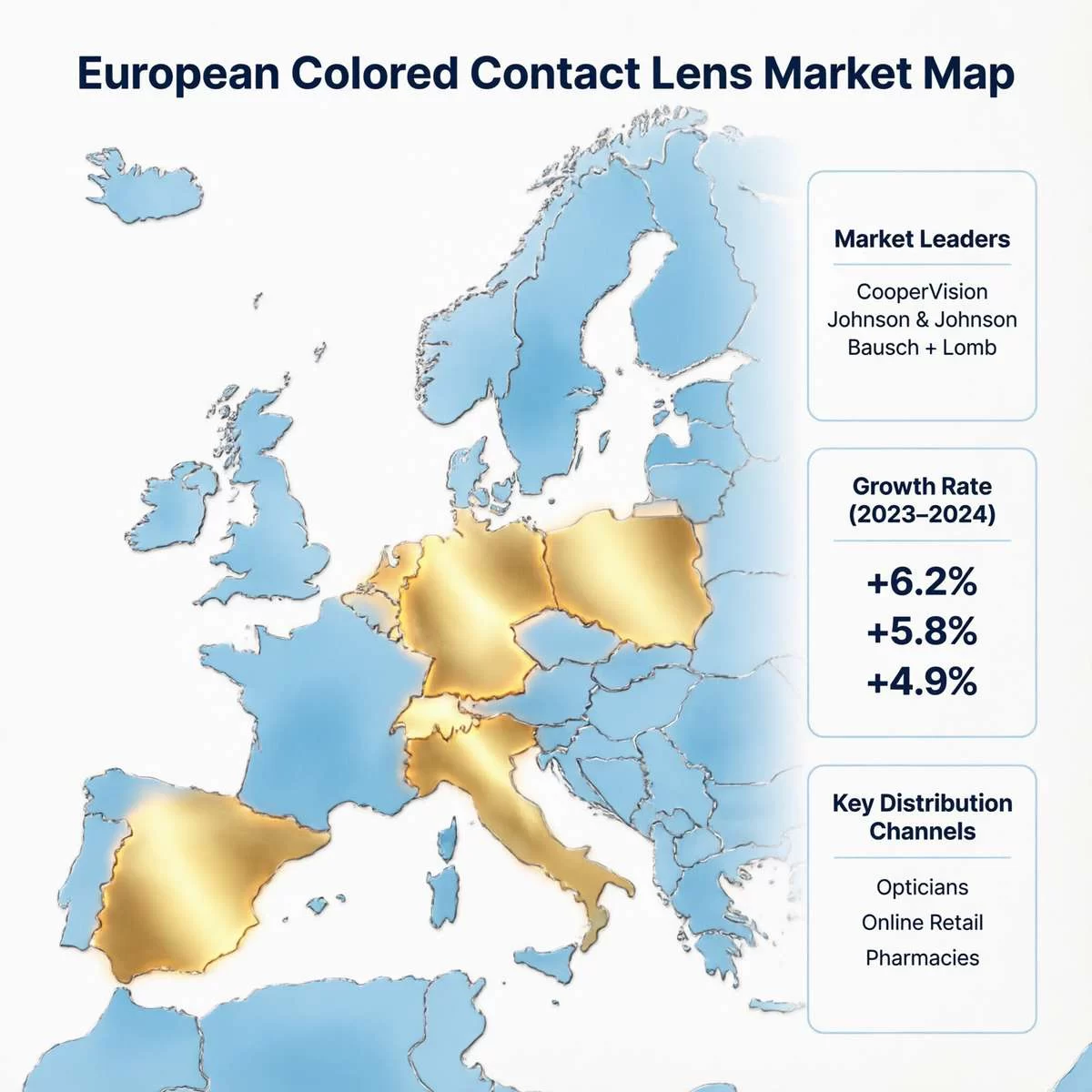
The European contact lens market (including both corrective and cosmetic lenses) was valued at approximately €4.2 billion in 2025, and it’s projected to grow at a CAGR of 5.8% through 2030. Within that, colored cosmetic lenses represent roughly 18-22% of the total contact lens market — and that share is growing faster than the market overall, driven largely by social media, K-beauty influence, and the post-pandemic return to socializing and events.
Western Europe dominates, accounting for about 72% of regional revenue. The top five markets — Germany, the UK, France, Italy, and Spain — collectively represent over 60% of all colored contact lens sales in Europe. But don’t sleep on Eastern Europe: Poland, Romania, and Hungary are growing at double-digit rates as disposable incomes rise and Western beauty trends filter eastward.
**What’s driving growth right now?** From where we sit, we see three major forces:
1. **Social media normalization.** Platforms like TikTok and Instagram have turned colored lenses from a niche Halloween product into an everyday beauty accessory. “Eye makeup” now includes changing your eye color, and younger consumers (18-30) are the fastest-growing demographic.
2. **Premiumization.** Consumers are willing to pay more for lenses that are comfortable, safe, and look natural. The days of cheap, obviously fake “Halloween quality” lenses dominating the market are over.
3. **Subscription and e-commerce growth.** Online sales of colored lenses have roughly doubled since 2020, with DTC brands and online optical retailers taking an increasingly large slice of the pie from traditional brick-and-mortar opticians.
But here’s the thing I always tell new brands: the European market is mature. Consumers are informed. Regulators are strict. You can’t just show up with a pretty Instagram page and expect to win. You need a real strategy.
—
## Regulatory & Compliance: Why CE Certification Is Non-Negotiable
If there’s one section of this guide you read carefully, make it this one.
In Europe, colored contact lenses — even purely cosmetic, non-prescription ones — are classified as **medical devices**. This is not like selling lipstick or false eyelashes. You’re putting something on a person’s cornea, and European regulators take that very seriously.
### The CE Marking Requirement
All colored contact lenses sold in the EU/EEA must bear the **CE mark**, which indicates compliance with the Medical Devices Regulation (MDR) — specifically Regulation (EU) 2017/745, which fully replaced the old MDD framework in May 2024.
Getting CE certification is not a quick process. From our experience guiding brands through it, here’s what you need to know:
– **Timeline:** Expect 6-12 months from start to finish for a new brand, assuming you’re working with a manufacturer that already has the necessary quality systems in place.
– **Key requirements:** You’ll need clinical evidence (or demonstration of equivalence to a legally marketed device), a technical file, ISO 13485 quality management certification for your manufacturing partner, and a designated European Authorized Representative.
– **Costs:** Budget anywhere from €15,000 to €50,000+ depending on how many product lines you’re certifying and whether you need additional clinical testing.
### The UK: A Separate Regulator Now
After Brexit, the UK has its own system. While CE-marked devices could be sold in the UK during the transition period, as of 2025, the **UKCA mark** is required for the Great Britain market (England, Wales, Scotland). Northern Ireland still accepts CE marking under the Windsor Framework.
In practice, this means you essentially need two certifications if you want to sell in both the EU and the UK. It’s an extra layer of complexity — and cost — that brands need to plan for.
### Common Compliance Mistakes We See New Brands Make
Having walked dozens of brands through this process, these are the pitfalls I’d flag:
– **Assuming your Asian manufacturer’s certification transfers.** A lot of factories have KFDA (Korea) or CFDA (China) approval, but that doesn’t automatically count in Europe. You need EU-specific certification from a Notified Body.
– **Cutting corners on the technical file.** Regulators can (and do) request your technical documentation at any time. If it’s incomplete or inaccurate, you could face product recalls and fines.
– **Forgetting about post-market surveillance.** CE marking isn’t a one-and-done thing. You need systems for vigilance reporting, complaint handling, and periodic safety updates.
– **Ignoring labeling requirements.** Every box needs specific information in the local language(s) of the market you’re selling in, including instructions for use, warnings, and batch numbers.
**Our advice:** Partner with an OEM/ODM manufacturer that already has CE certification for its base products and can guide you through the private label certification process. It dramatically reduces both the timeline and the risk. More on that later.
—
## Country-by-Country Market Characteristics
Europe isn’t monolithic. Consumer preferences, price sensitivity, and channel dynamics vary dramatically from country to country. Here’s a quick tour of the major markets, based on what we’ve observed:
### Germany: The Quality-Conscious Giant
Germany is Europe’s largest contact lens market, and German consumers are famously diligent about research and quality.
– **What sells:** Natural-looking lenses in brown and hazel tones. Germans tend to prefer subtle enhancement over dramatic transformation.
– **Price point:** Mid-to-premium. German consumers will pay more for quality and safety, but they expect genuine value. They’re also comparison shoppers — expect them to read reviews and compare specs before buying.
– **Channels:** Optical chains (like Fielmann and Apollo) still dominate, but online retailers like Lensway and Mister Spex are gaining ground.
– **Regulatory note:** Germany has some of the strictest enforcement of medical device rules in Europe. Don’t even think about cutting corners here.
### United Kingdom: The Early Adopter Market
The UK is often the test market for new colored lens brands entering Europe. English is the default language for most international brands, and UK consumers are more open to trying new DTC brands than their continental counterparts.
– **What sells:** A mix of natural and bold looks. The UK has a strong festival and party culture that drives demand for more dramatic styles. Grey and blue lenses are particularly popular.
– **Price point:** Broad. You’ll find everything from budget disposable lenses on Amazon to premium DTC brands at £30-£50 per pair.
– **Channels:** E-commerce is huge here — the UK has the highest online penetration for contact lenses in Europe. Optician chains like Specsavers still matter, but DTC and online marketplaces are eating into their share.
– **Key insight:** Influencer marketing works exceptionally well in the UK market. Beauty TikTok and Instagram are major discovery channels.
### France: The Fashion-Forward Market
France is all about aesthetic sophistication, and that extends to colored contact lenses.
– **What sells:** Natural, “your-eyes-but-better” styles. French consumers tend to favor hazel, honey, and green tones that complement light and medium eye colors. The “no-makeup makeup” aesthetic extends to eye color enhancement.
– **Price point:** Mid-range to premium. French consumers are brand-conscious and willing to pay for products that feel luxurious.
– **Channels:** Pharmacies and optical stores are important, but beauty e-commerce is growing fast. Brands with a strong aesthetic identity do well here.
– **Key insight:** French consumers care about packaging and brand story. Your visual identity matters as much as the product itself.
### Italy & Spain: The Southern European Style
These markets share some characteristics: warm skin tones, strong beauty cultures, and a love for natural-looking enhancement.
– **What sells:** Warm browns, hazels, and honey tones that complement Mediterranean complexions. Daily disposable lenses are gaining traction as consumers prioritize convenience and hygiene.
– **Price point:** More price-sensitive than Northern Europe. Mid-range brands perform best.
– **Channels:** Traditional optical stores still have strong presence, but social commerce is growing rapidly, especially among younger demographics.
– **Key insight:** Word-of-mouth and influencer recommendations carry significant weight in these markets.
### Eastern Europe: The Fast-Growing Frontier
Poland, Romania, Hungary, and the Czech Republic are the markets to watch.
– **What’s happening:** Disposable incomes are rising, Western beauty trends are spreading, and the colored lens market is growing at 10-15% annually in some of these countries.
– **What sells:** A mix of natural styles and more dramatic looks. Consumers here are experimenting and developing their tastes.
– **Price point:** Price-sensitive but moving upmarket. There’s a growing middle class willing to pay for better quality.
– **Key insight:** This is where new brands can gain a foothold before moving into more competitive Western European markets. The barriers to entry are lower, and consumer loyalty is still up for grabs.
—
## European Consumer Preferences: What Actually Sells
After working with European distributors and brands for years, here’s what we’ve learned about what European consumers actually want:
### Natural vs. Dramatic: Natural Wins Overall
Across most of Europe, **natural-looking lenses outsell dramatic styles by a significant margin**. The “I can’t tell you’re wearing colored lenses” look is the holy grail. This is different from some Asian markets where bold, obvious styles are more popular.
That said, there’s still a market for dramatic lenses — especially in the UK, Southern Europe, and among younger consumers for festivals and events. But if you’re launching a new brand, natural styles should be your core collection.
### Material Preferences
European consumers tend to be well-informed about lens materials:
– **HEMA hydrogel lenses** are still the most common, especially for planned replacement (monthly, quarterly) lenses.
– **Silicone hydrogel** is growing in popularity, especially among consumers who wear lenses for long hours. The higher oxygen transmission is a strong selling point.
– **Daily disposables** are the fastest-growing segment across Europe. Consumers value the convenience and hygiene.
### Replacement Cycle Trends
– **Daily disposables:** Fastest growing, driven by hygiene concerns and convenience.
– **Monthly lenses:** Still the mainstream in many markets, especially for budget-conscious consumers.
– **Yearly/long-wear:** Declining in Western Europe, still common in Eastern Europe and among price-sensitive buyers.
For new brands, we typically recommend starting with monthly lenses as a core offering and adding daily disposables as you scale.
—
## Distribution Channels: Where to Sell Your Lenses
### Traditional Optical Retail
Optician chains and independent opticians still account for the majority of contact lens sales in most European countries. Getting your products into these channels gives you credibility — but it’s also the hardest channel to break into as a new brand.
**Pros:** High credibility, professional endorsement, access to older demographics.
**Cons:** High barriers to entry, requires strong sales teams, lower margins.
### E-Commerce & DTC
This is where most new brands start, and for good reason.
– **Online optical retailers** (Mister Spex, Lensway, Vision Direct) — these are the online equivalent of optical chains. Getting listed gives you reach and credibility.
– **Marketplaces** (Amazon, bol.com, etc.) — volume potential, but price competition is fierce, and compliance enforcement is tightening.
– **DTC brands** — your own Shopify or WooCommerce store. Higher margins, full brand control, but you need to drive your own traffic.
**Our recommendation for new brands:** Start with DTC to build your brand story and gather customer feedback, then expand into online optical retailers and marketplaces as you gain traction.
### Social Commerce & Influencer Marketing
Social media is the #1 discovery channel for colored contact lenses among consumers under 35.
– **TikTok and Instagram** are the dominant platforms for product discovery.
– **Beauty influencers** can drive significant traffic and sales, but choose carefully — European audiences are savvy and can spot inauthentic endorsements.
– **Micro-influencers** (10k-100k followers) often deliver better engagement and ROI than big names in the European market.
—
## Opportunities & Challenges for New Brands
### The Opportunities
1. **The market is fragmented.** Unlike the Asian market where a few big brands dominate, Europe has no single dominant colored lens brand. There’s room for new players with strong positioning.
2. **Consumers are looking for alternatives.** Big brands are seen as boring and overpriced. Consumers are open to new brands that offer better design, better value, or a better story.
3. **E-commerce lowers barriers.** You can launch across multiple European countries from a single warehouse location.
4. **Eastern Europe is wide open.** Double-digit growth and less competition make it an attractive entry point for ambitious brands.
### The Challenges
1. **Regulation is complex and costly.** CE certification is a significant investment in both time and money. This is the single biggest barrier to entry.
2. **Competition is intense in Western Europe.** You’re competing with established brands, private labels, and a flood of products from Asia.
3. **Logistics and fulfillment.** Cross-border shipping, returns, and customer service across multiple countries and languages adds operational complexity.
4. **Price pressure.** Consumers have lots of options, and price comparison is easy. You need a clear value proposition beyond just “cheaper.”
—
## How to Choose the Right OEM Partner for the European Market
Your choice of manufacturing partner will make or break your European launch. Here’s what to look for:
### Non-Negotiable: CE Certification Experience
Don’t work with a factory that hasn’t done CE certification before. The process is specific and complex, and you don’t want to be their learning project.
**Ask:**
– How many of their current clients sell in the European market?
– Can they provide references from European brands?
– Do they have in-house regulatory expertise, or do they outsource it?
### Design Capability That Matches European Tastes
European consumers have different aesthetic preferences than Asian consumers. You need a manufacturer that understands this and can develop designs that appeal to the European market.
**Ask to see:**
– Color palettes they’ve developed for Western markets
– Natural-style lens designs (not just bold, dramatic styles)
– Their design iteration process
### Quality Systems & Transparency
ISO 13485 certification is a baseline. But beyond that, you want a partner that’s transparent about their processes, willing to show you their factory, and responsive when issues come up.
**Red flags:**
– Unwillingness to share quality control data
– Vague answers about production timelines
– Prices that seem too good to be true (they usually are)
### MOQ Flexibility
Especially when you’re entering a new market, you don’t want to be stuck with massive inventory. Look for a partner that offers reasonable MOQs — ideally under 1,000 pairs per design for initial orders.
### Why MIOMI Works for European Brands
At MIOMI, we’ve been helping brands enter the European market for years. Here’s what sets us apart:
– **CE-certified base products** that give you a head start on certification
– **Design expertise** in natural-style lenses that appeal to European consumers
– **Low MOQ flexibility** — you can start small and scale as you grow
– **Full ODM support** — from concept design to packaging to regulatory guidance
– **Transparent communication** — we’re partners, not just a factory in another country
We don’t just sell lenses — we help brands build successful businesses. That means honest advice about what will and won’t work in your target market, realistic timelines, and support at every stage.
—
## Final Thoughts: Is Europe Right for Your Brand?
Europe is not the easiest market to enter, but for brands that are serious about quality and long-term growth, it’s one of the most rewarding. The combination of high consumer spending power, growing demand for colored lenses, and a fragmented competitive landscape creates real opportunities for new brands that do it right.
The key is to go in with your eyes open. Understand the regulatory requirements, research your target market carefully, and choose partners who know the landscape. And if you’re not sure where to start? That’s exactly what we’re here for.
**Ready to explore the European market for your colored contact lens brand?** [Get in touch with our team](https://miomicon.com/contact/) for a free consultation. We’ll help you assess the opportunity, understand what’s required, and plan your entry strategy — no obligation, just honest advice from people who’ve been there.
—
*Got questions about entering the European market? Drop them in the comments or reach out directly. We answer every inquiry personally.*