If you’re sourcing colored contact lenses for your brand — whether you’re a startup building your first collection or an established retailer expanding your catalog — you’ve probably stared at a spec sheet full of numbers and wondered what half of them actually matter.
14.0mm vs. 14.2mm vs. 14.5mm? 38% water content or 55%? Base curve 8.6 or 8.7?
Here’s the truth: most new brand owners pick parameters based on what looks popular on Instagram, not what actually works for their target market. And that mistake costs them returns, bad reviews, and customers who never come back.
After years working with over 60 brands across 20+ countries, I’ve seen firsthand how getting the basics right — diameter, base curve, water content, and material — separates brands that thrive from those that fizzle out.
This guide breaks down each parameter in plain English, explains who it matters for, and gives you the framework to make smart choices for your brand. No chemistry degree required.
1. Diameter: Size Matters More Than You Think
Let’s start with the most talked-about (and most misunderstood) parameter: diameter.
Colored contact lenses typically range from 13.8mm to 14.5mm in total diameter. The iris itself is usually around 11-12mm for most adults. The colored part of the lens — the “graphic diameter” or “print diameter” — is what actually changes how your eyes look.
The Two Numbers You Need to Know
Every colored lens has two diameters, and suppliers often only list one (or worse, mix them up):
The graphic diameter is what determines “enlargement effect.” A 13.2mm GD looks natural; a 14.0mm GD gives that big-eyed doll look that’s popular in East and Southeast Asia.
What to Choose for Your Market
| Market | Typical Preference | Why |
|——–|——————-|—–|
| East Asia (China, Korea, Japan) | 14.2mm – 14.5mm TD, large GD | Big-eye beauty ideal; “doll eye” look drives sales |
| Southeast Asia | 14.0mm – 14.2mm TD, medium GD | Mix of natural and bold styles; varies by country |
| Europe & North America | 13.8mm – 14.2mm TD, small-medium GD | Natural look preferred; overt enlargement can look fake |
| Middle East | 14.0mm – 14.5mm TD | Bold, dramatic colors are popular; size preference varies |
Pro tip: If you’re launching a new brand and unsure where to start, go with 14.2mm total diameter and 13.4mm graphic diameter. It’s the sweet spot that works for 90% of markets. You can always add bolder sizes once you know your customers.
2. Base Curve: The Comfort Foundation
If diameter is about looks, base curve (BC) is about feel. It’s the single biggest factor in whether a lens is comfortable to wear — yet it’s the parameter most new buyers ignore.
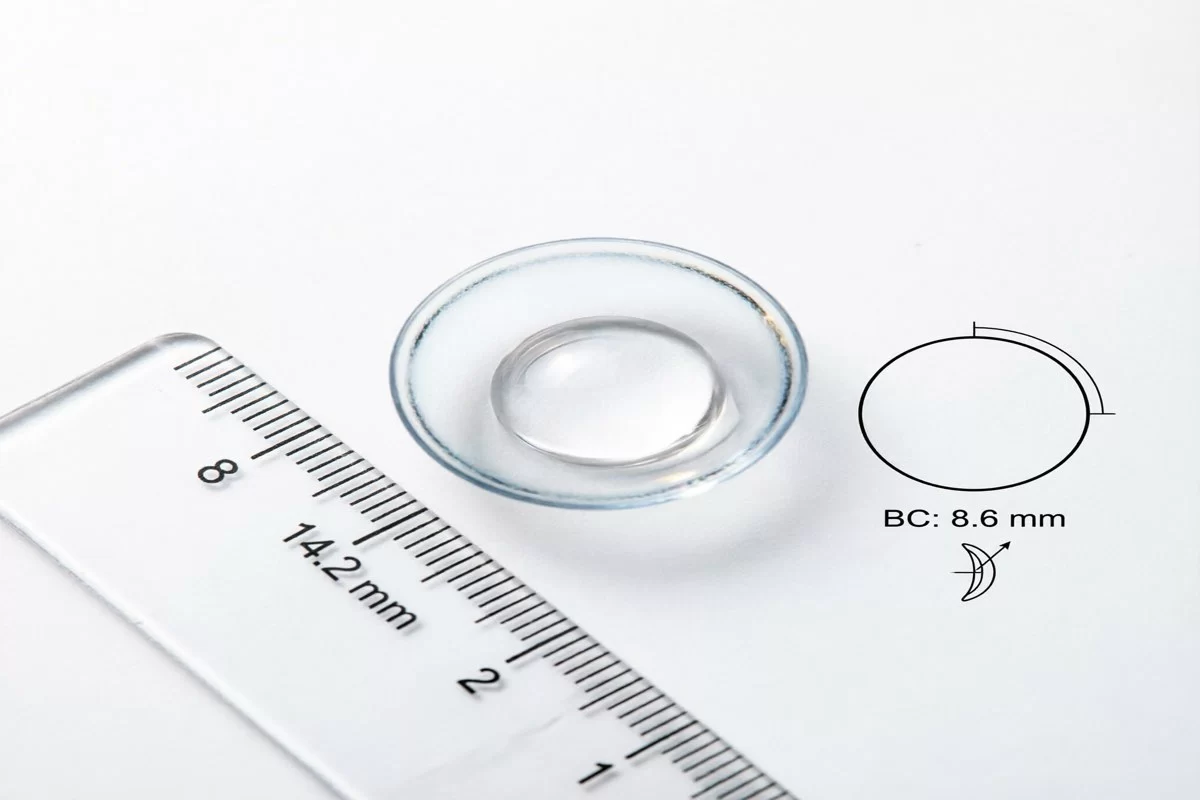
The base curve is the curvature of the back surface of the lens, measured in millimeters. A lower number means a steeper curve; a higher number means a flatter curve.
Most colored contact lenses come in 8.6mm or 8.7mm base curve. That’s because these two values fit the vast majority of people — roughly 85% of the population has a corneal curvature that works well with either 8.6 or 8.7.
Why Base Curve Matters
If the base curve doesn’t match the wearer’s eye:
What to Offer in Your Catalog
For most B2B buyers, I recommend 8.6mm as your standard. It fits the majority of customers across most markets.
If you’re targeting Europe or North America specifically, consider offering both 8.6mm and 8.7mm — wearers in these regions tend to have slightly flatter corneas on average, and having both options reduces returns.
Important note: Some factories will tell you “one size fits all” on base curve. That’s a red flag. Reputable manufacturers offer at least two BC options and can provide fitting data to back it up.
3. Water Content: The Moisture Balance
Water content is exactly what it sounds like — the percentage of the lens material that’s water. It usually ranges from 38% to 58% for colored contact lenses.
Common sense says “more water = more comfort,” right?
Not exactly. It’s more nuanced than that, and getting it wrong is one of the most common reasons customers complain about dryness.
The Water Content Paradox
Here’s what they don’t tell you in marketing materials:
Matching Water Content to Your Market
| Climate / Lifestyle | Recommended Water Content |
|———————|————————–|
| Dry climate (Middle East, desert regions) | 38-42% — resists dehydration |
| Humid climate (Southeast Asia) | 42-55% — comfortable in moist air |
| Office workers / screen time | 38-42% — less mid-day dryness |
| All-day wear (12+ hours) | 38-42% with silicone hydrogel (if available) |
For new brands: Start with 40-42% water content. It’s the most versatile and works across most climates. You can add high-water-content options later as a “summer” or “hydration” line.
4. Material: HEMA vs. Silicone Hydrogel
The lens material is what everything else is built on. There are two main categories you’ll encounter:
HEMA (Hydroxyethyl Methacrylate)
The standard material for most colored contact lenses. It’s a hydrogel polymer that’s been around for decades — safe, reliable, and affordable.
Silicone Hydrogel (SiHy)
The premium option. Silicone hydrogel lenses allow significantly more oxygen to reach the cornea.
Which Should Your Brand Carry?
For most new colored contact lens brands, HEMA is perfectly fine for the main product line. The vast majority of colored lens wearers use them for cosmetic purposes — special occasions, nights out, daily fashion — not for 14-hour work marathons.
That said, if you’re targeting:
Cost reality check: Silicone hydrogel colored lenses are harder to find in OEM/ODM because the material costs more and printing on silicone hydrogel requires different technology. Make sure your factory actually has the capability before you promise it to customers.
5. Replacement Cycle: Daily, Monthly, or Yearly?
This isn’t technically a “parameter,” but it’s one of the most important decisions you’ll make for your product line. The replacement cycle affects everything from pricing to packaging to regulatory requirements.
Daily Disposable (1-Day)
Monthly Disposable
Yearly / Traditional (Annual Replacement)
6. The Certification Question
If you’re selling internationally — and if you’re reading this, you probably are — certifications aren’t optional. They’re table stakes.
The Big Three
| Certification | Market | What It Means |
|————–|——–|—————|
| CE (CE marking) | European Economic Area + many others | Conforms to EU health, safety, and environmental standards |
| FDA clearance | United States | Approved by the US Food and Drug Administration |
| KFDA / MFDS | South Korea | Korean Ministry of Food and Drug Safety approval |
Why This Matters for Your Parameters
Different markets have different restrictions:
Real talk: If your supplier says “we have CE certification,” ask for the actual certificate and verify it with the notified body. I’ve seen more fake CE certificates than I can count. The consequences of getting caught with counterfeit certification are not worth the margin.
Putting It All Together: A Starting Point for New Brands
I know this is a lot of information. So let me save you some time and give you the default spec sheet I recommend for most new brands:
| Parameter | Default Choice | Why |
|———–|—————|—–|
| Total Diameter | 14.2mm | Works across 90% of markets |
| Graphic Diameter | 13.4mm | Natural enlargement — not too subtle, not too extreme |
| Base Curve | 8.6mm | Fits the majority of wearers |
| Water Content | 40-42% | Best balance for most climates |
| Material | HEMA (hydrogel) | Cost-effective, proven, widely available |
| Replacement Cycle | Monthly | Best balance of price, hygiene, and market fit |
| Certifications | CE (minimum) | Essential for international sales |
This is your baseline. From here, you can add variants based on market feedback:
The key is to start focused and expand as you learn what your customers actually want, not what you think they’ll want based on scrolling social media at 2 AM.
Questions to Ask Your Supplier Before You Order
Before you sign any contract or place a deposit, make sure you get clear answers to these questions:
1. “Can I see the actual test data for these parameters?” — Not just marketing claims, but real measurements.
2. “What base curve options do you offer, and what’s the fitting distribution data?” — A factory that knows its BC distribution is a factory that knows what it’s doing.
3. “Can I order sample packs with different parameters to test with my market?” — Any reputable supplier will be happy to send samples. If they push back, walk away.
4. “What certifications do you hold, and can I verify them?” — Get the certificate number and the notified body, then verify it yourself.
5. “What’s the MOQ for custom parameter combinations?” — If you want to offer both 8.6 and 8.7 BC, find out if that doubles your MOQ or if it’s a minor add-on.
Final Thought
Parameters are the foundation of your product. Get them right, and everything else — marketing, customer satisfaction, repeat purchases — gets easier. Get them wrong, and no amount of beautiful packaging or clever social media will save you.
The good news is that you don’t need to be an optometrist to make smart decisions. You just need to understand what each parameter does, who it matters for, and how it fits with the market you’re targeting.
Start simple. Test with real customers. Iterate based on feedback.
And if you’re ever unsure about a parameter choice — well, that’s what experienced OEM/ODM partners are for.
Have questions about choosing the right parameters for your brand? Or want to discuss a custom formulation for a specific market? Reach out to our team — we’ve helped brands across 20+ countries get this right, and we’re happy to help you too.