If you’re starting a colored contact lens brand, you’ll hear a lot of technical terms thrown around. Diameter, base curve, water content, Dk/t — it can feel like learning a whole new language.
But here’s the thing: these parameters aren’t just meaningless specs. They directly affect how comfortable your lenses are, how safe they are, and how customers perceive your brand. Get them wrong, and you’ll be dealing with returns, bad reviews, and customers who never come back.
In this guide, I’m going to break down every important contact lens parameter in plain English. I’ll explain what each one means, why it matters, and what you should look for when working with a factory. You don’t need to become an optometrist — but you should know enough to make smart decisions for your brand.
1. Diameter (DIA)
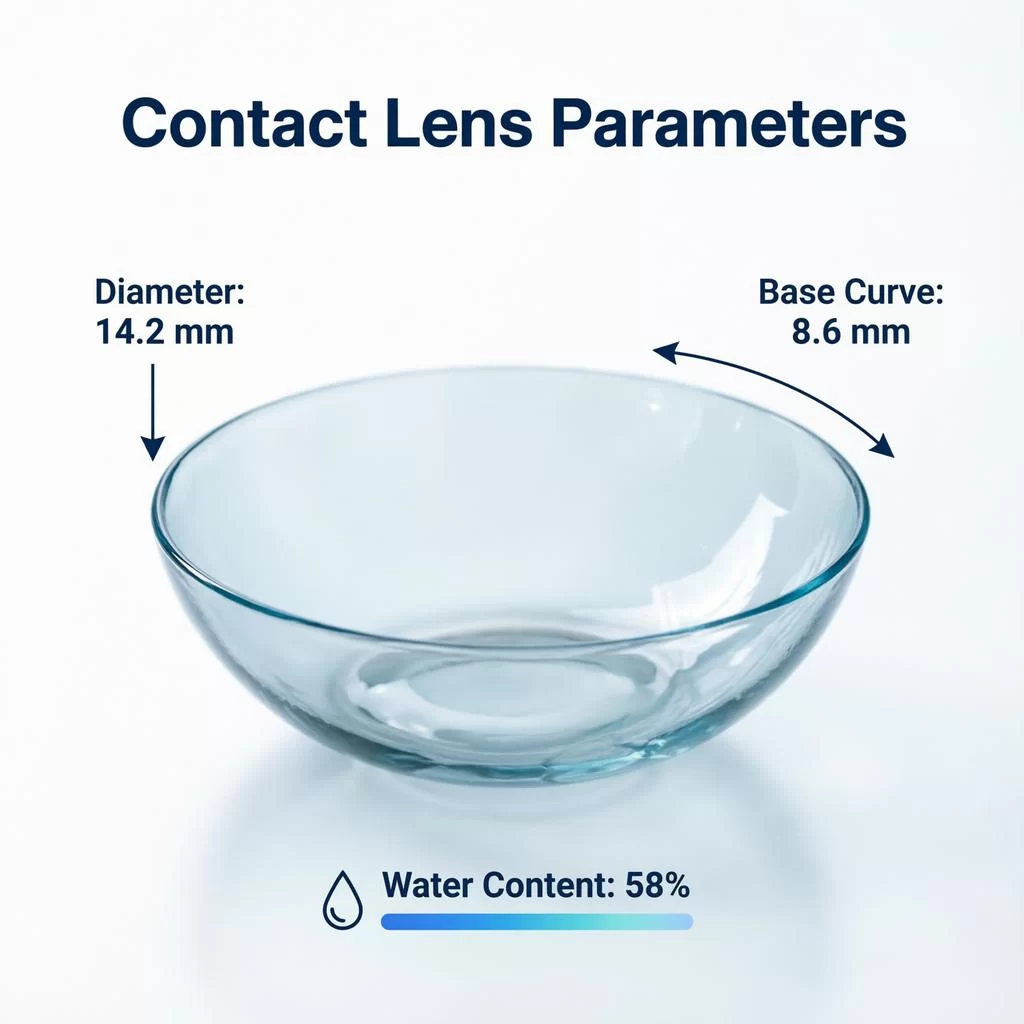
What it is: The overall width of the lens, measured in millimeters from edge to edge.
Typical range: 13.8mm – 14.5mm for standard soft contact lenses. Colored lenses are usually 14.0mm – 14.5mm.
Why It Matters
Diameter affects both fit and appearance.
Fit-wise, the lens needs to cover the entire cornea (the clear front part of the eye) and overlap slightly onto the sclera (the white part). If it’s too small, it might slide around or slip off-center. If it’s too big, it might not move enough with each blink, which can cause discomfort and reduce oxygen flow.
Cosmetically, this is where it gets interesting — and where a lot of confusion happens.
You’ll see brands advertising “14.5mm big eye lenses” or “14.2mm natural look.” But here’s what most brands don’t tell you: the total diameter isn’t the same as the colored part.
A 14.5mm lens might have a colored area that’s only 13.2mm. The rest is the clear outer ring. If you want a true “big eye” effect, you need to look at the coloring diameter, not just the total diameter.
What to Ask Your Factory
- What’s the total diameter of each design?
- What’s the actual colored/pattern diameter?
- How wide is the limbal ring (the dark outer edge)?
For most markets, 14.2mm is the sweet spot — big enough for a noticeable color change, small enough to fit comfortably on most eyes.
2. Base Curve (BC)
What it is: The curvature of the back surface of the lens, measured in millimeters. Think of it like the curve of a bowl — a lower number means a steeper curve, a higher number means a flatter curve.
Typical range: 8.4mm – 8.8mm for most soft contact lenses. Colored lenses are commonly 8.5mm – 8.7mm.
Why It Matters
Base curve is all about fit. Everyone’s cornea has a slightly different shape. If the lens curve doesn’t match the eye curve well enough, you get problems:
- Too steep (low BC number): The lens grips the eye too tightly. It doesn’t move enough with blinking. This causes discomfort, redness, and can even damage the cornea over time.
- Too flat (high BC number): The lens is loose. It slides around, blurs vision, and might even fall out.
The Big Question: One Size Fits All?
Here’s the honest truth about colored contact lenses: most brands offer only one base curve.
Why? Because adding multiple base curves means higher MOQs, more complex inventory, and more regulatory work. For prescription clear lenses, you’d have multiple BC options. For cosmetic colored lenses? One size is standard.
The good news is that most people have corneal curvatures that fall within a range where a single “medium” base curve (usually 8.5mm – 8.6mm) works fine. It won’t be perfect for everyone, but it’s comfortable for the vast majority.
If your target market is East Asia, 8.6mm tends to work well for most people. If you’re targeting Western markets, 8.7mm might be slightly better on average. But honestly, 8.5mm – 8.6mm is the industry standard for colored lenses, and it works for most people worldwide.
What to Ask Your Factory
- What base curve(s) do your stock designs come in?
- Can we do custom base curves? (Usually only for large OEM orders)
- What’s your return/exchange rate for fit issues?
3. Water Content
What it is: The percentage of the lens’s weight that comes from water.
Typical range: 38% – 60% for standard hydrogel lenses. Silicone hydrogel lenses can be lower (25% – 45%) but still transmit more oxygen.
Why It Matters
Water content affects comfort, durability, and oxygen transmission.
Higher water content (50%+):
- Pros: Generally feel softer and more comfortable initially
- Cons: Can dry out faster in dry environments or after many hours; more fragile; deposits can build up faster
Lower water content (38% – 45%):
- Pros: More durable, less prone to tearing; hold their shape better; may stay hydrated longer in certain conditions
- Cons: May feel slightly firmer on the eye
The Oxygen Myth
A lot of people assume higher water content = more oxygen to the eye. This is partially true for traditional hydrogel lenses, because oxygen travels through the water in the lens. But it’s not a simple relationship — other factors like thickness and material matter too.
And with silicone hydrogel? All bets are off. Silicone hydrogel lenses can have lower water content but transmit much more oxygen than regular hydrogel, because silicone itself carries oxygen.
What This Means for Your Brand
For yearly disposable colored lenses (the most common format for cosmetic brands), water content in the 38% – 45% range is standard. These lenses are durable, hold their shape well, and are easier to handle — especially for new wearers.
If you’re positioning your brand as premium or “all-day comfort,” you might want to look at higher water content options or silicone hydrogel. But expect to pay more per pair.
What to Ask Your Factory
- What’s the water content of each material option?
- What’s the difference in cost between the materials?
- Do you have silicone hydrogel options for colored lenses? (Note: many factories don’t, because embedding color in silicone hydrogel is technically harder)
4. Material: HEMA vs. Silicone Hydrogel vs. Others
What it is: The polymer the lens is made from.
The Main Options
HEMA (Hydroxyethyl methacrylate)
- The standard material for soft contact lenses for decades
- Good comfort, reasonable oxygen transmission for daily wear
- Affordable
- Most colored lenses are made from HEMA or HEMA blends
Mid-water hydrogels (pHEMA, etc.)
- Variations on HEMA with different additives
- Generally higher water content
- Slightly better oxygen transmission
Silicone hydrogel
- Much higher oxygen transmission (3-5x more than standard hydrogel)
- Better for eye health, especially for longer wear
- More expensive
- Harder to add color to — fewer colored lens options available
Oxygen Permeability (Dk/t)
You’ll see Dk/t numbers thrown around. Here’s what you need to know:
- Dk: How much oxygen the material lets through
- t: Center thickness of the lens
- Dk/t: How much oxygen actually reaches the cornea through the lens
For daily wear (8-12 hours), a Dk/t of 20+ is considered acceptable by most standards. For extended wear (overnight), you need much higher — 100+.
Most standard colored hydrogel lenses have Dk/t in the 20-40 range, which is fine for daily wear of 8-10 hours. Silicone hydrogel lenses can be 80-150+.
What This Means for Your Brand
If you’re selling yearly or monthly colored lenses for cosmetic use, HEMA or standard hydrogel is perfectly fine and what 90% of the market uses. It’s what your competitors are using, it’s what customers expect, and it keeps your costs reasonable.
Silicone hydrogel colored lenses are a nice differentiator if you can find a factory that makes them well, but they’ll cost more and you’ll have fewer design options.
5. Center Thickness
What it is: How thick the lens is at its center point, measured in millimeters.
Typical range: 0.06mm – 0.12mm for standard soft lenses. Colored lenses tend to be slightly thicker because of the color layer.
Why It Matters
Thinner lenses are generally more comfortable, because your eyelids don’t feel them as much when you blink. But there’s a trade-off:
- Too thin: More fragile, easier to tear, harder to handle (especially for beginners)
- Too thick: Less comfortable, lower oxygen transmission
Colored lenses are inherently thicker than clear ones because of the color layer embedded in the lens. This is normal and expected. A good colored lens might be 0.08mm – 0.12mm at the center, compared to 0.05mm – 0.08mm for a clear lens.
The quality of the color embedding technology matters a lot here. Cheaper factories just print the color on the surface, which can feel rough. Better factories use “sandwich technology” — the color is fully embedded between two layers of clear material, so the surface is smooth.
What to Ask Your Factory
- What’s the center thickness of your colored lenses?
- Do you use sandwich/embedded color technology or surface printing?
- Can I see a cross-section or microscope image?
6. Replacement Cycle
What it is: How long the lens is designed to be worn before you throw it away.
The Options
- Daily disposable (dailies): One day, then throw away. Most hygienic.
- Weekly: 1-2 weeks of use.
- Monthly: About a month of use.
- Quarterly: 3 months.
- Yearly/Annual: 1 year of use (most common for colored lenses).
Why This Matters for Your Brand
The replacement cycle you choose affects everything: pricing, positioning, target audience, and profit margins.
Yearly lenses (most common for colored):
- Lower cost per pair for your customers
- Higher perceived value (they last longer)
- Lower shipping costs per pair
- Easier to inventory
- But: people might buy less often
Daily lenses:
- Growing fast in the market
- Most hygienic option
- Higher frequency of purchase
- But: much higher MOQ, more SKUs to manage, requires prescription handling in many markets
For new brands just starting out, yearly disposable colored lenses are almost always the right choice. They’re what the vast majority of colored lens customers buy, they’re easier to source, and you need fewer SKUs.
7. Power (Prescription)
What it is: Whether the lens corrects vision (nearsightedness, farsightedness, astigmatism) or is purely cosmetic (plano / 0.00 power).
Why It Matters
This is a big strategic decision for your brand.
Plano only (no prescription):
- Simpler inventory
- Lower MOQ
- Less regulatory complexity in some markets
- But: you miss out on the huge number of people who need vision correction
With prescription (myopia):
- Bigger market — most people who wear contacts need vision correction
- More SKUs to manage (typically from -0.50 to -6.00 or -8.00 in 0.50 steps)
- Higher MOQ per SKU
- More regulatory scrutiny
Toric (astigmatism):
- Specialized market with less competition
- Much higher cost and complexity
- Usually only worth it for established brands
Recommendation for New Brands
If your factory offers it, I’d recommend offering both plano and myopia options. Yes, it means more SKUs and higher minimums. But it also means you can serve a much larger market.
Start with a reasonable range — say 0.00 to -6.00 in 0.50 increments. You can always expand later if demand is there.
8. Color Technology: How the Color Gets In
This isn’t usually listed as a “parameter,” but it’s one of the most important quality factors for colored lenses.
The Different Methods
1. Surface printing (cheapest, lowest quality)
- Color is printed directly on the lens surface
- Can feel rough or scratchy
- Color can fade or chip
- Pigment can contact the eye (not ideal)
- Avoid this if you can
2. Sandwich technology / 3-layer process (better)
- Color layer is fully encased between two layers of clear lens material
- Smooth surface — very comfortable
- Color can’t chip or fade
- Pigment never touches the eye
- This is the industry standard for good quality colored lenses
3. Digital printing / gradient technology (premium)
- More precise color placement
- Smoother gradients and more natural-looking patterns
- Still uses the sandwich method for safety
- More expensive, but the results look better
Why This Matters
Customers can feel the difference. Lenses with surface printing are less comfortable and can cause irritation. They also look cheaper — the color is flat and unrealistic.
Sandwich technology is what you should be looking for as a minimum standard. It’s more expensive than surface printing, but the quality difference is night and day.
What to Ask Your Factory
- Do you use sandwich technology or surface printing?
- How many layers are in each lens?
- Is the pigment on the surface or fully embedded?
- Do you have any test reports or certifications for the color pigments?
Putting It All Together: What to Spec for Your First Collection
If you’re launching a new colored lens brand and you’re not sure what parameters to start with, here’s my recommendation:
| Parameter | Recommendation | Reason |
|———–|—————|——–|
| **Diameter** | 14.2mm total / 13.0-13.5mm colored | Most versatile fit, noticeable but not over-the-top color effect |
| **Base Curve** | 8.5mm – 8.6mm | Industry standard, fits the vast majority of people |
| **Water Content** | 38% – 42% | Durable, easy to handle, good for yearly lenses |
| **Material** | HEMA hydrogel (sandwich technology) | Standard, affordable, proven technology |
| **Replacement Cycle** | Yearly | Easiest for new brands, lowest MOQ, what customers expect |
| **Power Range** | 0.00 to -6.00 (0.50 steps) if possible; plano-only if budget is tight | Serves the largest market without too many SKUs |
| **Center Thickness** | 0.08mm – 0.10mm | Comfortable but durable |
Final Thoughts
You don’t need to memorize all of this. But you should understand the basics well enough to have intelligent conversations with factories and to answer basic customer questions.
Remember: your customers are trusting you with something that goes in their eyes. Quality and safety should never be compromised for cost savings. A few extra cents per pair for better materials and sandwich technology is worth every penny when it means fewer complaints, better reviews, and customers who come back again and again.
When you’re evaluating factories, ask about all of these parameters. A good factory will be transparent about what they use and why. A bad factory will give you vague answers or try to sell you the cheapest option without explaining the trade-offs.
Looking for a reliable OEM/ODM partner for your colored contact lens brand? At MIOMI, we use sandwich technology for all our colored lenses and offer complete transparency on every parameter. Get in touch to learn more.