Let me start with something I’ve heard at least a hundred times from new brand owners:
“I want to start my own contact lens brand, but every factory I talk to wants a minimum order of 5,000 or 10,000 pieces per design. I don’t have that kind of budget — and I’m not even sure which designs will sell.”
If that sounds familiar, you’re not alone. The colored contact lens industry has traditionally been dominated by big brands with deep pockets. The big factories love those large orders because they’re efficient and profitable. Small brands? Often an afterthought.
But here’s the good news: low MOQ (Minimum Order Quantity) OEM has become a real, viable path for aspiring brand owners. You just need to know how it works, where the trade-offs are, and how to avoid the pitfalls that sink many first-time brands.
In this guide, I’ll walk you through everything I’ve learned from working with dozens of small brand owners over the years. No fluff, no sales pitch — just the real picture.
What “Low MOQ” Actually Means in Contact Lenses
First, let’s get on the same page about terms, because “low MOQ” means different things to different people.
In the contact lens OEM world, here’s roughly how the tiers break down:
| Tier | MOQ per design | Typical buyer |
|---|---|---|
| Traditional OEM | 3,000 – 10,000+ pcs | Established brands, large distributors |
| Mid-tier OEM | 1,000 – 3,000 pcs | Growing brands, regional players |
| Low MOQ OEM | 300 – 1,000 pcs | Startups, small brands, new market entries |
| Micro-MOQ / Private label | 50 – 300 pcs | Boutique brands, influencers, test runs |
If you’re just starting out, you’re probably looking at that bottom two tiers. And yes, they exist — but you need to understand the trade-offs.
Important reality check: A genuinely low MOQ for custom-designed colored contact lenses is around 300 pieces per design. If someone promises you 50 pieces per design with fully custom artwork and packaging, either the quality is going to be questionable, or you’re going to pay such a high unit cost that your margins disappear.
There’s always a balance. Your job is to find the sweet spot between “I can afford this” and “this will actually make me money.”
Why Low MOQ Costs More Per Unit (and Why It’s Worth It)
I’ll be straight with you: low MOQ means a higher per-piece cost. No way around it.
A factory’s cost structure is built around efficiency. When they run a production batch of 10,000 pieces of the same design, the setup cost gets spread across all those units. When they run 300 pieces, that same setup cost is spread across far fewer units.
But here’s what many new brand owners miss: the higher per-unit cost is actually a smart investment when you’re starting out.
Think about it:
- You test the market without betting the farm. Instead of sinking $20,000 into 10,000 pieces that might not sell, you spend $2,000 on 500 pieces and see what happens.
- You learn what your customers actually want. The design you love on paper might flop in the market. With low MOQ, you can iterate quickly.
- You build cash flow before scaling. Sell through your first small batch, reinvest the profits, then order larger quantities at better prices.
I’ve seen brands fail because they ordered 10,000 pieces of a single design based on gut instinct, only to discover that their market wanted something completely different. By the time they realized, they were sitting on inventory they couldn’t move and had no budget for a second attempt.
Low MOQ gives you room to learn. And in this business, learning cheaply is worth paying a bit more for.
The 5 Non-Negotiables When Choosing a Low MOQ Supplier
Not all low MOQ suppliers are created equal. Some are genuinely set up to serve small brands well. Others are just big factories that will take your small order but give you the worst priority, the longest lead times, and questionable quality control.
Here’s what to look for:
1. Certification That Matches Your Target Market
This is non-negotiable. If you’re selling in the US, you need FDA-cleared lenses. If you’re selling in Europe, you need CE marking. Selling in Southeast Asia? Check the specific requirements for each country.
A low MOQ supplier that skips on certifications is not a bargain — it’s a liability. Selling uncertified medical devices (and yes, contact lenses are medical devices in most countries) can result in seized inventory, fines, or worse.
Ask for the certificate files upfront. Verify them with the issuing body if you can. Any reputable supplier will provide these without hesitation.
2. Real Sample Capability
Before you commit to an order, you need to see and feel the actual product. A good low MOQ supplier will offer sample lenses — either standard stock samples or custom pre-production samples.
Stock samples are fine for evaluating base quality, comfort, and material. But if you’re doing custom designs, you’ll want custom samples before placing a full order.
Yes, custom samples cost money and take time. Yes, they’re worth it. Finding a design flaw before 500 pieces are produced is much cheaper than finding it after.
3. Clear Communication (in Your Language)
This sounds basic, but it’s make-or-break. When you’re working with an OEM supplier, especially overseas, communication gaps cause expensive mistakes.
You want a supplier that:
- Replies to your messages within 24-48 hours
- Has a contact person who speaks your language fluently
- Answers your questions directly instead of deflecting
- Sends clear, detailed order confirmations
If communication is slow or confusing during the sales process, it will only get worse once you’ve paid and they have your order.
4. Transparent Pricing Structure
The quote should be clear about what’s included and what’s extra. Watch out for hidden fees:
- Design/tooling fees — one-time or per-order?
- Sample fees — refundable on bulk order?
- Packaging costs — included or separate?
- Shipping — FOB, CIF, or DDP?
- Custom duties and taxes — who handles these?
A supplier that gives you a single per-piece price with no breakdown is either inexperienced or intentionally hiding costs. Either way, not ideal.
5. A Track Record with Small Brands
Ask for references. Ask how many small brands they work with. Ask if you can see examples of brands they’ve launched.
A factory that primarily works with huge brands might technically accept your 300-piece order, but you’ll be at the bottom of their priority list. Your production will get slotted in between bigger orders, your lead times will be unpredictable, and your quality control might be minimal.
Look for suppliers that actively cater to small and emerging brands. They’re set up for it, and they value your business because you matter to them.
Designing Your First Collection: Less Is More
I see this all the time: a new brand owner comes in wanting 15 different designs in their first collection. They’re excited, they have ideas, they want to offer everything.
I always tell them the same thing: start with 3-5 designs. Max.
Here’s why:
- Focused marketing spend. When you’re just starting, you have limited marketing budget. Trying to promote 15 designs means each one gets almost no attention. With 3-5 designs, you can concentrate your efforts and actually get traction.
- Easier inventory management. Tracking stock of 5 SKUs is manageable. Tracking 15 SKUs is a nightmare, especially when you’re also handling marketing, customer service, and everything else.
- Better cash flow. Five designs × 300 pieces each = 1,500 pieces total. Fifteen designs × 300 pieces each = 4,500 pieces. That’s triple the upfront cost.
- Cleaner brand identity. A tightly curated collection feels more premium and memorable than a scattered catalog of 50 designs.
Pro tip for selecting designs: Include at least one natural-looking everyday style, one slightly bolder “statement” style, and one style that targets a specific trend (like gray-toned lenses, or iris-enhancing patterns). This gives you range without overextending.
Packaging: Your First Impression, on a Budget
Packaging matters more than you might think, especially for a new brand. When a customer receives their order, the packaging is their first physical touchpoint with your brand. It sets expectations.
But packaging can also eat into your budget faster than almost anything else. Here’s how to approach it on a low MOQ budget:
Option 1: Stock packaging + custom stickers
The cheapest approach. Use standard stock blister packs or vials, then apply custom stickers with your branding. It’s not the most premium look, but it gets the job done when you’re testing the market.
Option 2: Semi-custom packaging
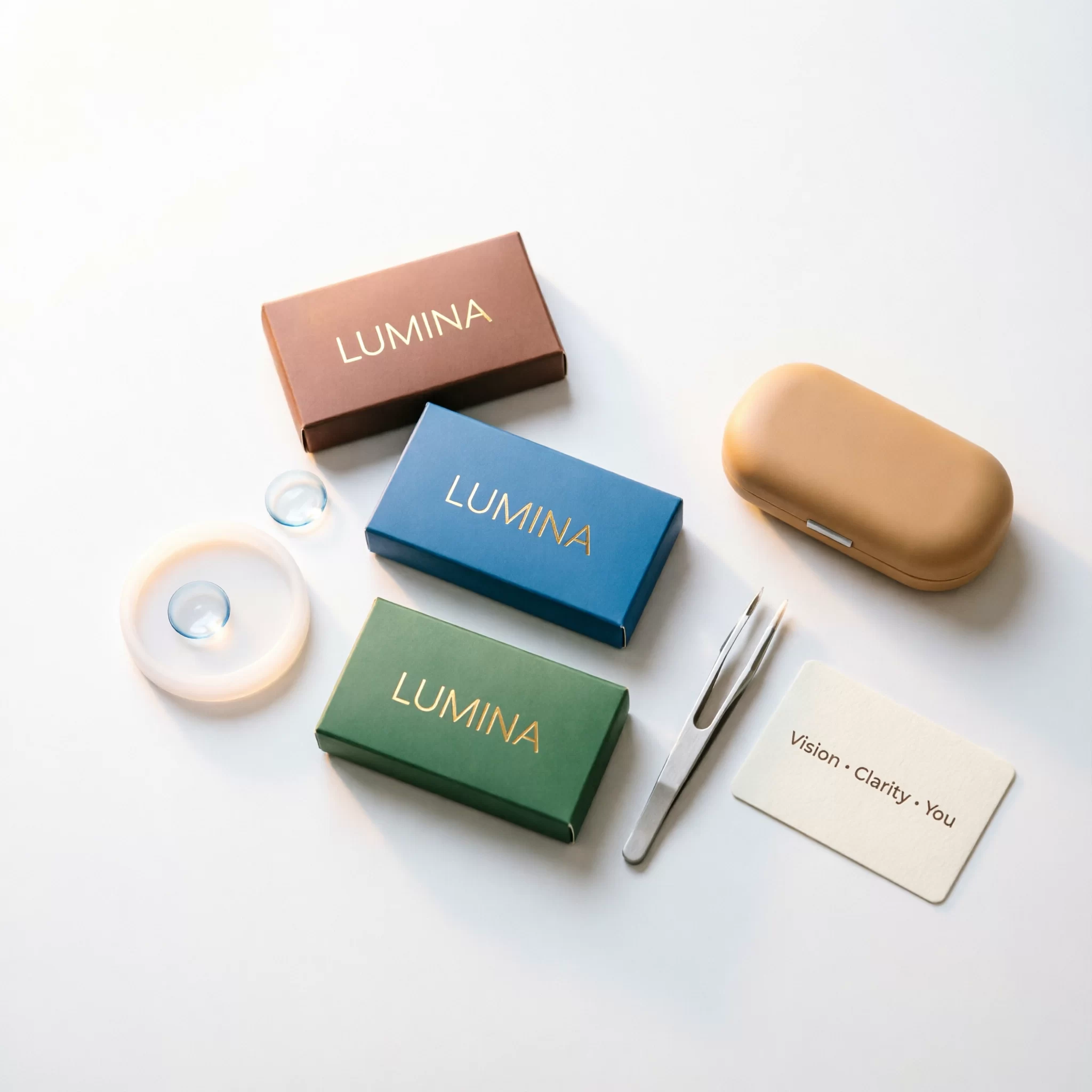
Some suppliers offer semi-custom packaging options — standard shapes and sizes with your logo and design printed on them. The MOQ is usually lower than fully custom packaging, and the result looks much more professional than stickers.
Option 3: Fully custom packaging
Custom boxes, custom blister packs, custom everything. This is what the big brands do, and it looks incredible — but it also comes with higher MOQs and higher costs.
My recommendation for new brands: Start with option 2 (semi-custom) if your budget allows. The difference in perceived value is significant, and it doesn’t cost that much more than stock packaging with stickers.
Also, don’t forget about the outer shipping packaging. A nice branded envelope or box makes the unboxing experience feel special, and in the age of TikTok and Instagram Reels, unboxing content is free marketing.
Lead Times: How Long Does This Actually Take?
One of the biggest frustrations for new brand owners is lead times. You’re excited to launch, and then you find out it’s going to take 4-6 weeks minimum.
Here’s a realistic timeline for a low MOQ OEM order:
| Stage | Typical time | Notes |
|---|---|---|
| Design and artwork finalization | 3-7 days | Depends on how many revisions you need |
| Sample production and approval | 7-14 days | Optional but recommended |
| Bulk production | 15-25 days | Low MOQ orders can sometimes be faster |
| Quality inspection | 2-3 days | Build this in, don’t skip it |
| Shipping (air) | 3-7 days | Faster, more expensive |
| Shipping (sea) | 20-35 days | Slower, cheaper — not always available for small orders |
Total realistically: 4-8 weeks from final design to delivery.
If a supplier promises 2-week turnaround on custom orders, be skeptical. Either they’re cutting corners on quality control, or they’re counting “production days” differently than you’re counting “calendar days.”
My advice: build buffer time into your launch plan. Tell yourself 8-10 weeks. If it comes sooner, great — you’ve got a head start on marketing. If it takes the full timeline, you’re not panicking and your launch date doesn’t keep slipping.
The Most Common Mistakes New Brands Make (and How to Avoid Them)
After seeing so many brands launch (and some fail), these are the mistakes I see most often:
Mistake 1: Skipping samples to save money
I get it. Samples cost money and add time to your timeline. But the cost of getting 500 pieces of a design that looks terrible is way higher than the cost of a sample set. Always sample before bulk production.
Mistake 2: Choosing the cheapest supplier
Price matters, but it shouldn’t be your only criterion. The cheapest supplier often cuts corners on quality control, materials, or certifications. A few cents cheaper per piece isn’t worth the risk of a product safety issue or a recall.
Mistake 3: Overestimating demand
It’s easy to get excited and order more than you need. But unsold inventory is dead money. Start small, prove the concept, then scale up. You can always reorder faster than you can sell through excess stock.
Mistake 4: Neglecting compliance and legal stuff
Contact lenses are regulated medical devices in most countries. You need proper certification, proper labeling, proper consumer information. Don’t skip this. The consequences can be severe.
Mistake 5: Not having a marketing plan
“I’ll just post on Instagram” is not a marketing plan. Before your product even arrives, you should be building an audience, creating content, and generating buzz. If you wait until you have inventory to start marketing, you’ll be sitting on stock for months.
When to Scale Up From Low MOQ
Low MOQ is great for starting out, but it’s not where you want to stay forever. As your brand grows, you’ll want to move to larger order quantities to get better per-unit pricing and healthier margins.
Here are signs you’re ready to scale up:
- You’ve sold through 2-3 consecutive batches without discounting heavily
- You know your best-selling designs (and which ones to drop)
- You have consistent, predictable monthly sales
- You have the cash flow to place larger orders
- You have the storage space for more inventory
A good milestone: when your monthly sales volume exceeds your MOQ by 2-3x, you’re probably ready to start ordering larger quantities and negotiating better pricing.
But don’t rush it. Scaling too fast — ordering more than you can sell — is a classic way profitable brands go out of business.
Final Thoughts
Starting a contact lens brand with low MOQ is absolutely doable in 2026. The industry has shifted, and more suppliers are catering to small and emerging brands than ever before.
But “doable” doesn’t mean “easy.” You still need to do your homework, choose your supplier carefully, start lean, and have a real plan for getting your product in front of customers.
The brands that succeed aren’t the ones with the biggest budgets. They’re the ones who understand their market, curate their collection thoughtfully, and build genuine connections with their customers.
Low MOQ OEM is the tool that lets you get started without needing a million dollars. What you do from there — that’s up to you.
Looking for a low MOQ OEM partner that actually gets small brands? At MIOMI, we specialize in helping emerging brands launch with MOQs as low as 300 pieces per design, without cutting corners on quality or certification. Drop us a line to discuss your project — no sales pressure, just honest advice.